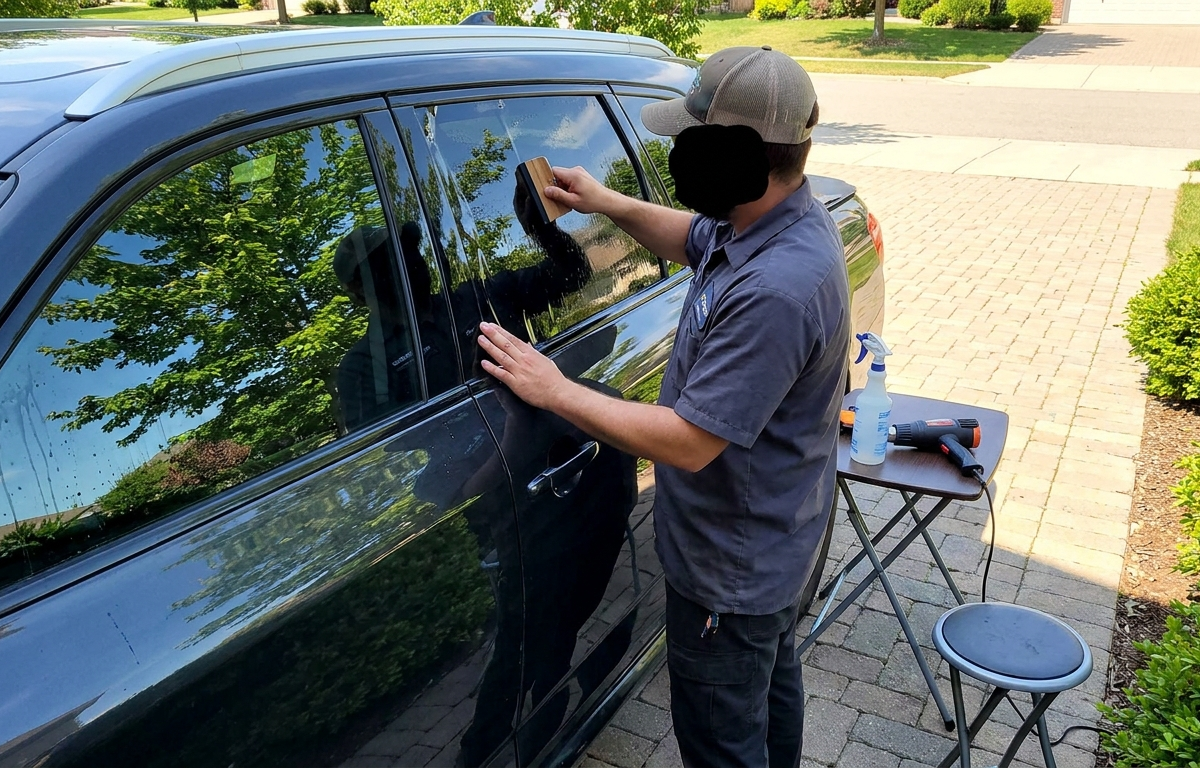
A ceramic package on a four-door SUV bills $170 more than carbon on the same truck, and too many mobile tint techs still quote both off the same "windows are windows" number. That's how you end up eating the film cost on ceramic jobs and pricing yourself out of the carbon ones. Window tinting isn't priced by the car. It's priced by the film tier, the window count, and whatever your state's VLT law lets you sell — and once you build your rate sheet around those three things, quoting gets fast instead of feeling like guessing.
The rate sheet: film tier first, vehicle second
Film cost drives most of what you charge, so it should drive the quote. Here's a full package sheet built on the 2026 side-work rate data for this trade:
| Package | Carbon | Ceramic |
|---|---|---|
| Full vehicle — sedan | $300 | $450 |
| Full vehicle — SUV / truck | $380 | $550 |
Then the line items that ride alongside the packages instead of hiding inside them:
- Two front windows, matched to the factory rears: $120
- Windshield sun strip, above the AS-1 line: $75
- Full windshield, clear ceramic (70%+ VLT where legal): $200
- Old film removal: $40 per window
- Flat glass, home or office: $12 per sq ft installed
Ceramic film costs you several times what carbon does at the supplier — that spread has to show up on the invoice, not get absorbed into a flat "tint the car" number. If a customer asks why ceramic runs $150 more on their sedan, you've got a real answer: it's the film, not your labor.
And here's the opinion that'll annoy half the shops in town: take dyed film off your menu entirely. Dyed is the tier that fades purple in three summers, bubbles at the edges, and generates the removal jobs you'll charge the next customer $40 a window to strip. Every dyed job you sell today is a callback with your name on it, and the customers shopping for it are comparing you against a $99 special you don't want to win. Make carbon your floor at $300, explain why in one sentence, and let the bargain hunters go get their purple windows somewhere else.
One worked quote, line by line
Take a four-door SUV that shows up with old purple film peeling on the two fronts, and a customer who wants ceramic:
- Old film removal, 2 windows × $40 — $80
- Full-vehicle ceramic, SUV package — $550
- Total: $630
That's the whole quote, built in under a minute off the sheet, and every line defends itself. The removal is real labor — brittle dyed film comes off in slivers and the adhesive fights you — so it's a real line, not a favor. The ceramic package already reflects the extra glass an SUV carries over a sedan. On a job that runs four hours with maybe $120 of film in it, you're clearing north of your $95 shop rate without inflating a single number, and the customer watched the price get built instead of hearing one mystery figure.
Charge windshield strips, sunroofs, and full-windshield clear ceramic as separate line items every time — they take precision the door glass doesn't, and lumping them into "the car" is how a four-hour job becomes a five-hour job you didn't get paid for. Same with a minimum: a lone $40 removal or single-window fix isn't worth the drive-out, so hold a floor around the $120 two-fronts package even on small calls.
The number that has to be on the invoice: VLT
Every state sets a legal Visible Light Transmission (VLT) limit — the percentage of light the tint lets through — and it's usually different for front side windows, rear side windows, and the windshield. Some states hold front windows close to bare glass, a few don't allow aftermarket film up front at all outside a medical exemption, and rear windows run darker almost everywhere — some states allow near-limo darkness back there. The numbers themselves move, state by state and year by year, so look up your state's current limit before you quote, and put the VLT you're installing to on the invoice.
That spread is exactly why "how dark can you go" isn't a question you answer from memory. Write the VLT percentage of the installed film on the invoice, next to the state's legal minimum for that window. It's the difference between a customer who gets pulled over and blames you, and a customer who has paperwork proving the install was legal the day you did it. It also protects you — a documented VLT number is the thing that separates "the shop tinted it too dark" from "the customer requested it darker than legal and signed off."
Package it so the upsell writes itself
Once your sheet is set, the upsell isn't a separate pitch — it's just showing the next column over. A customer looking at the $380 carbon SUV package is a customer who'll listen to thirty seconds on why $550 ceramic keeps the cabin cooler in July without going darker than legal. That's a $170 decision they make themselves when both numbers sit on one quote. Show both tiers every time, let them pick, and you've turned a yes-or-no price into a good-better decision — most people who see the comparison ask questions instead of walking.
The same logic works on repeat business. Tint doesn't fail often, but customers buy a second vehicle, refer the neighbor, or trade up to the SUV that needs the bigger package. A job done right — clean edges, documented VLT, no bubbling six months later — is the best advertising a mobile operator has, because it's sitting in the driveway every day the customer looks at it.
Where SideWRK fits
Quoting film tiers by hand for every vehicle that rolls up is exactly the kind of math that eats your morning. SideWRK's window tinting cost calculator runs the film-tier and window-count math for you, and the window tinting trade page is built around this exact pricing structure — packages by tier, removal as its own line, flat glass by the square foot. If you want to see how a quote turns into an approved, paid job without a spreadsheet, the live demo walks through it seeded for your trade specifically.
Mobile auto reconditioning trades all deal with tiered, matrix-style pricing — see how paintless dent repair prices by coin size or how auto glass techs split a windshield quote three ways for the same logic applied to a different panel.
Start free and build your film-tier rate sheet once instead of re-guessing it on every driveway. Five jobs a year free, no card, then $19/mo or $190/yr.
FAQ
How much does it cost to tint a car in 2026?
Working mobile-tech package rates run $300 for a carbon sedan, $380 for a carbon SUV or truck, $450 for a ceramic sedan, and $550 for a ceramic SUV — with two-front matching at $120 and old film removal at $40 per window as separate lines. The film tier drives the price difference, not the vehicle badge.
What's the difference between ceramic and carbon window tint?
Carbon film uses carbon particles instead of dye or metal, holds its color for years without fading purple, and rejects more heat than dyed film. Ceramic film uses nano-ceramic technology to block over 99% of UV rays and reject significantly more solar heat, which is why it bills $150–$170 more than carbon on the same vehicle.
What's the darkest legal tint I can put on my car?
It depends entirely on your state. Front side windows range from 70% VLT in states like New York down to 28–33% VLT in states like Florida and Arizona, and a few states don't allow aftermarket front-window film at all. Rear windows are almost always allowed darker. Check your state's exact limit before quoting a job, since it's the installer's name on the work if it's out of compliance.
Should I charge extra for removing old tint before a reinstall?
Yes — removal is separate labor at $40 per window, and it should never be folded into your new-install price. Old dyed film that's gone purple and brittle is often the slowest work you'll do all week, and it's not your fault the last install was cheap. On a two-window strip ahead of a $550 ceramic SUV package, that's an $80 line the customer can see and understand.
Should I still offer dyed film as a budget option?
There's a case for dropping it entirely. Dyed film fades, bubbles, and turns purple — it's the tier that generates removal jobs and callbacks, and the customers hunting for it are price-shopping against numbers you don't want to match. A carbon floor at $300 for a sedan keeps the budget conversation honest without putting your name on film that fails.
Which state's VLT limit applies if the car is registered somewhere else?
The one on the registration. This article says to look up your state's current limit before you quote, and for most techs that's the same thing — but a mobile operator working a metro that straddles a line can install identical film on two cars in the same week and be quoting against two different legal minimums. So the first question at the car isn't how dark they want it. It's where the vehicle is registered. Look that state's number up fresh, then write it on the estimate next to the film VLT you're installing. Same two minutes of paperwork either way; it just has to carry the right state's number on it.