A rock chip costs about $90 to fix. Leave it three weeks on a dashboard baking at 140 degrees and it's not a chip anymore — it's a crack running clear to the edge, and now you're quoting $600 instead of $90. That gap is the whole business. Most solo auto glass operators either eat it by underpricing the easy jobs, or leave money on the table by not knowing what to charge once ADAS cameras get involved. Neither has to happen.
Summer is when this shows up the most. Road trips mean interstate miles, and interstate miles mean gravel kicked up from truck tires. Chip season runs spring through the end of summer, which makes July the busiest stretch most mobile techs see all year for first-time calls.
The three jobs hiding inside "windshield work"
Customers say "my windshield" and mean one of three different jobs, and each one prices differently:
- Chip repair — resin injected into a chip the size of a quarter or smaller, no glass removal.
- Full replacement — the whole windshield comes out and a new one goes in.
- ADAS recalibration — required on most 2020-and-newer vehicles after any windshield replacement, because the forward-facing camera behind the glass runs lane-keep, automatic braking, and adaptive cruise.
Quote job #1 like job #2 and you'll scare off a customer over a $90 fix. Quote job #2 without mentioning job #3 and you'll eat a $250 surprise or, worse, hand back a car with a lane-keep system that's aiming at the wrong spot on the road.
What a chip repair should actually cost
Resin and a UV cure light run you a few dollars in materials. You're charging for the skill of reading the break and the trip to get there, not the resin. The 2026 side-work rate data puts a rock chip repair at $90, a standard replacement at $350, and an ADAS recalibration at $250 — those three numbers are the skeleton of every quote in this trade.
| Damage | Typical charge |
|---|---|
| Single chip, quarter-size or smaller | $90 |
| Each additional chip in the same visit | $10–$25 |
| Star break or short crack (under 3") | $100–$150 |
| Anything longer than a dollar bill | Repair won't hold — quote a replacement |
That last line matters more than the pricing. A crack past a certain length is a structural problem, not a cosmetic one, and repairing it is a disservice you shouldn't sell just to close the job. Say so. It's the kind of honesty that gets you the referral instead of the one-star review three weeks later when it spreads anyway.
Full replacement: the part most operators underquote
A standard windshield without any camera or sensor package runs around $350 in glass and labor for most sedans and older trucks — and the glass itself is more than half of that ticket. That $350 is what a lot of new operators anchor on — and then they quote the same number on a 2023 crossover with a windshield-mounted camera, and lose money the second recalibration comes due.
Aftermarket DOT-certified glass is 20–40% cheaper and fine for a vehicle with no camera package. OEM or OEE glass costs more but is close to mandatory on ADAS-equipped vehicles — the optical clarity of the glass itself affects how accurately the camera reads lane markings after the fact. Quoting aftermarket glass on a car that needs OEM to calibrate correctly is how you end up doing the job twice.
The ADAS recalibration conversation — this is where the money actually is
Roughly 85% of vehicles from 2020 on have a forward-facing camera mounted to the windshield. Replace the glass and that camera comes off its exact mounting position. It has to be recalibrated before the car is safe to hand back, full stop — this isn't an upsell you're inventing, it's a step the vehicle needs.
Here's a flag worth planting: a quote for a 2020-or-newer vehicle that doesn't show a calibration line isn't a cheaper quote — it's an incomplete one, and the operator who wrote it is either behind the trade or hoping the customer won't notice until after the glass is in. When you're the one bid of three that includes it, you're the one who read the car.
There are two calibration methods, and knowing which one a car needs is part of your job, not something you guess at:
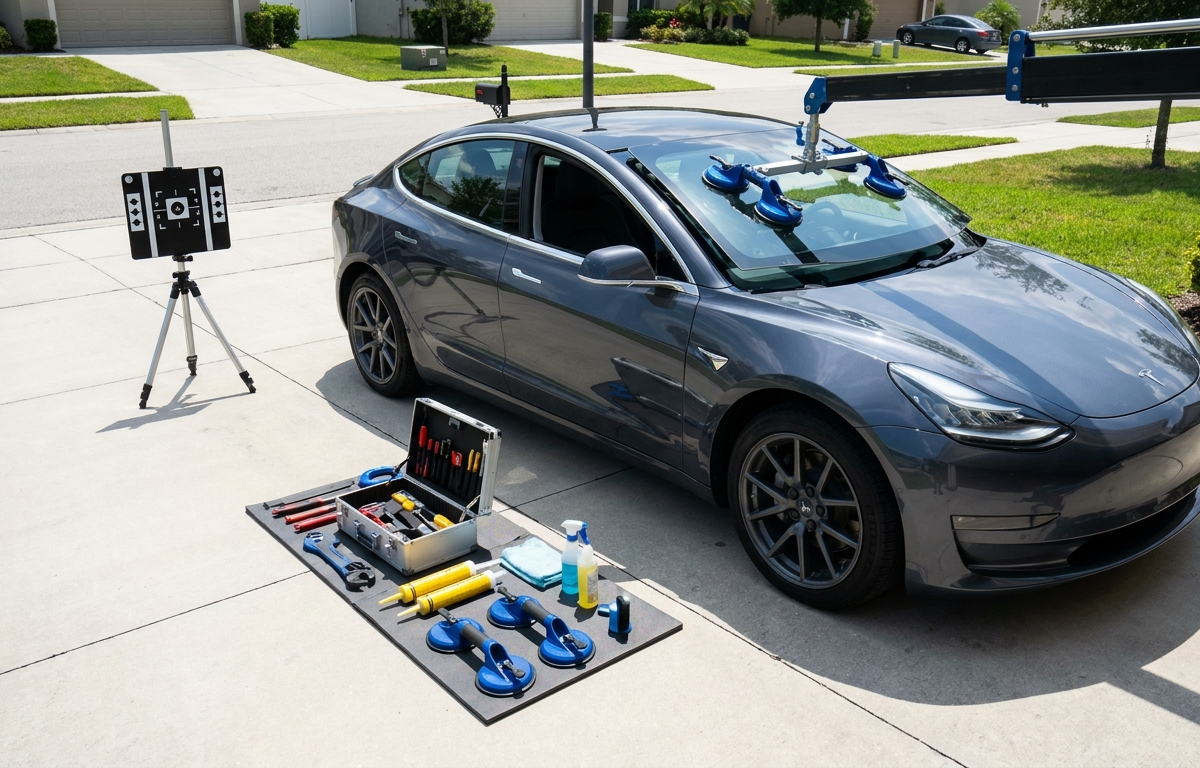
- Static calibration — done in a controlled space using target boards set at exact measured distances. You need floor space, level ground, and specific lighting. Most mobile operators can't do this from a driveway.
- Dynamic calibration — a test drive at a set speed range while a scan tool reads the camera's self-calibration. Some cars need this alone; many need both. A dynamic-only calibration is the $250 line; dual-method and dealer-only systems run higher.
If you're not equipped to do static calibration yourself, partner with a shop or dealer that is, and build their fee into your ticket as a line item rather than a mystery add-on discovered after the fact.
The whole ticket, assembled
Say the call is a 2023 crossover with a crack past repair length and a camera behind the mirror. Quoted honestly, line by line:
- OEE windshield, glass and install labor: $350
- Dynamic recalibration after install: $250
- Mobile trip fee, stated plainly on the estimate: $75
- Total: $675
The same crack in a 2014 sedan with no camera package: $350 out the door. The $325 between those two tickets isn't padding, and it isn't negotiable — it's the camera and the miles. Put all three lines on the estimate before the glass goes in. "Your car needs the camera recalibrated once the new windshield's in — that's a separate $250, and I'll confirm it passed before I hand the keys back" is a sentence that builds trust. Silence on that line is how a $350 job turns into an angry text about a $675 bill.
Mobile fees and the miles that eat your day
Mobile service is the whole draw of running this out of a truck instead of a bay, but the miles are real cost, not free convenience. A $50–$150 trip fee for driving to the customer is standard and defensible — say so plainly rather than burying it in the glass price, especially on rural calls where you're driving forty minutes each way for one windshield.
Insurance is part of the pricing conversation, not separate from it
A good share of your customers are going to run this through their insurer's glass coverage rather than pay cash, and several states — Florida, Arizona, and South Carolina among them — waive the deductible on windshield claims entirely. Know your state's rules and say them out loud during the estimate.
"Check if your policy covers glass with no deductible before you pay me out of pocket" costs you nothing to say. It's the kind of line that gets repeated to a neighbor.
Turn July into a route, not just a rush
Chip season doesn't end when the calendar flips to fall — it just gets quieter. The customers who call you for a $90 chip repair in July are the same ones who'll need a full replacement and a calibration in eighteen months when that spot finally cracks in a January cold snap. Note the vehicle, note the chip location, and follow up before it spreads instead of waiting for the second call to find you.
Price the three jobs honestly — the small repair, the full replace, and the calibration line nobody should have to discover after the fact — and the summer rush turns into steady work instead of a string of underpriced quotes.
Ready to quote it clean instead of guessing at the driveway? SideWRK's windshield replacement cost calculator breaks out glass, labor, and calibration so the number on your estimate matches the one you actually collect, and your auto glass trade page sets up invoicing and photos the same way. See how it looks for your business with the live demo — no signup required — or start free and send the next estimate before the chip spreads. Five jobs a year free, no card, then $19/mo or $190/yr.
If you're rethinking how you price any job against your real cost instead of a gut-feel number, the same logic behind ADAS line items applies to pricing concrete jobs to actually cover your cost — the math is the same trade to trade: know your real cost first, then quote.
FAQ
How much does it cost to fix a windshield chip?
A single chip the size of a quarter or smaller typically runs about $90, with each additional chip in the same visit adding $10-$25. A star break or short crack under 3 inches runs $100-$150 — anything longer than a dollar bill usually needs a full replacement instead of a repair.
Do I need ADAS recalibration after a windshield replacement?
If your vehicle is a 2020 model or newer, most likely yes — roughly 85% of vehicles from that year on have a forward-facing camera mounted to the windshield that has to be recalibrated after the glass is replaced. It's a safety step, not an upsell, and dynamic recalibration typically adds $250 to the ticket, more for dual-method or dealer-only systems.
Does insurance cover windshield replacement?
Many insurers cover glass claims, and several states — including Florida, Arizona, and South Carolina — waive the deductible entirely on windshield claims. It's worth asking your customer to check their policy before they pay out of pocket, since it costs you nothing to mention and builds trust.
Why did my small windshield chip turn into an expensive crack?
Heat and vibration make a chip spread — a dashboard baking at 140 degrees for a few weeks is enough to turn a $90 repair into a $600 replacement-plus-recalibration ticket on a camera-equipped car. Getting a chip repaired within days, not weeks, is the difference between the cheap fix and the expensive one.