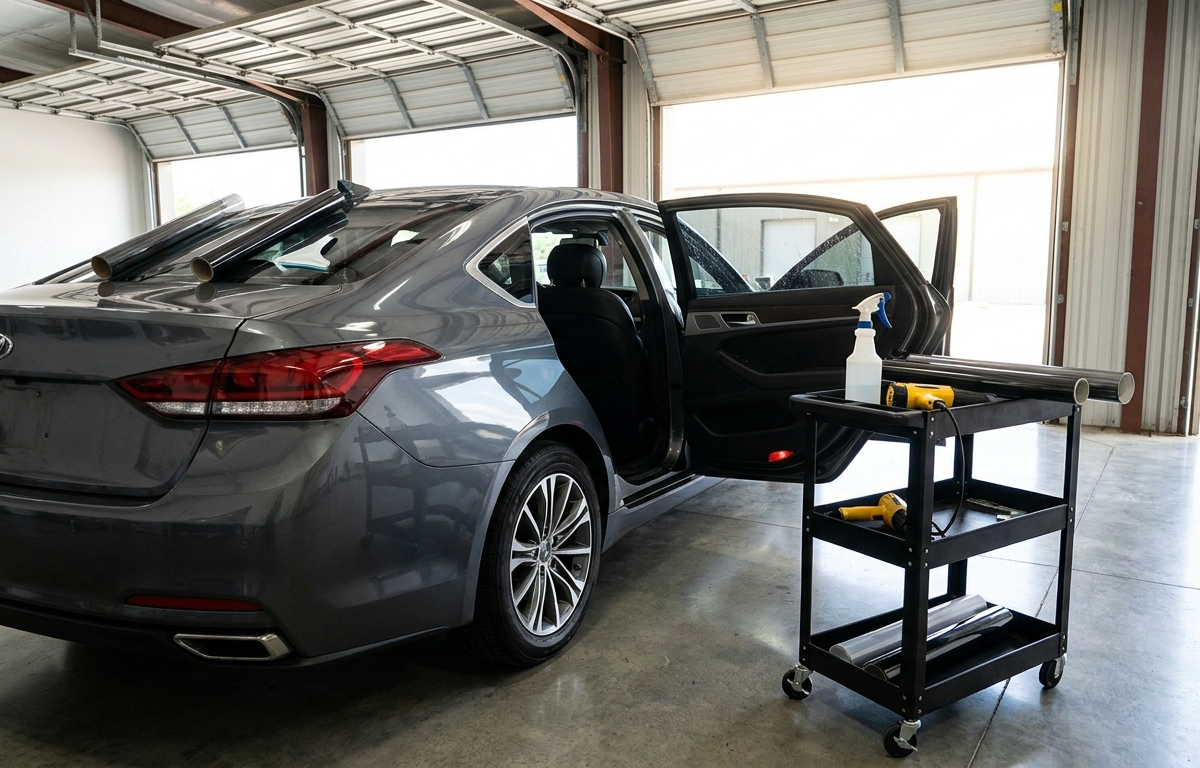
By the third week of June, half the tint shops in any given metro are booking three weeks out, and the other half are still filling next-day slots at whatever price a customer will pay. The difference usually isn't skill or equipment. It's whether the operator treated summer like a season to manage instead of a wave to ride.
Heat is the whole business model here. Once dash temps start hitting triple digits, "how much to tint my windows" searches spike, new-car buyers from spring want it done before their first road trip, and anyone who put it off last year finally calls. That demand doesn't spread evenly across June, July, and August — it slams the first six weeks and tapers hard by mid-August when school starts back up. For anyone running a window tinting business, booking that window right is worth more than any single upsell you'll make all year.
Run the money on one June week
Before any of the tactics, look at what a booked-out week is actually worth, priced off the 2026 side-work rate data for this trade. Say you run two installs a day, Monday through Saturday — twelve slots:
- 4 × full-vehicle ceramic, SUV at $550 — $2,200
- 3 × full-vehicle ceramic, sedan at $450 — $1,350
- 3 × full-vehicle carbon, SUV at $380 — $1,140
- 2 × full-vehicle carbon, sedan at $300 — $600
- Old film stripped on two of those vehicles, 8 windows at $40 — $320
Base week: $5,610. Take a 20% deposit on every booking and you've banked $1,122 before Monday's first peel. Hold a 10% peak-season premium on those twelve slots and the week closes at $6,171 — the premium alone is $561, which is a couple squeegee strokes short of an entire sedan carbon wrap you didn't have to do.
Now run it the other way. Skip the premium for six peak weeks and you've quietly handed back around $3,400. Skip the deposits and one no-show ceramic SUV slot in mid-July is $550 of dead air three other customers would have paid full price for. That's the stake. Every decision below is just defending that week.
Why the calendar fills unevenly
Three things stack on top of each other every summer: heat-driven urgency, spring car sales working through the pipeline, and pent-up jobs from people who meant to get it done last fall. A shop that doesn't plan for the stack either turns away money in June or sits half-empty by August because it front-loaded every slot on first-come pricing.
Here's the position worth planting a flag on: if your June calendar is full at your May prices, you didn't win the season — you mispriced it. A full book at flat rates means demand outran your price and you donated the difference. The premium isn't gouging; it's rationing twelve slots among more than twelve buyers, and the buyers who balk at 10% were price-shopping anyway. The fix isn't working more hours. It's deciding, before the rush hits, which weeks carry the premium and which ones you'll backfill with lower-margin work — legal touch-ups, single-window jobs, fleet work — that doesn't need the peak price to be worth doing.
Book the season, not the day
Take deposits on every summer appointment, full stop. A no-show in March costs you an open afternoon. A no-show in the second week of July costs you a slot other people would have paid the premium for. A 20% deposit at booking, non-refundable inside 48 hours, filters out the tire-kickers and protects the calendar slot that's actually worth protecting — on that $5,610 week above, it also means over a grand of the revenue is already in hand before the week starts.
Tier your lead times honestly instead of promising everyone "this week":
| Job | Typical summer lead time |
|---|---|
| Carbon package ($300 sedan / $380 SUV) | 3–7 business days |
| Ceramic package ($450 sedan / $550 SUV) | 7–15 business days |
| Removal + retint | add 1–2 days to either |
Quoting the real wait up front — and writing it into the estimate the customer approves — beats the customer showing up to a rescheduled appointment and blaming you for it. If you haven't nailed down your per-tier numbers yet, run them through the window tinting cost calculator before the rush hits, not during it.
Say no to the wrong jobs in June
The riskiest month to say yes to everything is the one where you have the least slack to fix a mistake. A single rear windshield with a defroster grid you've never worked around, done as a favor between two full jobs, can eat the two hours you needed for the $550 ceramic SUV that's actually paying your July rent. During peak weeks, hold a minimum ticket — the $120 two-front package is a sane floor — and decline the odd one-off unless it fits a real gap in the schedule. Not because the customer isn't worth it, but because the trade-off isn't.
This is also the month a five-minute VLT reading and a plain sentence on the invoice save you a headache later: note the film's rated VLT and, where you can measure it, the net VLT with the factory glass — the number a traffic stop actually checks. Customers rarely ask for this, but the ones who get pulled over remember which shop documented it and which didn't.
The referral engine runs itself in season
Tint has one advantage almost no other trade gets: the result is visible in the driveway thirty seconds after you finish. Ask for the review while the car's still sitting there and the customer is looking at their own reflection instead of glare — not the next day, not "when you get a chance." A short text with a review link goes out before they've pulled out of the driveway.
Summer customers also talk to other summer customers. Someone getting their windows done in June is exactly the neighbor another June customer complains to about the heat. A simple "know anyone else dealing with this" ask, timed right after they've seen the difference, converts better in July than any ad spend will. Pest control operators run the same play during their own summer peak — the timing logic behind asking for reviews while you're still in the driveway works the same whether the customer's looking at a clean window or a treated yard.
Bank the slow season while you're busy
August and September thin out fast. Use the busy weeks to pre-sell what fills the gap: a fall ceramic upgrade quoted at drop-off for the customer who chose carbon in June, a follow-up call in September to the ones who only did the $120 front-two package in a hurry during the rush. The estimate you write in June can carry a note about the upgrade — no pressure, just a price on file so the fall call isn't a cold one. A carbon-to-ceramic gap of $170 on an SUV is an easy autumn conversation with someone who spent July feeling the difference through their windshield.
See a deposit-backed season before you build one
Run a busy June week through the SideWRK demo seeded for window tinting and see how a deposit-backed estimate, the VLT note, and a same-day review request actually work together before you build your own version from scratch. When you're ready to book your own season this way, start free and run it for real. Five jobs a year free, no card, then $19/mo or $190/yr.
FAQ
How much is a summer rush premium actually worth on window tinting?
On a fully booked two-a-day week — a realistic mix of ceramic and carbon packages totaling $5,610 — a 10% peak premium adds $561, and holding it across six peak weeks is worth around $3,400. Customers who are heat-desperate pay it; the ones who balk were price-shopping anyway. Build it into the estimate as a line, not a verbal add, so there's no dispute at pickup.
Should I take walk-ins during peak tint season?
Only if you've built slack into the schedule on purpose — a couple of short slots per day for single-window jobs or touch-ups at your minimum ticket. Filling every hour with booked, deposited work and then squeezing walk-ins on top usually means one of the two jobs gets rushed, and a rushed $550 ceramic install is the kind of mistake that costs you the review you were counting on.
What's a fair deposit to require for a window tinting appointment?
Twenty percent, taken at booking and non-refundable inside 48 hours of the appointment. On a $550 ceramic SUV package that's $110 — enough to filter serious customers from tire-kickers without feeling predatory, and across a booked twelve-slot week it puts over $1,100 in hand before Monday. State it plainly on the estimate the customer approves.
How do I know if my tint job meets the legal VLT limit?
Check your state's specific front-side and windshield VLT minimums before quoting — they vary widely, and some states set a different limit for SUVs and trucks than for sedans. Measure and note the net VLT (film plus factory glass) on the invoice where you can, since that combined number is what gets checked in a traffic stop, not the film's rated percentage alone.
Is ceramic tint worth upselling during the summer rush?
Yes, when the customer is already motivated by heat — ceramic's selling point is heat rejection, not darkness, and the $170 gap between a carbon and ceramic SUV package is easiest to justify in the exact month the customer's steering wheel is too hot to touch. Quote it as a real option with the honest lead time attached rather than pushing it; the no-pressure mention on the estimate does more for the next referral than a hard upsell does.