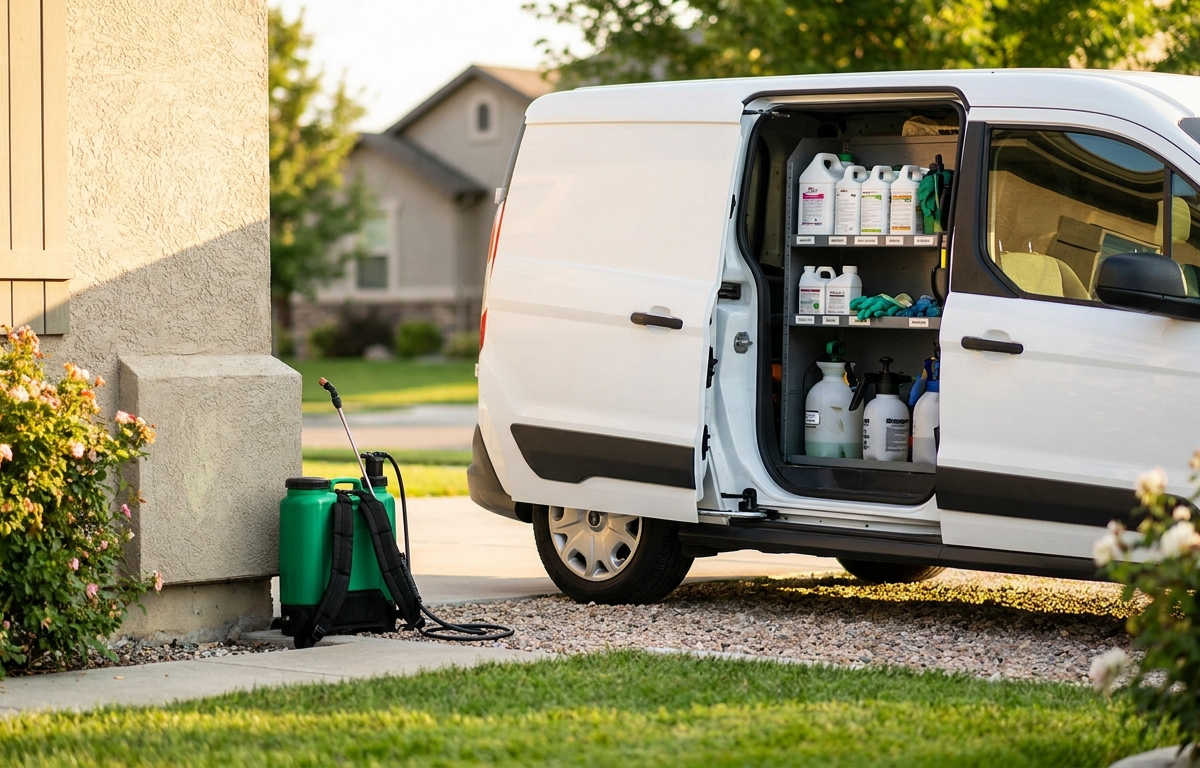
A tech on his fourth stop before lunch doesn't think about reviews. He thinks about the next address, the ant trail behind the last house, whether he remembered the granular bait for the yard with the dog. Reviews are the thing that happens later, if at all — and "later" is where most of them die.
Summer is when pest control gets busy enough that this actually matters. Ants, wasps, mosquitoes, the occasional rodent moving down from a hot attic — call volume climbs, and so does the number of doors you're standing in front of with a sprayer in your hand. Every one of those stops is a review you didn't ask for, walking away.
Here's the volume math: a solo operator running 15-20 stops a week in peak season sees 60-80 completed jobs a month. If even a third of those customers would leave a review with a two-minute nudge, that's 20+ reviews a month sitting on the table. Most operators get two or three. The gap isn't the work — it's the ask.
What one review is actually worth in dollars
Volume math is nice; dollar math is what should change your habits. Follow one review through: a homeowner picking between three identical-sounding companies reads yours and calls. An initial service bills $175 and a recurring visit $125, per the 2026 side-work rate data — so that one converted caller is $175 up front plus four quarterly visits, another $500. Call it $675 in the first year, from one review, before they mention you to a neighbor.
Now stack it. If the 20 reviews you could collect this summer swing just five homeowners over the next year — one each, no compounding — that's about $3,375 in booked work. And the bigger tickets ride in on the same stars: a $350 rodent exclusion, a $600 bed bug job, a $900 termite treatment. Nobody hires a stranger for a $900 problem off a website that says "family owned, licensed, guaranteed." They hire the profile with forty specific reviews.
So here's the stance, and it's not a stretch: the review ask is the best-paying thirty seconds in pest control. The service rate in this trade is built on $75-an-hour labor. No wand, no bait gun, no ladder work pays anywhere near what a thirty-second sentence in a driveway pays when it lands a $675 account. Treating the ask as optional is the most expensive habit on the truck.
Ask while you're still in the driveway
The single biggest lever is timing. A review request made while the customer can still see you loading the truck converts at multiples of an email sent that night. You're a person to them right now, not a name in an inbox competing with forty unread messages.
Don't make it a production. Walk them through what you found and treated — "got the perimeter, hit the nest under the deck, you'll see activity drop off in a few days" — then pull up the QR code on your phone: "If you've got thirty seconds, a Google review helps more than you'd think. Most people are choosing between three companies that all say the same thing on their website."
That last line matters because it's true. Pest control websites are interchangeable. Reviews are the only thing a homeowner trusts that isn't your own marketing copy talking about itself.
For scale, that hypothetical driveway stop was real money too:
| Line | Price |
|---|---|
| Initial service — full perimeter treatment | $175 |
| Wasp nest removal under the deck | $150 |
| Ticket total | $325 |
If they sign on quarterly at $125 a visit, the account is worth about $675 in year one. The review ask took half a minute of it.
Text beats email, and it isn't close
If you're following up after the visit instead of asking in person, send a text within an hour or two, not an email that night. People read texts. Emails from a pest company sit in the same graveyard as the dentist reminder and the extended warranty offer. A short text — "Thanks for having us out today. If the service was solid, a quick review here would mean a lot: [link]" — gets read in the time it takes to unlock a phone.
One text, one follow-up if you hear nothing in a few days, then let it go. Chasing past that reads as needy and can backfire.
And never offer a discount or gift card for a review. It feels generous, but platforms have gotten aggressive about pulling incentivized reviews wholesale — you can lose the whole history in one policy sweep, not just the tainted ones. Ask honestly, for free, or don't ask.
Time it to the second visit, not just the first
A one-and-done spray earns a review about a spray. A customer who's had the follow-up — where the ants are actually gone, where the nest didn't come back — reviews a result. That reads more convincing to the next homeowner scrolling your profile because it's specific: "came back to check, no more activity in the kitchen."
Since a $175 initial usually rolls into a scheduled follow-up anyway (one treatment rarely kills everything on contact — that's why the recurring visit exists), the follow-up is the better ask. Build it into the checklist: treat, confirm it's resolved, then ask.
When the review is bad
It'll happen — usually from someone who expected total elimination in one visit, or who blamed you when a new colony wandered over from next door a month later. Respond publicly, calmly, and specifically. Not "we're sorry you feel that way," which reads defensive to everyone watching. Closer to: "We treated the perimeter on [date] for ant activity — pressure from neighboring properties can bring new activity weeks later, and we'd like to come back under warranty. Call the number on your invoice."
That response does two jobs: it fixes the customer, and it shows the next fifty readers you handle problems instead of arguing. A five-star page with zero one-stars looks scrubbed. A 4.8 with one well-handled complaint looks real.
Turn the ask into a referral, not just a star
While you're standing there, add the second line: "If any of your neighbors mention bugs, tell them to text me — I'll get them on the schedule this week." Summer means their neighbors' yards have the same ants and wasps theirs did. A homeowner who just watched you solve their problem is primed to mention it two doors down.
Route density is free money in this trade. Three $175 initials on one street beat three across town — less drive time, more of that $75-an-hour rate actually collected instead of burned on windshield time, and a visible truck doing its own advertising. A referral chain that starts with one driveway conversation can fill a block by Labor Day.
Make the ask repeatable, not a one-off effort
Operators who build a real review base don't have a "review month." They have a habit: every completed job ends the same way — confirm the work, ask or send the text, note it in the customer's file so you're not asking twice in one season. If the business runs out of an app instead of a notebook, tag which jobs you've asked on and which reviews landed. That's the difference between guessing you're on top of it and knowing your ask rate.
A branded invoice with your license number and a clean summary of what was treated does quiet work here too — it's the last thing the customer sees, and it should look like a company worth recommending, not a slip of paper with a number scrawled on it. That's the habit that turns a busy season into a full referral chain instead of a stack of one-off jobs — the mechanics carry across trades, even if the bugs don't.
If review tracking still lives in your head, fix that before next season buries you. See what running your pest control route looks like inside the app — job history, invoice, and the customer's contact info in one place instead of three. Then start free and see if the habit sticks when it's built into closing every stop. Five jobs a year free, no card, then $19/mo or $190/yr.
FAQ
How soon after a pest control job should I ask for a review?
In person before you leave, or by text within an hour or two of finishing. Same-day asks convert far better than an email that night or a follow-up days later, when the visit has faded.
What is one Google review worth to a pest control operator?
If it converts a single homeowner, about $675 in year one — a $175 initial service plus four quarterly visits at $125. Twenty reviews collected over a summer that swing five callers is roughly $3,375 in booked work, and the bigger tickets ($350 exclusions, $600 bed bug jobs, $900 termite treatments) follow the same stars.
Should I offer a discount for leaving a review?
No. Platforms pull incentivized reviews wholesale, and one policy sweep can erase your entire history — not just the tainted ones. Ask for free or don't ask.
Is it better to ask after the first visit or the follow-up treatment?
The follow-up, when your program includes one. A review written after the problem is confirmed gone is specific and convincing; one written on relief after the first spray is neither. Since the $175 initial usually schedules a follow-up anyway, the better ask costs you nothing extra.
What if a customer leaves a bad review because the bugs came back?
Respond publicly and specifically — name the treatment date, explain that pressure from neighboring properties brings new activity, and offer to return under warranty. A calm, factual reply reads better to future customers than silence or defensiveness ever will.
Two things about those driveway lines
The neighbor line is not a pitch, so don't let it sound like one. Say it after you've walked them through what you found and treated, and after you've told them the house looks good — not while you're still coiling the hose. At that point you aren't selling anything. You're a professional mentioning he has room this week, standing two doors from a house with the same ants. If it lands, it lands. If it doesn't, you're out one sentence and the customer never felt worked.
And route density is worth more than the hourly math makes it look. Standard pest control visits don't bill by the hour at all — an initial service is $175 whether the drive was four minutes or forty, and a recurring visit is $125 the same way. On a flat per-service menu, drive time isn't collected at a lower rate. It isn't collected. Every mile between stops comes straight out of what you clear that day, which is why the neighbor two doors down is worth more to you than an identical $175 job across town, even though the two invoices read the same.
That's the other reason to close those houses onto a quarterly plan: it puts you back on the same block four times a year instead of once. The whole menu, what a one-time call is worth against the same house on a plan, and where an hourly line still applies are laid out in the pest control pricing playbook.