A homeowner calls and asks what it costs to take down "the big tree out back." That's the whole question, and it's genuinely impossible to answer over the phone — not because you're hiding the number, but because a 50-foot maple standing clear in an open yard and the same 50-foot maple wedged against a fence line are two entirely different jobs wearing the same description. Quoting blind is how solo operators eat hours they never priced.
Feet measure the tree. They don't measure the job.
Most pricing advice in this trade starts with a per-foot table, and that's exactly the habit that underbids you. Here's the stance, plainly: per-foot pricing is how tree guys go broke, because the tree doesn't set the price — the ground under it does. Two trees identical to the inch can be a two-hour drop or a full day on ropes, and a per-foot number can't tell them apart.
Price in risk units instead. Per 2026 side-work rate data, the working unit rate is $350, and a removal gets sized by how it has to come down, not how tall it stands:
| Tier | What it means | Units | Price |
|---|---|---|---|
| R1 | Small tree, straight fell, clear landing zone | 1 | $350 |
| R2 | Full-size tree, room to drop or section simply | 3 | $1,050 |
| R3 | Full-size tree, rigged and roped down in pieces | 5 | $1,750 |
Trimming and pruning runs $350 a visit, brush and limb haul $200, stump grinding $200, storm cleanup from $500. A typical straightforward removal lands around $900. The tiers do what feet can't: they price the method.
The same maple, twice — worked to the dollar
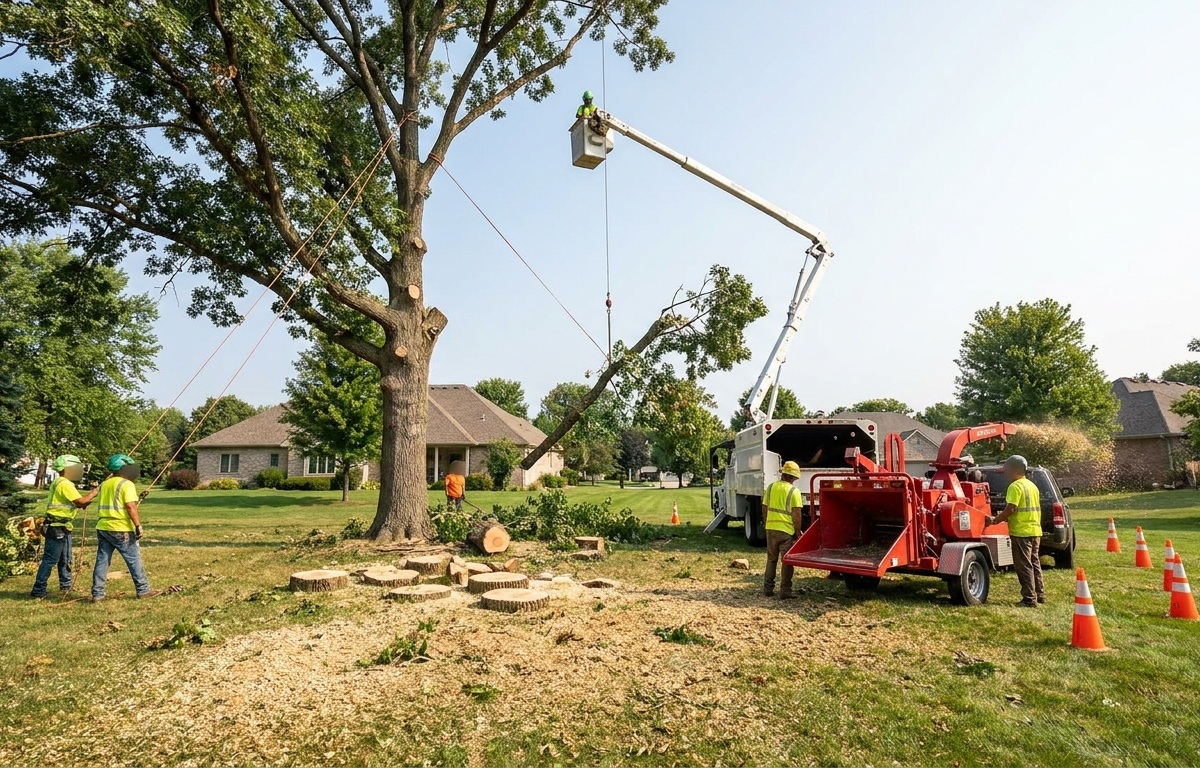
Price the article's own opening problem. Two 50-foot maples, same species, same height, same trunk. One stands in an open backyard with a clear drop zone. The other is wedged in the ten feet between the house and a privacy fence, chipper parked fifty feet away.
Open yard — notch, drop, buck:
- Removal, straightforward drop and section: $900
- Brush & limb haul: $200
- Stump grinding: $200
Total: $1,300.
Against the fence — roped down piece by piece:
- Removal at R3, rigged takedown, 5 units × $350: $1,750
- Brush & limb haul (hand-carried to the chipper): $200
- Stump grinding: $200
Total: $2,150.
Same tree. $850 apart. A homeowner comparing your two quotes for "a 50-foot maple" thinks one of them is a rip-off — until you show the line items and explain that on the second job, every limb comes down on a rope instead of gravity, and every piece walks to the truck by hand. Quote per foot and you'll split the difference on both jobs: overpriced on the easy one, and eating several hundred dollars of rigging time on the hard one.
What pushes a tree up a tier
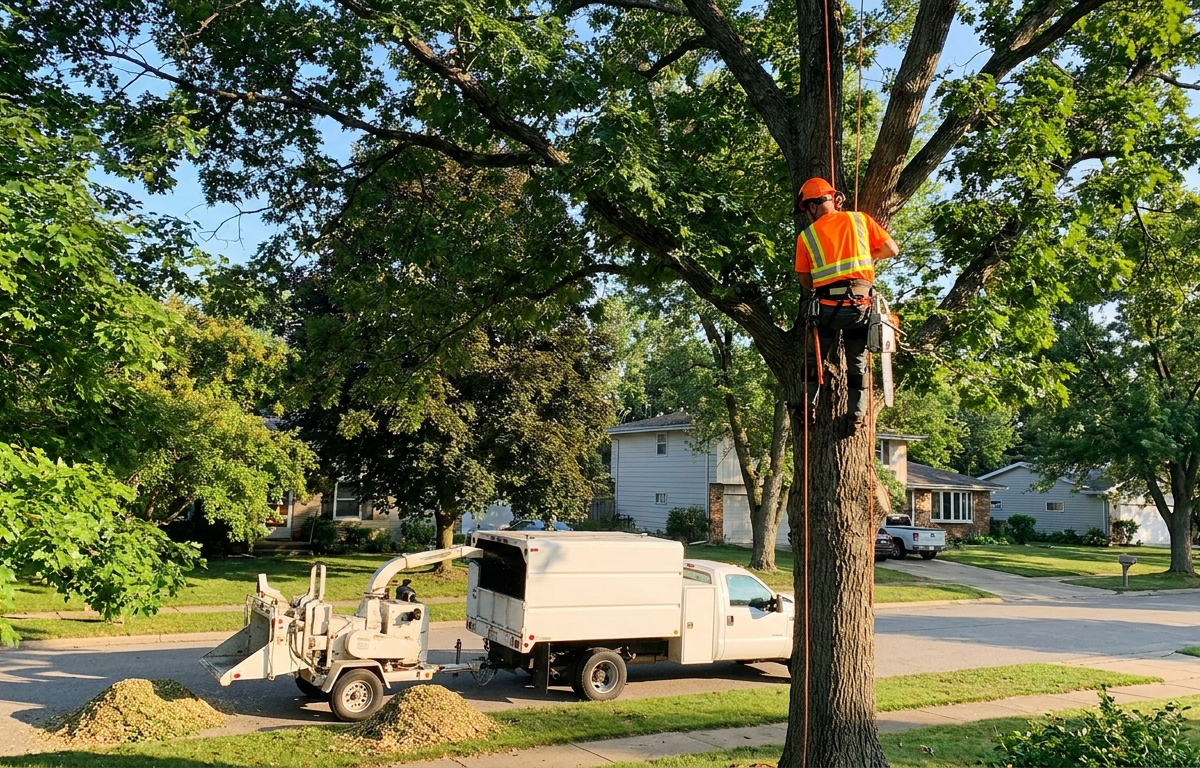
Trunk diameter matters more than new operators expect — a trunk over 24 inches takes real time to work through and dulls chain faster, which is labor and equipment cost, not padding. Canopy spread and branch count change how many pieces you're lowering instead of dropping. A heavy lean toward a fence, roof, or power line forces the roped-down removal even when the tree itself is ordinary.
And access is the tier-changer first-year operators miss most. If the chipper can't get within fifty feet, every piece gets carried, and the carry is where the day goes. Price the walk to the truck, not just the cut.
Stump grinding is a separate line, always
Never fold the stump into the tree price by habit. Quote it separately every time, even if you bundle the total for the customer — $200 for a typical single stump. A customer who wants the tree gone but the stump left shouldn't pay for work you're not doing, and one who wants both should see two clear numbers, not one mystery total. The separate line also does quiet sales work: plenty of customers who "didn't want the stump done" change their mind when it's a visible $200 instead of an unknown.
Storm and emergency work earns a real premium
A tree across a driveway after a storm is not a scheduled removal, and it shouldn't be priced like one. Storm cleanup starts at $500 and climbs, and a 25–50% premium for same-day or after-hours response is standard in the trade, not gouging — you're working around live hazards, in bad footing, often with an anxious customer standing too close, and you dropped whatever else was on the schedule. Put it on the invoice plainly: "emergency response premium," its own line. A padded hourly rate invites argument; a named line item answers the question before it's asked.
Quote from photos, confirm on site
A phone photo with a size reference — the customer next to the trunk, a garage door for scale — gets you close enough to give a range and to filter out jobs wrong for your rig. But never treat a photo quote as final. Lean angle, soil, and what's actually behind the tree only show up in person. The photo tells you it's a 50-footer; only the site visit tells you whether it's the $1,300 maple or the $2,150 one, and locking the number early means you find out which on your own dime.
Build the number the same way every time
However the job prices out, the customer should see it broken out — removal tier, stump if requested, haul, any emergency premium — never a lump figure they have to trust blind. A tree removal cost calculator is a fast sanity check on a size or access situation you haven't priced in a while. And once the number's right, a clean branded estimate the customer approves from their phone wins more jobs than a lower price will — a napkin number next to a real document looks like exactly what it is.
The business side of tree work — quoting, invoicing, getting paid on the spot after a job that can't wait for a check — lives on the tree service trade page, and the live demo is seeded with tree jobs, no signup required. Contractors in other physical trades fight the same underpricing trap: the concrete guide and the masonry repair cost guide both walk through jobs where access and condition swing the number as hard as size does.
Tree work is unforgiving of a bad guess — the liability, the equipment wear, and the physical risk are all real whether or not the price reflected them. Size the tier out loud, adjust for diameter, lean, and access before you say a final number, and send it as a real estimate instead of a verbal guess: start your free 14-day trial — no card.
FAQ
How much does it cost to remove a tree in 2026?
A straightforward full-size removal runs around $900, with the working unit rate at $350: a small clear-drop tree at one unit ($350), a full-size tree with room to work at three ($1,050), and a rigged, roped-down removal at five ($1,750). Access and lean move a tree between tiers far more than height does.
Does stump grinding cost extra on top of tree removal?
Yes — $200 for a typical single stump, and it should always ride as its own line item rather than hide inside the removal price. Customers who skip it should see the price drop; customers who want it should see exactly what it costs.
Why do two same-size trees get such different quotes?
Because the method sets the price, not the height. A 50-foot maple in an open yard drops and bucks for about $1,300 including haul and stump; the identical tree wedged against a fence gets roped down piece by piece and lands at $2,150. The $850 difference is rigging time and hand-carrying, not markup.
Why do tree services charge more for emergency or storm removal?
Storm cleanup starts around $500, and a 25–50% premium for same-day or after-hours work is standard — live hazards, unstable footing, and a dropped schedule are real costs. List it as its own "emergency response premium" line so nobody has to wonder what it covers.
Can I get an accurate tree removal quote from a photo?
A photo with a size reference is good for a range and for screening jobs that are wrong for your equipment, but the tier only gets confirmed on site. Lean, soil, and what's behind the tree decide whether it's the open-yard price or the roped-down price, and that difference can run $850 on the same tree.