A homeowner calls about a crumbling chimney and asks what it'll run. You say "depends," and they hear "he doesn't know his own trade." Here's the actual anchor: straightforward repointing runs $12 a square foot — so a hundred square feet of failing joints on a garden wall is a $1,200 job, per the 2026 side-work rate data — and everything else in masonry pricing is a defensible move up or down from that number. Get specific about where a job sits and you sound like someone who's bid a thousand of these. Stay vague and you lose the work to whoever quotes a flat number first, even a wrong one.
Why the number moves
Three things move a masonry price more than anything else: how the original mortar was mixed, how high off the ground the work sits, and whether you're replacing joints or replacing brick.
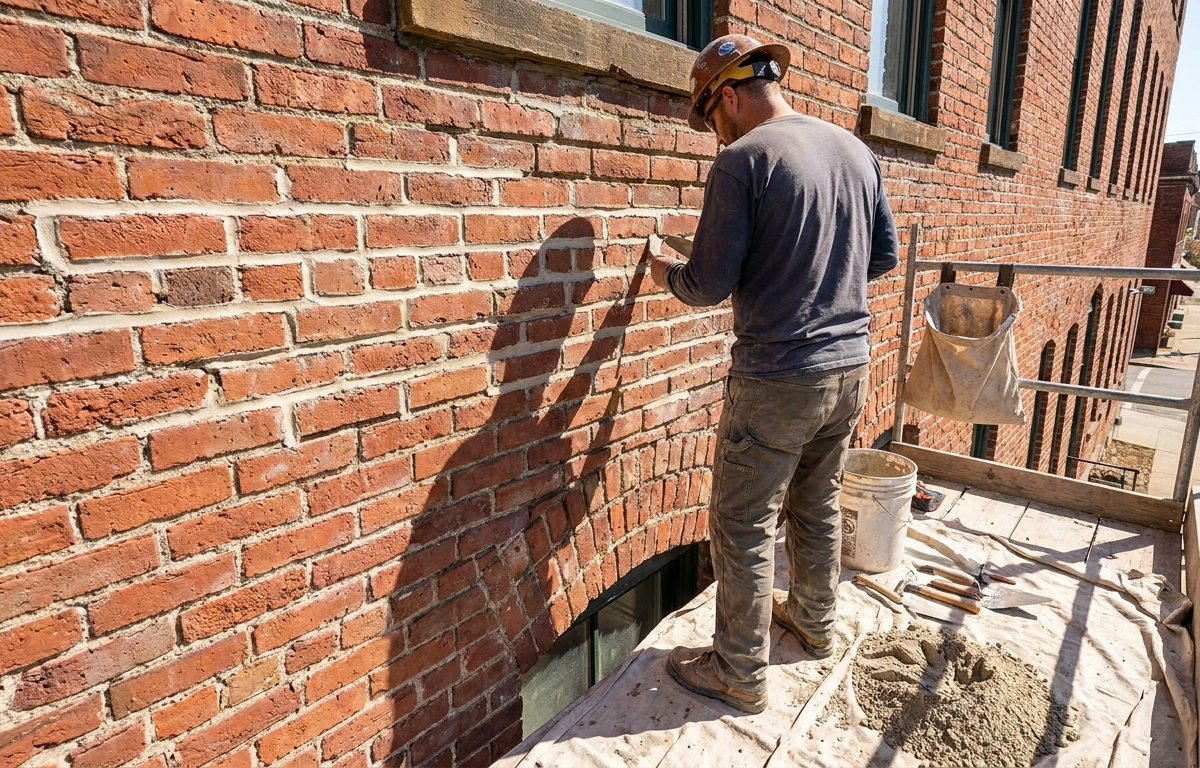
Ground-level repointing at $12 a square foot is the baseline — a porch stoop, a low wall, a foundation section you can reach from a stepladder. Take the same joint work above a roofline and you're renting scaffold or setting pump jacks, and that cost belongs on the invoice as its own line, not smeared invisibly into your rate. More on that below, because it's where most new masons quietly lose money.
Historic work is its own category. A pre-1930s building was likely laid with soft lime mortar. Repoint it with modern Portland-cement mix and you trap moisture behind brick that was built to breathe — the faces spall, and it's your name on the invoice when they do. Matching a Type O lime mortar and working at the slower pace it demands earns a real premium over the $12 baseline, and it should. This is the job where undercharging costs you a callback and a reputation, not just margin.
Then there's the line between repointing and rebuilding. Joints erode; that's repointing. When the brick itself is spalled, cracked, or frost-shattered, you're cutting out units — a small spalled-brick patch of about fifteen square feet runs $330, roughly $22 a square foot, because unit replacement is surgery, not raking.
A rough price map
| Job type | Realistic price |
|---|---|
| Ground-level repointing (100 sq ft wall) | $1,200 — $12/sq ft |
| Spalled-brick patch, ~15 sq ft | $330 |
| Chimney crown repair (patch & seal) | $450 |
| Repair brick or stone steps | $500 |
| Tuckpoint chimney above the roofline | $1,200 |
| Rebuild chimney stack from the roofline | $2,500 |
| Parge foundation wall, ~120 sq ft | $720 — $6/sq ft |
| Stone/brick veneer install, ~80 sq ft | $1,360 — $17/sq ft |
| Block retaining wall, ~60 sq ft face | $1,920 — $32/sq ft |
Treat the table as anchors, not a script. Regional labor and material costs shift every row. But notice the shape of it: the per-foot rate triples between parging and structural block work, and that spread is exactly what you're explaining when a customer asks why the retaining wall costs more per foot than the foundation coat.
The worked example: one chimney, one invoice
Take a hypothetical two-story house with a chimney shedding mortar above the roofline. Here's how the estimate should read:
| Line | Price |
|---|---|
| Tuckpoint chimney, ~70 sq ft of brick face above roofline @ $12/sq ft | $840 |
| Scaffold rental & setup, 2 days | $360 |
| Invoice total | $1,200 |
Check it against your minimum — $300 is the industry norm for a small-repair call, and this clears it easily — and check the material side: mortar, sand, and bagged goods on a repoint run about 20% of the ticket, call it $240, which leaves roughly $960 for two days of you on a scaffold. That's the whole quote, built in two minutes, and every line survives a customer's questions because each one is a real cost with a real reason.
Here's the opinion part, and it's earned: a mason who buries scaffold in his square-foot rate is choosing to lose one of two ways. Either he quotes chimney work at his ground-level rate and eats the rental, or he pads his baseline to cover rigging he doesn't always need and loses the garden-wall bids to guys charging honest ground-level prices. The scaffold is a line item. Print it.
Build in the stuff that isn't the wall
A few more items that belong on the estimate, not folded into the rate:
- Mortar matching time. Custom color or a lime mix eats an hour or more before you've struck a single joint. Bill for it.
- Cleanup and haul-off. Old mortar and broken brick don't disappear. Dump fees are real money on a rebuild.
- A minimum charge. A quarter-day drive for a ten-square-foot patch doesn't pencil at $12 a foot alone. The $300 minimum exists for a reason — the $330 small-patch price sits just above it on purpose. Quote the minimum up front so nobody's surprised.
Where deposits protect you
Masonry work sits on the calendar for weeks between the estimate and the day you show up with mortar and a hawk. Materials get ordered, scaffold gets scheduled, and a customer who ghosts after all that costs real time and real cash. A deposit at approval — 20 to 30% is typical — covers the material buy-in on a $2,500 stack rebuild and filters the tire-kickers before you've committed a Saturday.
If you're writing the estimate on your phone anyway, build the deposit into it instead of chasing a check later. SideWRK's masonry setup lets the customer approve the scope and pay the deposit by card in the same tap — no separate invoice, no "I'll Venmo you Friday."
Quoting it right the first time
Walk the wall before you price it. Photograph every section that needs work, identify the mortar if you can, and measure the real square footage — a wall that looks like 80 square feet from the driveway is closer to 110 once you count pilasters and returns, and at $12 a foot that eyeball error is $360 you just donated. SideWRK's takeoff tool traces a wall or roofline from the satellite view and drops a real measurement into the estimate, which beats a guess on the back of a business card.
Then price each section separately on the same estimate — repointing here at $12, the spalled patch there at its own price — instead of blending it into one number the customer can't take apart. A broken-out estimate builds more trust than a lump sum ever will. The masonry cost calculator is a fast sanity check on your per-foot number before you hit send.
Concrete runs through the same honest-pricing problem from the slab side — how to price concrete jobs so they actually cover your real cost walks through it.
See how the full flow looks for this trade at the masonry demo, no signup required. Ready to quote the next chimney with real numbers instead of "depends"? Start your free 14-day trial — no card and build the estimate before you're off the roof.
FAQ
How much does it cost to repoint a chimney?
For the section above the roofline, expect around $1,200 all-in: roughly 70 square feet of brick face at the $12-per-square-foot repointing rate, plus $300 to $400 of scaffold rental billed as its own line. If the stack is far enough gone that units need to come out, a rebuild from the roofline runs about $2,500.
What's the difference between repointing and tuckpointing?
They're used interchangeably on most residential calls, but tuckpointing technically means a decorative two-tone finish — a thin contrasting line laid over the structural joint to mimic finer brickwork. Straight repointing just replaces failed mortar. Confirm which one the customer actually wants before you price it, because the decorative version is slower work.
Why is historic masonry repair so much more expensive?
Buildings from before roughly 1930 were laid with soft lime mortar that lets the wall flex and breathe. Repoint them with modern Portland cement and moisture gets trapped, cracking brick over time — so historic work means sourcing or custom-mixing a matched lime mortar, like a Type O, and working slower. That skill premium is real, and it's the one job where a cheap quote should scare the customer, not attract them.
Should I charge by the square foot or by the job?
Build the number by the square foot — $12 for repointing, more for unit replacement — then present the customer one clear total per section. They get a price they can understand; you keep math that scales. Until you trust your own production rates, a job price protects you from underbidding an oddly shaped wall.
Do I need a deposit for a small masonry repair?
Under your $300 minimum, no — you're in and out same-day. Once a job needs matched brick, custom mortar, or scaffold rental, take 20 to 30% at approval, because you're committing real material cost and calendar time before the first joint gets cut.