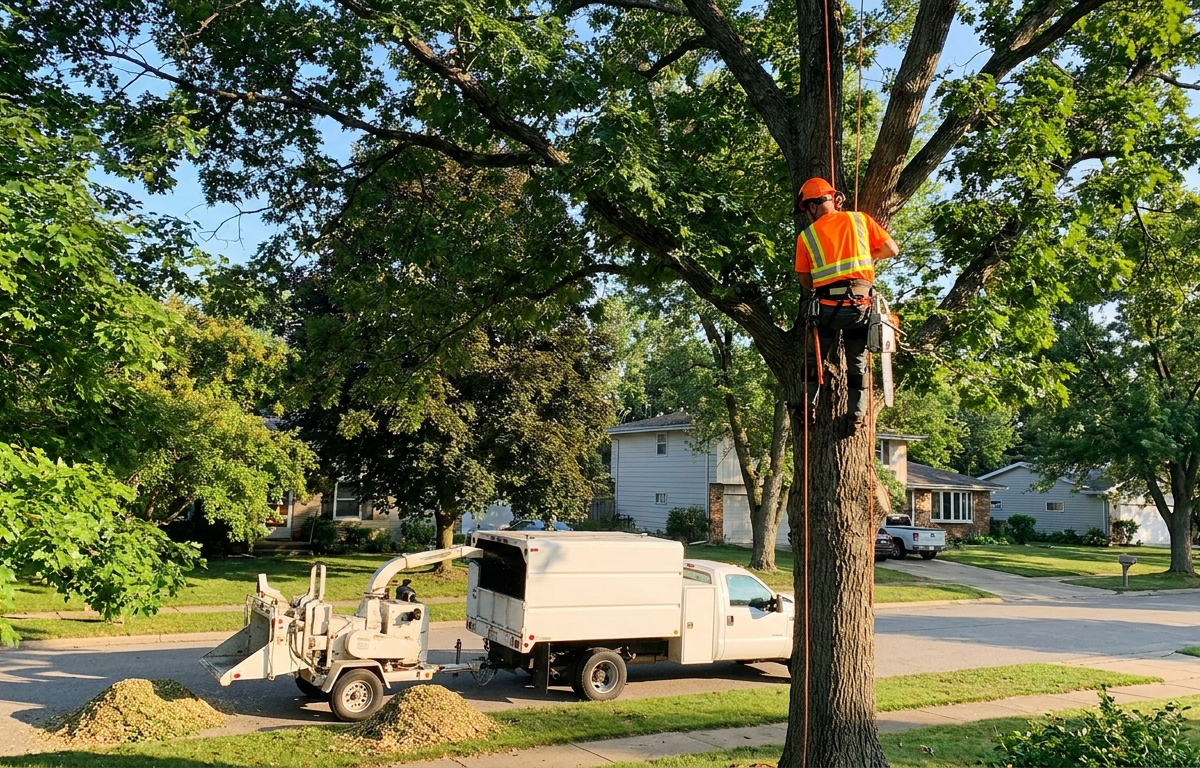
Say you just dropped a 60-foot oak that was leaning over a garage. The chips are still flying, the limbs are cleaned up, the customer is happy, and they're writing a check for $1,400. Most tree guys take the check and drive away.
That moment, standing in the yard with sawdust still on your boots, is when you either build a repeat customer or don't see them again for years.
First, know what that check is actually made of. Per 2026 side-work rate data, a hypothetical job like this prices out as two lines: the removal itself at $900, and the storm-style cleanup and limb haul at $500. Total: $1,400. Two lines, on paper, itemized. Hold that thought — it's the key to everything below.
Because it's the same property. Same customer. They have other trees, probably eight or ten of them. You spotted problems while you were up there: deadwood in the canopy, a codominant stem on the maple, bracket fungi at the base of the birch. The customer doesn't know any of it. They hired you for the one emergency and that's where their attention stopped. Say something in the next 20 minutes and you have a real shot at being their tree person for the next decade. Say nothing, and you probably never see them again.
The One-and-Done Trap
Tree service runs on disaster response. Storms, die-offs, roots cracking sidewalks — that's what generates calls. Most operators get good at showing up fast and moving to the next job. The recurring maintenance side never gets built because nobody set it up.
The other problem is price competition. If your whole pitch is speed and rate, there's always someone who'll undercut you by $100. That operator usually disappears within 18 months, but while they're around they train homeowners to shop on price. You end up chasing new customers constantly, with no repeat revenue underneath you.
The operators who build real income from tree service aren't the cheapest in town. They're the ones with a list — a customer database with notes on every property, what they spotted, and when to follow up. The emergency calls still come, but as upside on top of a base that pays whether or not a storm rolls through.
Quote in Units, Not Vibes
Here's an opinion most of the trade won't say out loud: "about $1,400" quoting is why homeowners think tree work is priced by mood. When the number arrives with no anatomy, every quote sounds like a guess and every competitor's lower guess sounds just as valid.
The fix is per-unit pricing. Price removals at $350 a unit: a small tree is one unit ($350), a mid-size is three ($1,050), a big technical takedown is five ($1,750). Brush hauls at $200. Stump grinding at $200. A pruning visit at $350. Now the walk-around at the end of a job isn't a pitch — it's arithmetic the customer can follow. "That maple's a three-unit removal if it fails. A $350 prune this fall probably keeps it off that list." Nobody argues with a rate card the way they argue with a vibe.
What to Do Before You Take the Check
The last thing on any tree job, before payment, is a 10-minute walk of the property with the customer. Not a sales pitch. Just: "Can I show you what I noticed while I was up there?"
You have real credibility in that moment. You just did the work. You were in the canopy looking at things they've never seen from the ground. Most homeowners can't spot a weak branch union from 40 feet below or tell early decay from normal bark texture. Point at two or three specific things and put unit prices on them right there. If you can't quote on the spot, send the estimate by end of day.
Then: "I do an annual pruning visit in this area — $350, once a year, and I flag anything before it turns into a removal. Want me to put you on the list?"
That's the whole pitch. A customer who just watched you handle an emergency rarely hesitates at $350 a year for someone to keep the rest of the trees off the emergency list.
The Ten-Year Math on One Property
Walk this hypothetical property forward and the numbers make the case better than any script.
Year one: the emergency — $900 removal plus $500 cleanup and haul, $1,400. Add the stump grind they skipped in the moment and approve two weeks later: $200. Year one total, $1,600.
Years two through ten: the $350 annual pruning visit, nine of them — $3,150. Somewhere in that stretch, realistically, one more storm call at $500 and a brush haul at $200, because mature trees don't stop being mature trees.
Ten-year total: about $5,450 from one address. Versus $1,400 and a wave goodbye. The recurring customer is worth roughly four times the drive-away version — and the pruning visits slot into the slow weeks when the phone isn't ringing, which is exactly when you need them.
When you present the annual visit, don't discount it to close. Discounting trains people to negotiate every renewal. Point at the math instead: "One emergency removal costs four years of maintenance. Let's keep you out of emergency mode." If you want to reward the relationship, give the known property scheduling priority after storms. That's worth more to them than $50 off, and it costs you nothing.
The Follow-Up System
You don't need CRM software until you're past 40 recurring customers. A notes app works before that.
After every job: customer name, address, what you did, what you flagged, when to follow up. Set a reminder for 10-11 months out. When it fires, send a text: "Hey, it's [your name] from [business name]. We took down that oak last year. Want to get on the spring pruning schedule before I fill up?"
That text takes under a minute. Customers who got good work will answer it. Most won't remember your exact rate from last year; they'll remember the itemized invoice looked professional, and they'll say yes.
What ISA Certification Does
You don't need to be an ISA Certified Arborist to run a tree service. Plenty of operators do solid work without it. But if you want to price above the local market and get considered for commercial or municipal work, it's worth the investment.
The exam requires documented experience and covers tree biology, risk assessment, pruning standards, and safety. Once certified, your number appears in the ISA's public directory — where the homeowners who research before hiring go to vet you.
The daily value is language. "That oak has a significant failure zone above the northeast fork, and I'd recommend cabling this season" lands differently coming from a certified arborist with a per-unit rate card. The customer doesn't push back on the price the same way, because it no longer sounds manufactured.
The same move works across the service trades — HVAC operators build maintenance plans and pest control operators convert one-time jobs into annual contracts on the identical principle: present the ongoing relationship at the moment you've already earned trust.
If you're running tree work independently and want the itemized estimates, invoices, and follow-up reminders handled from your phone, start free. Five jobs a year free, no card, then $19/mo or $190/yr.
FAQ
How do I turn a one-time tree removal into a recurring customer?
Before taking payment, walk the property with the customer for about 10 minutes and point out two or three specific things you saw from the canopy — deadwood, a weak branch union, early decay — with unit prices attached. Then offer the annual pruning visit at $350. Customers who just watched you handle an emergency rarely hesitate at that number.
How should tree work be priced?
Per-unit: removals at $350 a unit (a small tree is one unit, a mid-size three at $1,050, a large technical takedown five at $1,750), with brush hauls and stump grinding at $200 each and pruning visits at $350. Itemized unit pricing is also what makes the end-of-job walk-around read as arithmetic instead of an upsell.
What is a recurring tree customer actually worth?
On one hypothetical property: a $1,400 emergency (a $900 removal plus $500 cleanup) plus a $200 stump grind in year one, then nine annual $350 pruning visits, one more storm call, and a brush haul across the following decade — about $5,450 total. That's roughly four times what the drive-away version of the same customer pays.
Does ISA certification actually help a tree service business?
It isn't required, but it lets you price above market, gets you considered for commercial and municipal work, and puts your number in the public directory homeowners use to vet arborists. Day to day, it gives you credible language for what you saw in the canopy, so recommendations don't sound like manufactured billing.