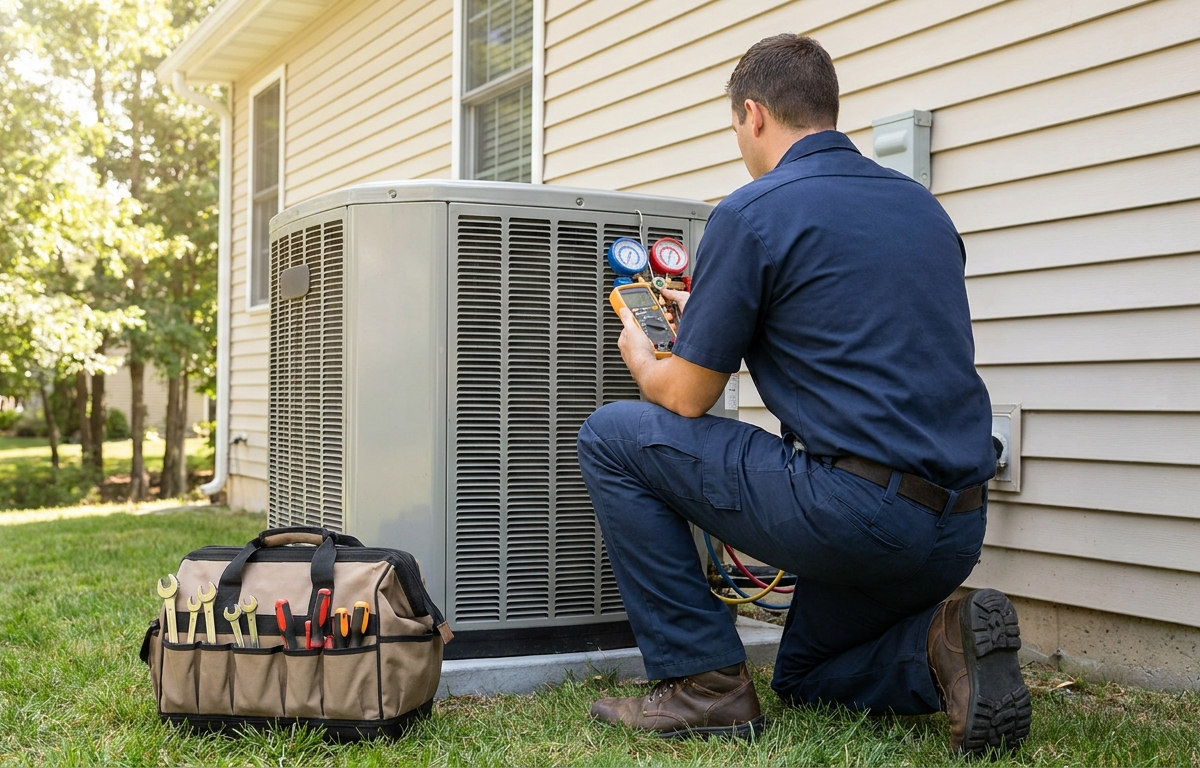
The math is simple enough to annoy you. You drive 20 minutes to a call, swap a failed capacitor in 40 minutes, collect $280, and drive away. Next summer, when something else on that aging system lets go, the homeowner calls whoever answers first. Not necessarily you.
Or: you swap the capacitor, spend four minutes talking on the driveway, and leave with $280 plus a signed maintenance agreement. Same customer. Same visit. Now they are yours next fall too.
The math is easy. The pitch is the hard part, and most write-ups on maintenance plans skip what actually matters: the exact words, the right moment, and what the numbers look like when a real enrollment goes down. So let's walk one, start to finish.
Why the Service Call Is Your Only Real Sales Window
Cold outreach does not convert for maintenance plans. A postcard asking a stranger to commit to a yearly agreement closes under 5 percent of the time. The follow-up phone call after a repair is barely better.
The window that works is during the service call, while trust is at its peak. You just fixed something. You proved you know what you are doing. The customer is relieved and paying attention. That window lasts about 15 minutes, and once you are loading the truck it is gone.
Build the Plan Before You Pitch It
Lock the plan down before the first pitch. Two visits a year is the foundation: spring for cooling, fall for heat. One visit a year undersells it; the customer feels like they are paying for something invisible.
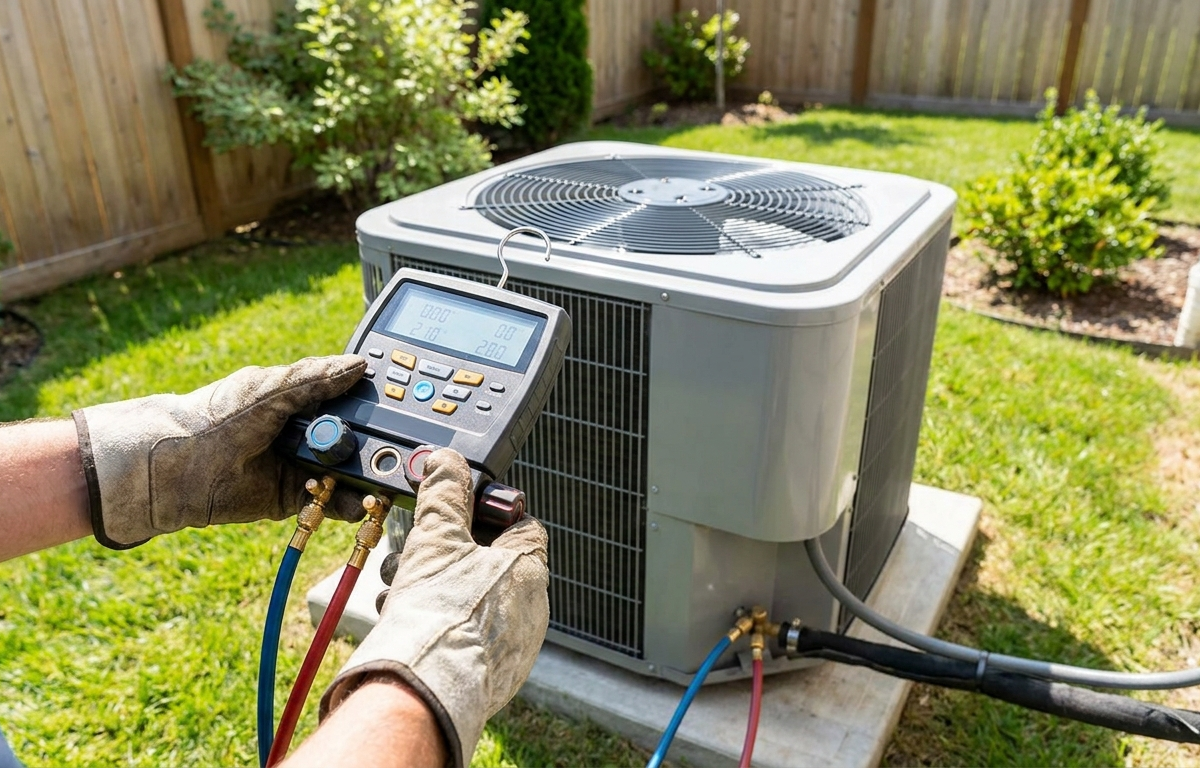
Write out what each visit covers. Cooling side: refrigerant pressures, condenser coil cleaning, drain pan and line, capacitors and contactors, supply and return temps. Heating side: heat exchanger, igniter and flame sensor, temperature rise, venting. If you cannot say exactly what is in it, the customer will question the price at every renewal.
Now anchor the price to your real one-off rates. Per 2026 side-work rate data, a standalone AC tune-up bills $150 and a service call runs $110, with common repairs at $280 for a capacitor, $220 for a coil and filter clean, $350 for a refrigerant recharge, and $320 for a thermostat install. Two tune-up visits bought separately is $300. Price the plan at $249 a year with 10 percent off repairs and priority scheduling, and the customer gets a real $51 discount for committing while you get spring and fall work you can route on your own schedule.
One more stance, and it cuts against common advice: skip the $16.99-a-month billing gimmick. Franchise shops bill monthly because a dispatcher and a software department manage the churn. A solo operator running a hundred micro-subscriptions is doing office work without an office. Bill the year on the driveway, card or check, done. If $249 once a year is a dealbreaker for a customer, the plan was not going to survive renewal anyway.
One Enrollment, Worked All the Way Through
Say the call is a 12-year-old condenser that quit on the first hot Saturday of June. You diagnose a failed run capacitor, swap it, and the system lights off. The ticket is $280.
While you write it up, the pitch:
"Before I head out — this capacitor is the kind of thing a spring tune-up catches weak, before it strands you on a weekend. I run a maintenance plan, $249 a year. Two visits, spring and fall, and you get 10 percent off any repair plus front-of-line scheduling when it's 95 out. Want me to set it up while I'm here?"
Here comes the objection, and on an older system it is nearly guaranteed: "The unit's already 12 years old. Why would I pay to maintain something on its way out?"
Answer it with arithmetic, not adjectives: "That's exactly the system worth maintaining. A new one mostly needs a filter. This one — if the coil loads up, airflow drops, it ices, and now you're at $220 for the coil clean plus $350 for a recharge if it's low. That's $570 on one skipped tune-up, against $249 for the year. The plan is me catching the cheap version of every one of those problems."
The driveway total when they say yes:
- Capacitor replacement: $280
- Maintenance plan, year one: $249
- Collected today: $529
That is $249 of found money on a call you were already standing at, plus a customer who is now scheduled instead of shopping.
Year two is where it compounds. You show up in spring and fall like you said you would, so renewal is not a sale — it is a habit. Renewal: $249. And when the original thermostat finally dies in October, they do not call around; you install the new one at $320 minus the plan discount, $288 on the ticket. Year-two value of that one driveway conversation: $537, with zero marketing spent and both visits routed on days you chose.
When in the Call to Bring It Up
After you have explained the repair, before you hand over the invoice. During diagnosis the customer is anxious; wrong moment. After payment, the moment has passed. The invoice handoff is natural because you are already talking about money and you have just demonstrated competence.
One thing that kills the close: leading with the discount. Open with "you save 10 percent on repairs" and the customer hears he expects me to need more repairs. Lead with prevention. The discount is a footnote.
The Other Three Objections
"I'll think about it." Usually means the value did not land. Ask what they would want cleared up. Most of the time the real concern surfaces: price, or doubt that two visits matter.
"The system is pretty new." New systems still need documented maintenance — some manufacturer warranties require it to stay valid. Know which brands. That is a real answer, not a tactic.
"Can I call you in spring to set it up?" About 80 percent of those never call; life intervenes. Offer to lock the spring date now instead. A date on the calendar survives; an intention does not.
If none of that works, leave clean. "No problem — my card's on the invoice." Hard pressure costs you the repair relationship, which is worth more than any single enrollment.
Getting to 100 Enrolled Customers
The tipping point for a solo operator sits around 100 active plans. Below that, the plan feels like paperwork. Above it, spring and fall revenue stops depending on weather or luck: 100 customers at $249 is $24,900 a year before a single repair call, and plan customers hand you nearly all their repair work on top.
Getting there takes 12 to 18 months of pitching every call. At three to five calls a week converting one in five — very reachable once the words feel like yours — you are adding one or two plans a week. A short text recap after each visit ("system's running right — reply if you want details on the maintenance plan I mentioned") picks up the customers who were almost ready on the driveway.
Do not discount the plan to close. Discounting trains people to wait for a deal and makes every renewal a negotiation.
---
The same logic runs across trades — mobile mechanics use it to keep customers off the dealership's schedule, and electricians run comparable inspection programs. If you want plan customers, recurring visits, and payments tracked from your phone, SideWRK is built for one-person HVAC operations. Start your free 14-day trial — no card.
FAQ
How much should a solo HVAC operator charge for a maintenance plan?
Anchor it to your real visit rates. With a standalone tune-up at $150, two visits bought separately is $300, so a $249 plan with 10 percent off repairs gives the customer a genuine discount while paying you for two routed visits. Bill annually; monthly billing is franchise machinery a solo operator does not need.
When is the best time to pitch an HVAC maintenance plan?
After you have explained the repair and before you hand over the invoice, on the same call. You just proved competence on their equipment, which is why that window closes at rates cold outreach never touches. Reference the exact part you fixed when you pitch.
Is a maintenance plan worth it on an older system?
That is the strongest case, not the weakest. On an aging unit, one skipped tune-up can turn into a $220 coil clean plus a $350 recharge — $570 against $249 for the year. Documented maintenance also matters for the repair-or-replace conversation later, because you will have the system's history in hand.
How many maintenance customers does it take to matter?
Around 100 active plans is where the recurring base changes the business: $24,900 a year at $249 before repair revenue, most of which those same customers bring you anyway. At one to two enrollments a week from normal call volume, that is a 12-to-18-month build.