SideWRK is an electrician invoice app that carries your license and the permit number.
An electrician invoice app has one job a generic one skips: tying the bill back to the inspection. Free for five jobs a year; $19 a month after that.
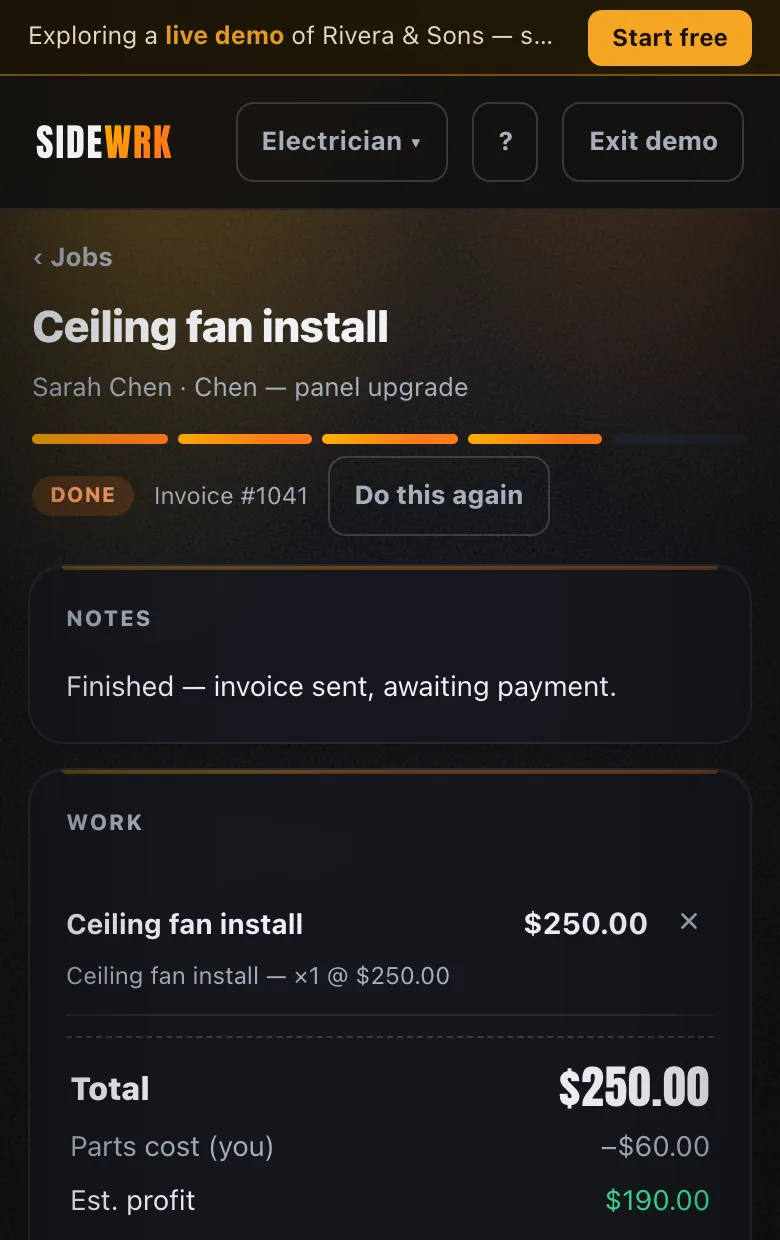
A customer-supplied fan on a new braced box. The quote itself is further down the page, after the panel upgrade.
Rough-in and final on the job, the permit number on the bill
Electrical work comes with paperwork. In most states the work also needs a licensed electrician, and a homeowner’s permit usually covers only work the owner does themselves on their own property. The invoice prints a notice that the work is performed to the locally adopted edition of the NEC.
So the paperwork is part of the job, and the app treats it that way:
- A Permit & inspections card on every job. The number, the issuing authority, and where the permit stands: needed, applied, issued, passed or closed.
- Both inspections, dated. Rough-in and final each get a pass or fail and the day it happened, so you know whether you’re waiting on the city or clear to close the wall.
- License and permit printed for you. Your license number prints on every estimate and invoice once you save it. Each job’s permit number prints on that job’s estimate and invoice.
- The permit fee at cost. Enter what you paid and it bills as its own line with no markup.
An invoice is a record of what you did. Any AFCI or GFCI protection listed on it is as you reported it. It’s not an inspection certificate, and SideWRK doesn’t decide whether a job needs a permit. Your building department does.
A panel upgrade, quoted at $2,200
100-amp panel out, 200-amp in, same location on the garage wall. The service drop and the meter are the utility’s. Everything else from the weatherhead down is yours.
| Swap the panel, land and label every circuit (hrs) | 8 × $95 | $760 |
| 200-amp main breaker panel, 40-space | $420 | |
| Standard breakers | 16 × $12 | $192 |
| AFCI and GFCI breakers | 4 × $62 | $248 |
| Meter base, service entrance cable and hub | $260 | |
| Ground rods, clamps and #4 copper | $120 | |
| Permit fee, passed through at cost | $200 | |
| Total the customer approves | $2,200 | |
| Parts cost (you), private | −$1,024 | |
| Est. profit | $1,176 |
Eight hours at $95 is $760, about a third of the ticket. The four arc-fault and ground-fault breakers cost more than the sixteen standard ones put together, which is the line customers ask about. The cost line includes the permit, passed through at the $200 the city charged in this example.
Flat-rate electrical pricing, by the device
A homeowner wants to hear "$185 an outlet," not an hourly rate and a guess. The app starts every electrician on this menu, and recessed lights bill per can, so six cans is one line with a six on it.
| Work | Starting price |
|---|---|
| Service call or diagnostic | $125 |
| Recessed light, each | $150 |
| Outlet or GFCI install | $185 |
| Ceiling fan install | $250 |
| EV charger install | $750 |
| Panel upgrade | $2,200 |
| Labor, per hour | $95/hr |
The $95 an hour is the electrician row of our 2026 Side-Work Rate Report, where 60% of a typical electrical ticket pays for time and 40% for material. A panel upgrade runs the other way, as the quote above shows.
Electrician
The panel, the pull, the cover plate going back on.
Service call. Flat price. Paid.
Every job on the menu starts from a set price, $125 for the service call up to $2,200 for a panel upgrade.
A ceiling fan install, quoted at $250
Bedroom light comes down, a fan the customer bought goes up. The old box isn’t rated to carry a fan, so it gets replaced with a braced one.
| Hang, wire and balance the fan (hrs) | 1.5 × $95 | $142.50 |
| Fan-rated box with brace | $45 | |
| Fan and light wall control | $38 | |
| Connectors, screws and hardware | $24.50 | |
| Ceiling fan, customer-supplied | $0 | |
| Total the customer approves | $250 | |
| Parts cost (you), private | −$60 | |
| Est. profit | $190 |
The fan is the customer’s, so it goes on as a part at $0. Set its condition to customer-supplied and the document says so, which matters the day the motor hums and they call you about it.
$19 a month, or $190 for the year. Five jobs a rolling year are free and need no card. SideWRK takes nothing out of what your customer pays.
Start freeWire by the foot, devices installed
From our own electrical calculator. Copper moves, so check the price the week you quote.
| Item | Typical |
|---|---|
| 14 AWG, for 15-amp lighting and outlets | about $0.75 a foot |
| 12 AWG, for 20-amp kitchen, bath and laundry | about $1 a foot |
| 10 AWG, for a 30-amp dryer, A/C or water heater | about $1.50 a foot |
| Standard outlet, installed on existing wiring | $150–$350 |
| Switch, installed | $100–$300 |
| Light fixture, installed | $150–$300 |
| New 240-volt circuit for a dryer or EV | $250–$800 |
Price a rewire or a run of circuits
Field math on the truck
Four field calculators sit under Pricing tools in the Shop tab when your trade is set to electrician: wire size, voltage drop, conduit fill and box fill. They’re there for the moment you’re standing at the panel wondering whether a run that long needs the next size up. Treat the answer as a reference and check it against the code your jurisdiction adopted. The box fill calculator also runs free in any browser.
Inspections, and what the invoice won’t certify
Where do the rough-in and final inspections go?
On the job’s Permit & inspections card. Each inspection gets a result and a date, next to the permit number and the issuing authority.
Can I bill recessed lights per can?
Yes. Recessed light is a per-each line at $150 to start. Set the quantity to six and the line reads 6 × $150.
Does the invoice certify the work is to code?
No. It records what you did, carries your license and permit numbers, and prints a notice that work is performed to the locally adopted edition of the NEC. Any AFCI or GFCI protection listed is as you reported it. An invoice isn’t an inspection certificate.
How do I handle a fixture the customer bought?
Add it at $0 and set its condition to customer-supplied. The label shows on the estimate and the invoice, and at $0 it adds nothing to your parts cost.
Are the wire size and voltage drop calculators in the app?
Yes. Wire size, voltage drop, conduit fill and box fill open from Pricing tools in Shop when your trade is electrician.