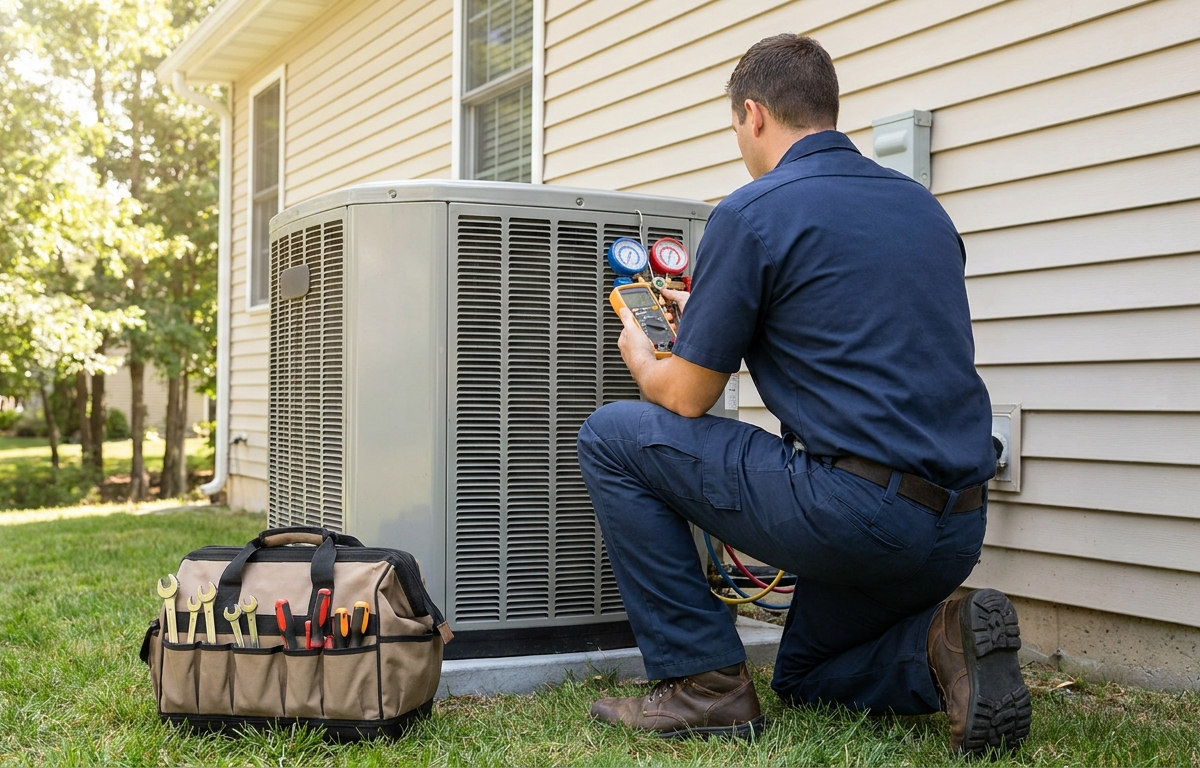
Here's a number worth memorizing: if a repair costs more than half of what a new system runs, the math has already made the call for you. That's the whole model behind most repair-or-replace decisions, and yet plenty of solo techs still either lowball a system that's clearly done or talk someone into a replacement with five good years left in it, because nobody actually did the arithmetic out loud.
Summer is when HVAC solo operators see more units than the rest of the year combined — more service calls, more diagnostics, more chances to either pad an invoice or actually help someone make a real decision. The upsell isn't a sales technique bolted onto the repair. It's the diagnosis, finished all the way through instead of stopped at "here's what's broken today."
The math that makes the call for you
Two rules of thumb do most of the work. The 50% rule: if a single repair costs more than half of full replacement, replace. The age-times-cost rule: multiply the unit's age by the repair estimate, and past roughly 5,000, replacement wins.
Now watch what happens when you run a real unit through both. Say the call is a dead 3-ton split system, twelve years old, and the diagnosis is a failed compressor. The repair — part, labor, recovery and recharge — quotes at $850. A new 3-ton system installed runs $7,800.
The 50% rule says repair: $850 is well under the $3,900 halfway line. The age-times-cost rule says replace: 12 × 850 = 10,200, double the threshold. Same unit, same numbers, opposite answers.
Here's the stance, and it's one worth arguing about: when the two rules disagree, trust age-times-cost. The 50% rule is a homeowner's rule — it only looks at today's invoice. Age-times-cost is an operator's rule, because it prices what you know from the bay: a twelve-year-old compressor didn't fail in a vacuum. The coil, the contactor, the fan motor all have twelve years on them too, and you're bolting an $850 part onto a system that's most of the way through its 15-to-20-year life. The 50% rule would still say "repair" at $3,800. Nobody who's done a callback on a unit like that believes it.
Neither number is gospel — a twelve-year-old unit with one weak capacitor is a different animal than one on its second compressor. Refrigerant type, compressor health, and remaining service life are what the rules are approximating. Run the repair and replacement numbers through a job profit calculator before you say anything out loud, so the figure you quote already accounts for your real cost, not just the sticker. That's the difference between "the tech said I needed a new unit" (sounds like an upsell) and "here's both numbers and why the math tips one way" (sounds like a professional).
What counts as a real problem — and what doesn't
The line between honest upselling and inventing work is simple: would you make the same call if this were your own house? A cracked heat exchanger, a compressor pulling double the rated amp draw, a coil so corroded it's leaking refrigerant every few weeks — those are real. A capacitor that tests fine but you'd "recommend replacing anyway just in case" is not.
Photograph everything you find. A rusted-through coil, a burnt contactor, a compressor housing with visible pitting — a picture of the actual part does more selling than any pitch you could write, and it protects you if the customer questions the call six months later. Attach the photos to the estimate itself, with a plain note: what you saw, why it matters, what happens if it's ignored.
Present it as a decision, not a verdict
Nobody wants to be told what to do with $7,800. They want options. Priced off 2026 side-work rate data — $110 service call, $150 tune-up, $220 coil and filter clean — that dead 3-ton becomes a three-tier estimate:
| Option | What's in it | The number |
|---|---|---|
| Patch | Diagnostic $110 + compressor repair $850 | $960 |
| Repair + tune-up | Patch $960 + AC tune-up $150 + coil/filter clean $220 | $1,330 |
| Replace | New 3-ton system, current efficiency standard | $7,800 |
The middle tier is the honest one for a customer who can't swing replacement this year: $1,330 buys the compressor plus a serviced coil and a documented baseline, so if the unit limps another two summers, it limps in its best possible shape — and you're the tech with the readings when it finally quits. The patch tier exists so the customer sees you're not hiding the cheap option. The replace tier exists because on this unit, the age math genuinely favors it.
Write all three into the estimate as line items the customer can check or uncheck, so the total updates as they decide — cleaner than three paper quotes, and you're not doing math on a clipboard while they watch. See what that looks like in a live demo built for HVAC work. Let the numbers do the talking.
When "this can wait" is the right answer
The fastest way to lose a customer for good is to recommend a replacement that turns out to be optional. Flip the example: same failed compressor, but the unit is seven years old. Now age-times-cost reads 7 × 850 = 5,950 — barely over the line — and both rules are effectively saying the same thing: fix the part. Say it plainly: "This isn't a system-level problem, it's a component. $960 and you're running." That sentence, from the right tech at the right moment, is worth more than a season of five-star reviews. It's why that customer calls you in three years instead of shopping around.
The techs who build a route instead of a string of one-off calls are the ones willing to say "not yet." It costs you one job today. It buys you the next ten years of that address.
Document the diagnosis, not just the fix
Every repair-or-replace conversation should leave a paper trail: what you found, what you measured (amp draw, refrigerant pressure, coil condition), what the options cost, and what the customer chose. That protects you from a callback dispute, and it's the foundation for the maintenance-plan conversation next spring — a system you already know inside out is an easier sell to keep an eye on. See how other techs turn that trust into a standing maintenance plan once the repair-or-replace call is behind them.
Run it like a business, not just a route
Every repair-or-replace call is also a documentation call: what you found, what you quoted, what the customer approved. SideWRK builds branded HVAC estimates with good-better-best line items the customer can check on their phone and approve before you're back in the truck. See how it's set up for HVAC work and start free. Five jobs a year free, no card, then $19/mo or $190/yr.
FAQ
How do I know if an AC repair is worth it or if I should recommend replacement?
Run both rules. On a 12-year-old 3-ton with an $850 compressor repair against a $7,800 replacement, the 50% rule says repair ($850 is under $3,900) but age-times-cost says replace (12 × 850 = 10,200, past the ~5,000 threshold). When they disagree, weight the age rule — it's the one that accounts for every other twelve-year-old part still on the system.
What's the difference between an honest upsell and pushing an unnecessary replacement?
An honest upsell is a problem you'd flag on your own equipment — a cracked heat exchanger, a corroded coil, a compressor pulling abnormal amperage — backed by a photo and a measurement. If you can't point to a specific failing part or a cost threshold the customer can check themselves, it's not a real recommendation, it's a guess dressed up as one.
What should the three tiers on a repair-or-replace estimate look like?
For a dead 3-ton compressor: a $960 patch (the $110 diagnostic plus the $850 repair), a $1,330 middle tier that adds a $150 tune-up and a $220 coil and filter clean, and the $7,800 replacement. The middle tier is usually the honest pick for a customer buying time; the other two exist so the decision is theirs, made with all three numbers visible.
Should I offer financing or payment options for a system replacement?
Presenting all three tiers side by side lets the customer weigh the real gap between $1,330 and $7,800 instead of feeling boxed in, and letting them pay by card on the spot — with a pay-over-time option through a financing partner at checkout — removes the "let me think about it and call three more companies" delay.
What should I put on the estimate when I recommend replacement instead of repair?
The diagnostic readings that led to the call (amp draw, refrigerant pressure, photos of visible damage), the repair number, the replacement number, and one plain sentence on why the math favors one — "$850 on a 12-year-old system scores 10,200 on the age test; past 5,000, repair money is usually throwaway money." That record turns "the tech said so" into a decision the customer made with the facts in front of them.