Say you quote a 150-foot wood privacy fence off a per-foot number you found on a homeowner cost site. Looks clean on paper. Then you hit a run of buried roots on the back property line, the customer wants a walk gate with a self-closing hinge you didn't price, and the permit office wants a survey before they'll sign off. Three weeks later you've made less on that job than you would have flipping burgers, and you still have to warranty the gate.
That's the problem with the fence pricing numbers that show up when you search "cost per linear foot." They're built for homeowners comparing bids, not for you building one. They average out all the stuff that actually eats your margin. And here's the part nobody says out loud: a borrowed per-foot rate is an underbid by design. Every hard condition on your specific site subtracts from your pay, and nothing ever adds to it.
What the per-foot number is actually made of
Nationally, installed fence runs somewhere between $20 and $60 a linear foot depending on material, and that range is wide for a reason.
| Material | Typical installed cost/ft | What drives the spread |
|---|---|---|
| Chain link | $32–$71 | Height, gauge, gate count, coating |
| Wood (pine to cedar) | $10–$45 | Species, picket style, post spacing |
| Vinyl | $30–$60 | Panel style, wind rating, color |
Inside every one of those ranges, labor typically runs $10–$35 per foot on its own, and it swings by fence type: chain link is fastest to hang and sits near the bottom, wrought iron and custom wood are slowest and sit at the top. Materials — posts, rails, pickets or mesh, concrete, hardware — usually land right around half the total, with the rest split between labor, overhead, and your margin.
The number you find online is an average across a thousand jobs with different dirt, different access, and different gate counts. Your job isn't average.
The four things the calculators skip
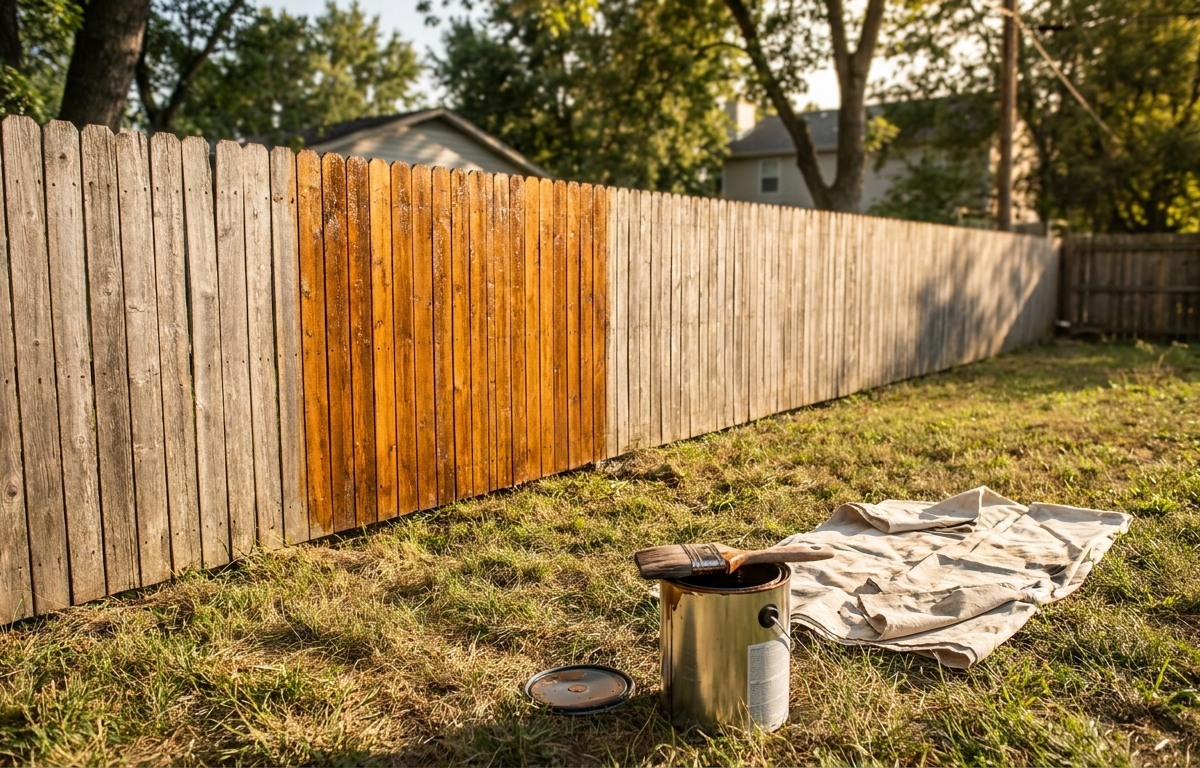
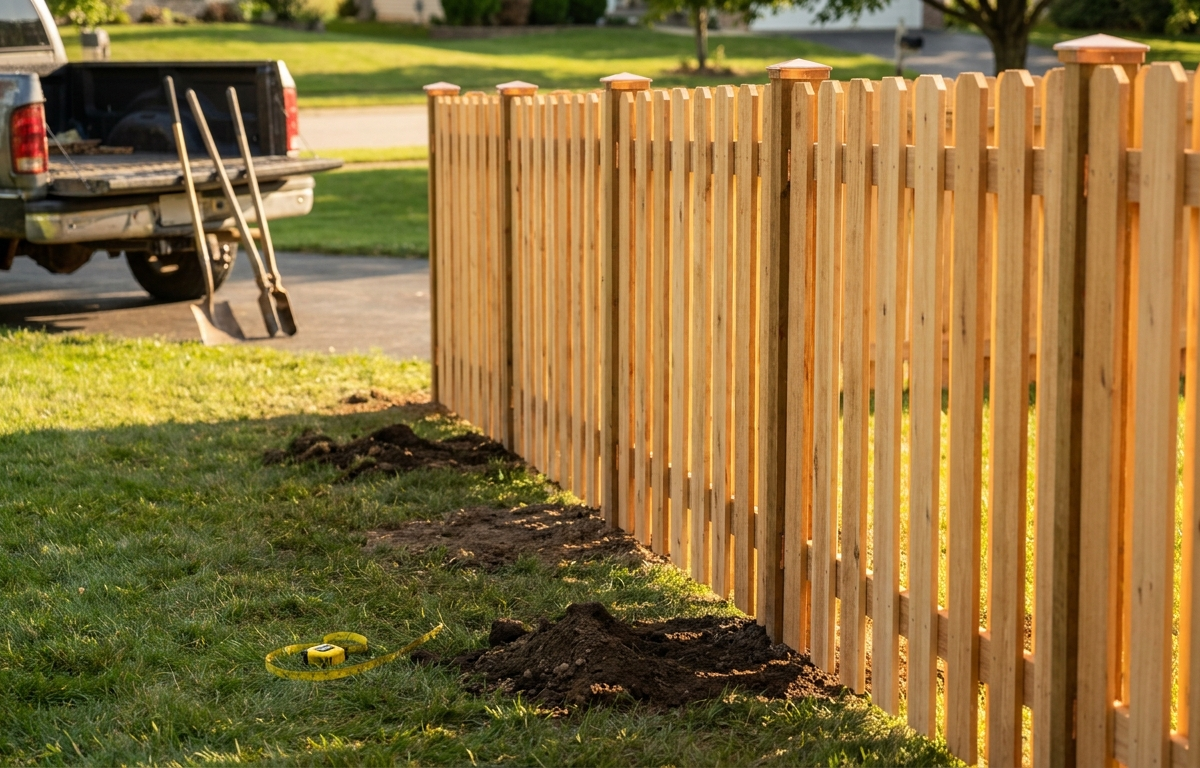
Ground conditions. Rock, roots, caliche, high water table — any of it turns a post hole from a 10-minute auger job into a 45-minute fight with a digging bar. If you haven't walked the line and probed a few post locations before you quote, you're guessing.
Gates. A walk gate with basic hardware and a drive gate with a self-closing, self-latching hinge kit are not the same line item, and homeowners with pools or small kids will ask for code-compliant hardware. Price gates separately, by the piece, not folded into a blended per-foot rate.
Permits and surveys. Some jurisdictions want a permit for anything over 4 feet, some want a boundary survey near a property line, and a few require both. Find out before you bid, and if the customer needs a survey, that's their cost, not a surprise you eat.
Waste and remeasure. Add 10–15% to your material take-off for cuts, bad boards, and the post that snaps when you're tamping it in. Then remeasure the perimeter yourself before you order — a tape-measured guess from the truck window is how a "200 foot job" turns into 230 feet of material you didn't price.
Build your own rate instead of borrowing one
Work it in this order every time:
- Material cost. Linear footage times cost per foot for that fence type, plus posts, concrete, and hardware, plus your waste percentage. Add your material markup on top — 25–35% is normal in the trade, higher on anything you have to special-order.
- Labor cost. Crew size times hourly rate times hours on site. A two-person crew runs roughly 4–6 hours per 100 feet on a straightforward wood fence; rock, slope, and gate count all add hours. Price your own hours the same as a helper's — your time on a shovel is not free just because you own the truck.
- Overhead. Insurance, fuel, tool wear, the trailer payment, the software you run your business on — all of it gets divided across your jobs somehow. A flat 20–30% of material-plus-labor is a workable starting number until you've run your own.
- Margin. Add profit on top of all of the above, not folded into it. Residential work typically supports 25–35%, custom iron or anything with a design component more like 35–45%.
Run material, labor, and overhead through the fence installation cost calculator before you send a bid — it'll show you where a job sits against typical ranges before you commit. And if you're not sure a specific job clears your bar after all four steps, run it through is this job worth it before you say yes.
That 150-foot fence, priced for real
Take the privacy fence from the top of this article and put actual dollars through those four steps.
- Materials. Cedar pickets, rails, 19 posts on 8-foot centers, concrete, and hardware run about $13 a foot: $1,950. Add 12% waste and you're at $2,180. Marked up 25%, the materials line reads $2,725.
- Labor. Two of you, a day and a half on site — 24 man-hours at $40 is $960.
- Overhead. 25% of material cost plus labor ($2,180 + $960) adds $785.
- Margin. 25% on top of $2,725 + $960 + $785 brings the fence run to $5,590. Call it $5,600 — a hair over $37 a foot.
- The walk gate, self-closing hardware and all, goes on its own line: $400.
Bid: $6,000.
Now check it against the 2026 side-work rate data: a wood privacy install runs $35 a linear foot — $3,200 on a typical 91-foot backyard run — with a gate at $400, post replacement at $50 a post, and stain-and-seal at $5 a foot. Landing at $37 on a 150-footer with a gate and a rooty back line is right: near the market, above it for reasons you can point to. Landing at $22 because a homeowner site said so is the flipping-burgers job from the opener.
Where fence guys actually leave money on the table
Most of the margin loss isn't in the per-foot rate. It's in three habits:
Quoting off a walk-through, not a plan. A five-minute walk and a guess at footage is how rock, slope, and a hidden gate get missed. Fifteen extra minutes with a tape and a notepad pays for itself the first time it catches a problem.
Treating gates and hardware as an afterthought. Upgraded hinges, a keyed lock, post caps, or a stain-and-seal package are all things a customer will say yes to if you show them, not bury them in the base bid. That's the honest upsell — you found something they'd actually want, you priced it separately, and you let them choose.
No change-order habit. If you hit rock nobody could see, or the property line survey moves the fence ten feet, that's a change to the job, not something you eat to keep the peace. Photograph it, price it, get the customer's approval before you keep digging. A branded change order sent from your phone looks like a professional handling a normal part of the job — a text saying "hey, gonna need more" looks like you're padding the bill.
Put the number where it can't get lost
However you land on your rate, the job isn't priced until it's written down somewhere the customer can see and approve — material breakdown, labor, gates as separate line items, and anything contingent on ground conditions spelled out up front. A clean, itemized estimate answers "why does this cost so much" before it's asked; a number scribbled on the tailgate doesn't.
Fence work pairs naturally with other outdoor trades that touch the same yards — landscapers who need a fence before they finish a design, tree crews clearing a line before install day. See how landscaping pricing breaks down real cost the same way, or how a tree service turns one call into a recurring customer on the same street you're already fencing.
Ready to stop rebuilding this math from scratch on every bid? Start your free 14-day trial — no card and let SideWRK turn your pricing into an estimate the customer approves from their phone — gates, materials, and labor itemized, change orders built in, and a Money tab that shows your real profit on every job, not just what you invoiced.
FAQ
How much does it cost to install a fence per linear foot?
Installed fence typically runs $10-$45/ft for wood, $30-$60/ft for vinyl, and $32-$71/ft for chain link; current side-work rate data puts a wood privacy install at $35/ft — about $3,200 for a typical 91-foot run. Those averages don't account for your specific site's ground conditions, gate count, or access, so build your own number from cost up and treat the average as a sanity check.
Why did my fence job cost more than I quoted?
The four things generic per-foot calculators miss are ground conditions (rock or roots that turn a 10-minute post hole into a 45-minute fight), gates with upgraded hardware, permits or surveys the jurisdiction requires, and material waste from cuts and bad boards. Walking the line and probing post locations before you quote catches most of these before they become a change order.
Should gates be priced separately from the fence?
Yes — a basic walk gate and a drive gate with self-closing, self-latching hardware are very different jobs, and folding them into a blended per-foot rate almost always underprices them. A standard walk gate is around a $400 line item on its own; price gates by the piece so the customer sees exactly what they're paying for.
What margin should I build into a fence installation quote?
Residential fence work typically supports a 25-35% margin on top of material, labor, and overhead costs; custom iron or design-heavy work can support 35-45%. Add your margin on top of the full cost stack rather than folding it in, so you can see it clearly on every job.