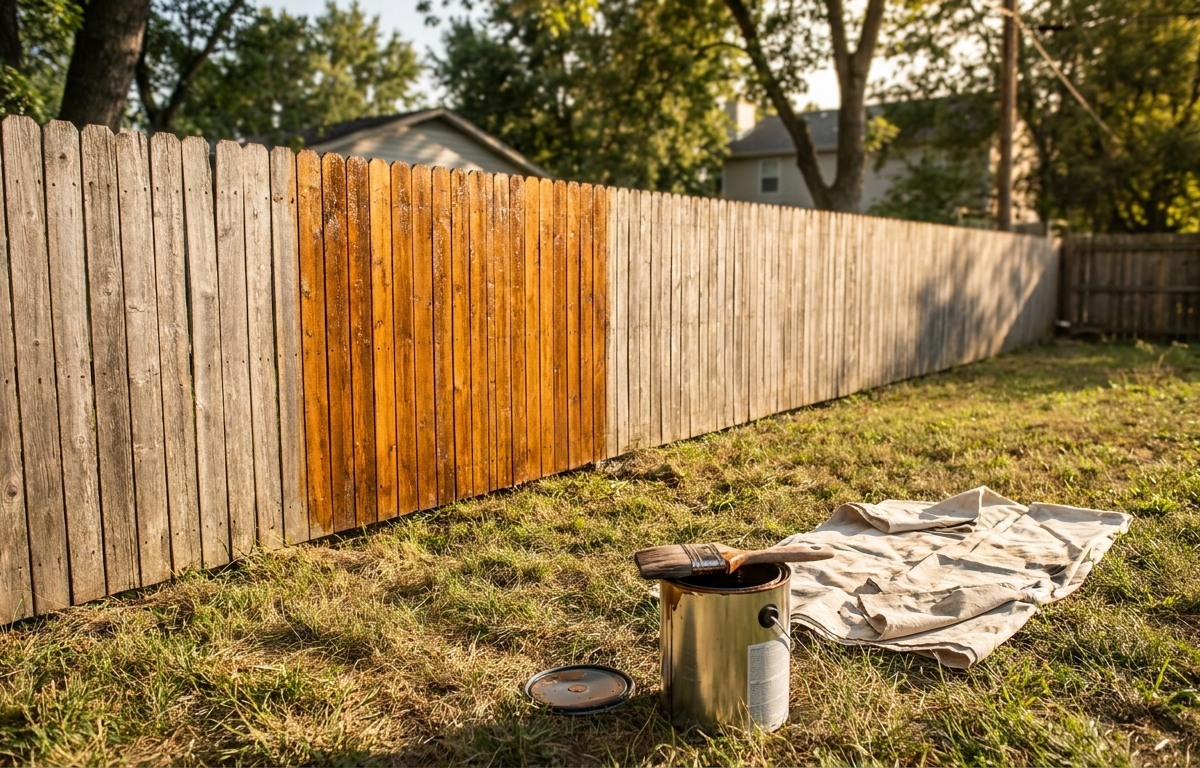
A wood fence with no coat on it grays inside one summer and starts rotting at the post line within three years. That clock is the whole business case for a service most fence builders treat as an afterthought: the stain job is the second sale sitting inside every install you finish, and it pays better per hour than the install did.
Run the numbers on a typical build. A 91-foot fence at $35 a linear foot is a $3,200 ticket — and roughly half of that ticket is lumber, concrete, and hardware before you've made a dime. The stain job on that same fence carries a couple pails of product and a sprayer. Almost everything on that invoice is yours. And unlike the install, it comes back around every three to four years for as long as the fence stands.
Most builders pour the posts, hang the panels, collect the final payment, and drive off. The ones making real money off a single fence say one more thing before they leave: this needs a coat, here's when, and here's what it costs. Everybody else is handing a repeating job to whoever the homeowner finds on a search in three years.
The fence you just built is already your next job
A fresh install is the easiest stain pitch you will ever make. The customer already trusts you. You're standing in their yard, the wood is still raw, and you can point at the exact boards that'll silver by August without protection. You're not cold-calling a stranger about fence maintenance — you're finishing a conversation you already started.
This is a wood-fence play, full stop. Vinyl, composite, and chain link don't take a coat. But if you build wood at all, staining shouldn't be a separate business you never got around to starting. Same customer, same driveway, a fraction of the install's hours, and no lumber bill eating the ticket.
Bill the foot you walk, not the square foot of board
Here's where a lot of fence outfits quote themselves out of the job before they start: they price stain work by the square foot, like it's a driveway. The customer didn't buy 900 square feet of board. They bought 150 feet of fence. That's the number in their head, and it's the number your stain quote should ride on.
Quote by the linear foot. Per 2026 side-work rate data, fence stain and seal work runs $5 a linear foot per face as a working default — a 180-foot fence line, one face, is a $900 job. Nobody argues with a linear foot. They can walk the line with you and count it. Hand that same customer a square-foot quote and now you're both doing height math on a fence with a rot board and a lattice top, and the quote conversation turns into an audit.
Keep the square foot as your own sanity check, not the customer's price. A 6-foot fence carries 6 square feet of board per linear foot, so $5 a foot per face works out to about 83 cents a square foot — run that check in your head on a tall fence or a short one, then quote the line, not the math.
Two rules that go with the unit:
- Each face is its own line. Both sides means two passes, twice the product, twice the price. Say it before you quote, not after — "street face, yard face, or both?" is a ten-second question that doubles the ticket.
- Prep gets its own line too. Raw wood that's never been coated sprays fast. A fence somebody coated once in 2019 and forgot needs stripping, and that time goes on the invoice where the customer can see it — not folded into the per-foot price where it disappears and quietly turns your stain rate into a stripping rate.
A 150-foot cedar fence, priced line by line
Take a 150-foot cedar privacy fence, 6 feet tall, one year after install, customer wants both faces done. During the prep walk you find two posts gone soft at the grade line — cedar boards outlast bad drainage every time. The invoice:
| Line | Math | Price |
|---|---|---|
| Stain & seal — street face | 150 lin ft × $5 | $750 |
| Stain & seal — yard face | 150 lin ft × $5 | $750 |
| Post replacement × 2 | 2 × $50 | $100 |
| Total | $1,600 |
That's $1,600 on a fence you already built, sold in the same yard where you got paid the first time. The post swap is the part most guys miss: prep is when you find the soft posts, the popped rails, the gate that dropped a half inch — each one a real line at a real price, caught with tools already on the truck. If the deck's gray while you're back there, a deck stain and seal runs $800 flat, and one return visit becomes a $2,400 day.
Then the fence goes back on the clock. Cedar wants a fresh coat every three to four years. Same fence, same $1,500 in stain work, next cycle — booked by you, or booked by whoever the customer finds when they finally notice it's gray.
What needs a coat, and when
The pitch changes with the wood, so know the clock you're selling against:
| Wood | First coat | Reseal |
|---|---|---|
| Pressure-treated pine | 60–90 days after install, once it dries | Every 2–3 years |
| Cedar | Inside the first year | Every 3–4 years |
| Redwood | Inside the first year | Every 4–5 years |
The honest version of the pressure-treated pitch matters. New PT lumber is wet, and stain won't hold on wet wood — coat it the week you build it and you're booking your own callback. So tell the customer the real timeline at the walkthrough: "this needs to dry until about October, I'll put you on the schedule now." An honest constraint just became a booked job.
On product, give them a real choice instead of picking for them. Clear sealer is the cheap, fast, function-only option. Semi-transparent is where most homeowners land — color plus visible grain, on the shorter end of the reseal window because UV eats it faster. Solid-color lasts longest and hides patched or mismatched boards, which makes it the right pitch on a fence that's already been repaired.
Turning one coat into a route
A single stain job is fine money. A route of them is the better business. Every coat you sell is a dated event with a known interval — note the wood and the coat date, set a reminder for the low end of the reseal window, reach out a month before it's due. That's a job you generated, not one you're bidding against three other trucks for.
Cluster them and the math gets better again. Three fences on one street beat three fences scattered across town — same logic that makes a mowing route profitable makes a stain route profitable, and fences come with the interval built in.
The tool for this is the invoice itself. Put the wood type, the product, and the coat date on the document the customer keeps, not just in your notes. Three years from now, when they wonder whether it's time, the answer is sitting in their email with your name on it. SideWRK keeps that history pinned to the customer so the reminder fires whether you remember or not, and the fence installation cost calculator will price the next build while you're at it. Want to see the whole loop — quote, invoice, reminder — run it in the live demo.
Ready to stop losing the reseal to whoever shows up next? Start free and put every fence you've built on a schedule that brings you back. Five jobs a year free, no card, then $19/mo or $190/yr.
FAQ
How much does it cost to stain or seal a fence?
Working from 2026 side-work rate data, fence stain and seal runs about $5 per linear foot per face — a 180-foot fence line, one face, is a $900 job, and both faces doubles it. Heavy prep, like stripping an old peeling coat, belongs on its own line on top.
Should fence staining be priced by the square foot or the linear foot?
Quote the linear foot. The customer thinks of their fence as 150 feet, not 900 square feet, and a linear-foot price is one they can walk off themselves. Keep square footage as a private sanity check on unusually tall or short fences — $5 a foot per face on a 6-foot fence comes out near 83 cents a square foot.
How soon can a new wood fence be stained?
Cedar and redwood can take a first coat inside the first year. Pressure-treated pine has to dry out first — usually 60 to 90 days after install — or the coat fails and peels. Coating wet PT lumber the same week it goes up is one of the most common reasons a stain job turns into a callback.
How often does a fence need to be resealed?
Pressure-treated pine wants a fresh coat every 2 to 3 years, cedar every 3 to 4, redwood every 4 to 5 — sun and weather shorten all of those. Putting the wood type and coat date on the invoice means the reseal reminder points back at you instead of relying on the customer to notice the gray.
Is fence staining worth offering as a fence builder?
It's the best margin in the trade. An install ticket is roughly half materials before you profit; a stain job's product cost is a couple of pails, and it repeats on a 2-to-5-year cycle for the life of the fence. Pitch it at the final walkthrough, standing next to work the customer just paid for.