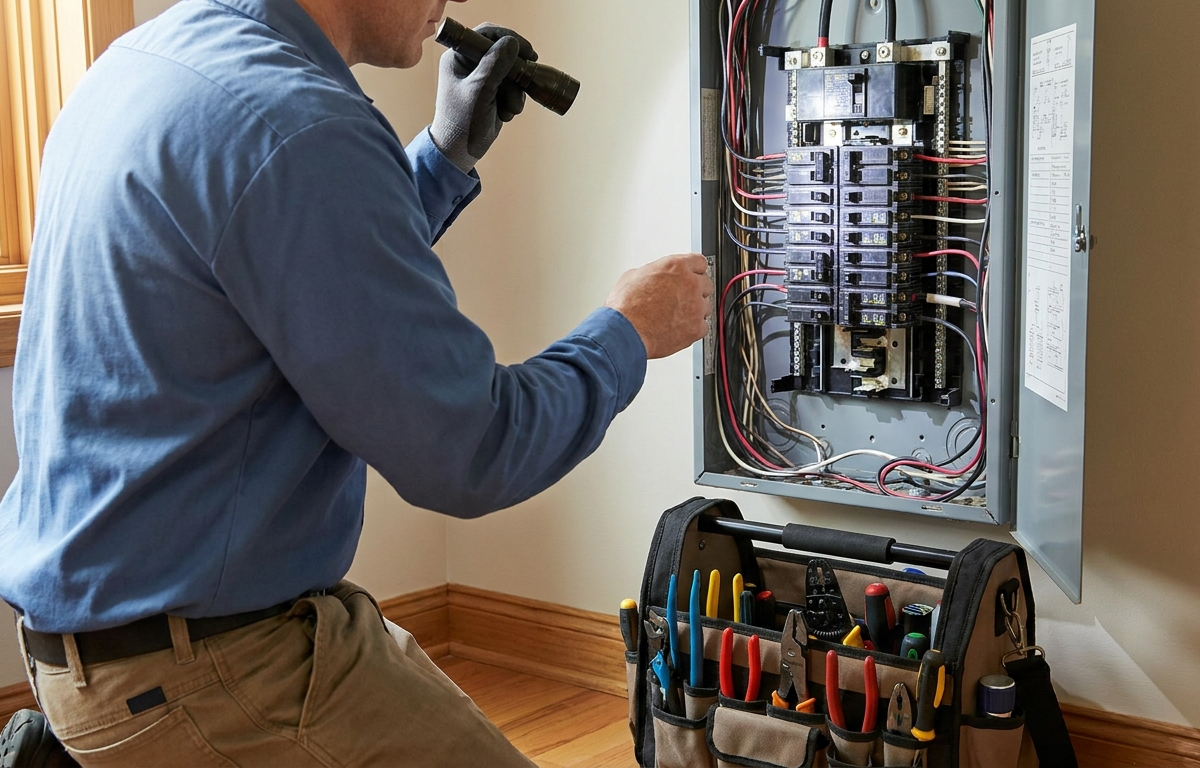
You're there for a tripped breaker. You reset it, the circuit holds, you pack up. But on the way to the truck you clocked it: the panel is a Federal Pacific Stab-Lok, a brand tied to house fires for forty years. You said nothing. Too awkward. Not what they called you for.
Six months later they have an electrical fire. Or they don't — and the next electrician they call mentions the panel, quotes the upgrade at $2,200, and picks up referrals from every neighbor who hears the story.
Here's the stance this whole article rests on: the silent electrician costs the customer more than the pushy one ever could. Skipping the walk-around isn't politeness. It's leaving someone in a house with a problem you were trained to see and they weren't. Honest upselling is just doing the whole job — looking at the whole picture while you're already standing in it, and saying what you genuinely see.
Here's the system, and then what it's worth across a year.
The two-minute walk-around
Before you pull a tool, spend two minutes looking. Six things to check every time:
Panel age and brand. Federal Pacific and Zinsco you need to know cold — documented failure rates, flagged on every home inspection. Any panel past 30–40 years deserves a mention regardless of brand. Full with no open slots? Write that down too.
Aluminum branch wiring. Installed heavily from about 1965 to 1973. It loosens at connections over time. Not an alarm bell by itself, but the fix — proper connectors or pig-tailing — is legitimate billable work.
Missing GFCI protection. Bathrooms, kitchens, garages, exterior outlets. Code issue and shock hazard both. At $185 installed, it's the fastest yes in residential work once you explain why it exists.
Two-prong outlets. Ungrounded receptacles in pre-1960s homes. Customers didn't know this was fixable work they could ask for.
EV charger potential. Two-car garage, no 240V. One question — "do you have an EV, or thinking about one?" — and nothing more. A Level 2 charger install runs $750.
The panel's future. Nearly full, aging, or undersized for what the house is becoming. The upgrade is a $2,200 job when its day comes, and its day comes more often than you'd think.
You fix nothing extra today. You're not converting a $125 service call into a hard sell. You're keeping your eyes open and your notes honest.
Three questions before you say anything
Not every observation belongs in the conversation.
Is it a safety hazard? Then you say it, every time, plainly: "I want to flag something I noticed in the panel." Staying quiet about a Stab-Lok isn't tact. It's negligence with a friendly face.
Is it a code violation? Worth raising if they're selling, renovating, or pulling permits — an inspector will find it anyway, and better they hear it first from someone they already trust.
Is it a value-add with no safety angle? One mention, no pressure: "While I'm here — that garage has no 240V. If an EV ever shows up in the driveway, that install runs about $750. Just putting it on your radar." Then drop it. People who feel informed call back. People who feel sold to don't.
What the walk-around is worth in a year
This is the math that turns a habit into a raise. Say you run 50 service calls a year on the side — at the $125 service call rate where residential work sits in the 2026 side-work rate data, that's $6,250 of base revenue. Now run every one of those calls through the walk-around, with honest attach rates:
| Add-on | Attach rate | Jobs | Price | Revenue |
|---|---|---|---|---|
| GFCI installs | 1 in 5 calls | 10 | $185 | $1,850 |
| EV charger installs | 1 in 12 calls | 4 | $750 | $3,000 |
| Panel upgrades | 2 close per year | 2 | $2,200 | $4,400 |
| Ceiling fan / small installs | 3 per year | 3 | $250 | $750 |
| Add-on total | $10,000 |
Same 50 doorbells. Same customers. $16,250 instead of $6,250 — the walk-around more than doubles the year, and not one of those line items required pushing anything. The GFCIs were code gaps. The chargers were a question. The panels were flagged months before they closed. Recessed lighting jobs at $600 show up the same way once customers learn you're the one who notices things.
Those attach rates aren't a promise; they're a planning number. Cut them in half and the habit still adds $5,000 to a side business for two minutes per call.
What it looks like on one call
Say the call is flickering bathroom lights. You show up, find a dying fluorescent fixture, and sort it. Then the walk-around pays out in the same visit:
| Line | Amount |
|---|---|
| Service call / diagnostic | $125 |
| GFCI install — bathroom | $185 |
| GFCI install — exterior outlet | $185 |
| Ticket total | $495 |
The GFCIs weren't a pitch. The bathroom had none, you said so, you quoted $185 each, and the homeowner said yes to both because the reason was real. The mid-1980s panel in the hallway got one calm sentence — "nearly full, nothing urgent, but if you ever add something big, that's a $2,200 project, so plan for it" — and a line in your notes.
The follow-up that compounds
After every call, spend 60 seconds writing down what you saw but didn't touch. The 25-year-old panel. The garage with no 240V. The kitchen running eight outlets off one GFCI.
Set a reminder for six months out. When it fires: "Hey — I was out for your outlets in March and flagged that the panel's getting up there. I've got some availability in the next few weeks if you want me to take a look." Some won't answer. Some will, and you're not cold-calling strangers — you're following up with someone who already let you into their house. Four months after the flickering-lights call, that homeowner's kid buys an EV, and the $750 charger install goes to the electrician whose note said "garage, no 240V." That's the whole system: walk around, ask the three questions, say what's real, write it down, follow up.
Running your own electrical side business? SideWRK tracks the job, the customer history, and those follow-up notes from your phone — start free. Five jobs a year free, no card, then $19/mo or $190/yr. More for the trade at /electrician.
FAQ
How do I upsell electrical work without being pushy?
Only mention what you genuinely found, and sort it first: safety hazards get said every time, code issues get raised when they're selling or renovating, and nice-to-haves get exactly one pressure-free mention with a real price attached — "an EV charger install runs about $750" — then you drop it.
What are the highest-converting electrical add-ons?
GFCI installs at $185 close most often because the code-and-safety reason is concrete, EV charger installs at $750 close on a single question when there's a two-car garage with no 240V, and panel upgrades at $2,200 close months later off a calm flag and a follow-up note.
How much extra revenue can a walk-around add per year?
On 50 service calls at $125, honest attach rates — ten GFCIs, four EV chargers, two panel upgrades, three small installs — add about $10,000 on top of the $6,250 base. Even at half those rates, two minutes per call is worth around $5,000 a year.
Which electrical panels should I always flag?
Federal Pacific Stab-Lok and Zinsco, both with documented failure histories that home inspectors flag on sight. Beyond those two, mention any panel past 30–40 years old or one that's full with no open slots — that's the $2,200 upgrade conversation, and it should start long before the panel forces it.
Should electricians charge flat-rate or hourly?
Run a hybrid: flat rate for repeatable jobs — $185 outlet installs, $250 fan installs, $750 EV chargers — and hourly at your shop rate plus a service call for diagnostics or anything with unknown scope. The five-call week above bills $1,910 on the menu against $1,549 on the clock for a fast electrician.
Does flat-rate pricing cost me money on jobs that run long?
Sometimes, on purpose — that is the risk the premium pays for. In the worked week the six-can recessed job billed $20 less flat than hourly. If one job type loses consistently, that is data: raise its rate or move it back to the clock.
The Walk-Around Only Pays If It Lands on Paper
Everything above runs on your eyes and a 60-second note. Two more pieces make the system stick: an estimate that makes the offer for you, and the field math that keeps a quoted number from biting you later.
Let the Estimate Do the One Mention
The one-mention rule works even better in writing. Put what you found on the estimate as optional lines — the bathroom GFCI at $185, the exterior outlet at $185 — and let the homeowner check or uncheck each one on the approval page while the total updates. You said your calm sentence in the hallway. The estimate repeats it without you standing there, and a checkbox can't be pushy. The base repair gets approved and signed from their phone either way, which is exactly what an itemized estimate is for: the job they called about, the work you flagged, each piece priced, none of it forced.
When the panel upgrade finally closes, give the permit its own line instead of folding it into the $2,200. A visible permit line tells the customer the job is being done right, and it stops a real cost from quietly eating the margin.
Write Down the "No," Too
Some flags get declined. The homeowner hears Stab-Lok, nods, and says not this year. Their house, their call — but put one plain line in your notes: what you flagged, the date, and that they passed for now. If that panel ever does fail, you have the record that you said something. And six months out, the same line is your follow-up script. You're not trying to remember the house; you're reading your own note back. A short disclosure note on the document itself does the same job in front of the customer: honest, dated, and in writing.
Run the Field Math Before the Number Leaves Your Mouth
The $750 charger price assumes a sane install. A detached garage at the end of a long run is a different job than a wall shared with the panel — run length can push the conductor size up, and a wrong guess either eats your margin or fails inspection. Four free calculators, built for exactly this, run from your phone in the driveway:
- Wire size calculator sizes the conductor for the circuit you're actually planning
- Voltage drop calculator is the long-run check that decides whether that size holds
- Conduit fill calculator tells you how many conductors that raceway takes
- Box fill calculator settles whether the existing box has room for what you're adding
Two minutes of math in the driveway beats calling on Tuesday to re-quote. And a customer watching you check numbers before you name a price hears the same thing the walk-around says: this one doesn't guess.
Price the Found Work Off a Menu, Not the Clock
The walk-around finds the work. How you bill it decides what it pays.
So move the repeatable jobs — the GFCIs, the fans, the chargers — onto a flat-rate menu, because hourly billing is a tax on being good at your job. A slower electrician on a bad day bills more than a sharp one who fixes the same fault in a third of the time. The customer with the best tradesman gets the smallest bill.
Bill a realistic five-call week both ways and the gap shows up in one line. Hourly at $95 with materials at cost: a 30-minute GFCI install is $70, an hour on a ceiling fan is $155, three and a half hours on an EV charger is $633, four hours on six recessed cans is $620, and a 45-minute dead-circuit diagnostic is $71 — $1,549 for about ten hours. The same five calls on a menu — $185, $250, $750, $600, and a $125 service call — bill $1,910. That is $361 a week, roughly $1,400 a month, purely because flat rate stops handing your speed to the customer as a discount.
Read the recessed-lighting line before you flat-rate everything, though: hourly beat the menu there, $620 against $600, because six cans is slow methodical ceiling work. That is not a flaw in the model, it is the model telling you which jobs belong on the menu and which still deserve the clock. The working menu behind that week: service call and diagnostic $125, outlet or GFCI install $185, ceiling fan on existing wiring $250, recessed lighting per room $600, EV charger $750, panel upgrade $2,200. Materials live inside those numbers — figure roughly 40% of a ticket on the bigger installs — and you track your real time on the next twenty of each before you lock any of them in. If a "standard" outlet swap keeps running forty-five minutes instead of twenty, the rate moves up, not your patience.
The $125 service call is not padding, it is the cost of showing up — drive time, fuel, and the fact that finding out why an outlet is dead sometimes takes longer than the fix. Charge it for the visit and the diagnosis, then roll it into the invoice once the customer approves the repair, and say the whole thing on the booking call in one breath: "$125 for the visit and the diagnosis, and if you go ahead with the repair that comes off the bill." A homeowner who hears the second half before hanging up is deciding whether to book you; one who hears it holding the invoice is deciding whether they got played.
And flat rate does not replace judgment. An intermittent fault, a panel someone else has already "fixed" twice, aluminium branch wiring — that is hourly or a not-to-exceed estimate, not a guess dressed up as a firm number. Most electricians who switch run the hybrid: the menu for repeatable work, $95 an hour plus the service call for anything that starts with "I'm not sure what's wrong." Say which one applies before you start, not after.
The electrician pricing playbook puts the going rates, the price drivers, and what belongs on the record in one place, and the live demo shows the estimate-to-paid flow running on a seeded electrical business, no signup.
Send the Note When You're Already Going to Be Nearby
The six-month reminder tells you it's time. It doesn't tell you which day, and on a side business the day matters more than the month.
Send it the week you're already booked on that street. "I'm over on Elm Thursday" turns a follow-up into an easy yes, because you're not asking a homeowner to schedule around you — you're offering a slot that costs you no extra windshield time. When you work Saturdays around a day job, two houses on one street beats crossing town twice for the same two tickets, and the second one is nearly free.
So the note has two triggers, not one: the calendar says the flag is ripe, and the schedule says you'll be close. When both line up, that's the text. If the panel flag comes due in a month you're never over there, it keeps — the flag doesn't expire.