Say you're pricing every job at $45 an hour because that feels fair. Gas, a jug of surfactant, maybe a nozzle tip once a season — call it $30 an hour in costs, so $45 looks like solid profit. It isn't, and the gap between what an hour feels like it costs and what it actually costs is where most pressure washing pricing quietly dies.
Here's the blunt version up front: $45 an hour in this trade isn't a price, it's a donation. If you can't itemize your loaded hour to the dollar, you're the cheapest operator in town and you don't know it yet.
The $68 hour, built line by line
The number most solo operators should be pricing against is about $68 per billable hour, and it's worth showing exactly where that comes from, because every line is a cost you're already paying whether or not you've ever written it down. Assume a solo rig billing around 60 hours a month:
- Fuel, surfactant, sodium hypochlorite, wear tips: $30 — the part everyone already counts
- Insurance — liability, equipment, commercial auto, about $600 a month spread over those 60 hours: $10
- Machine, pump, and trailer depreciation — a $12,000 rig against a roughly 1,500-hour pump life: $8
- Drive time — call it 25 unpaid minutes between jobs, spread across the billable hour: $9
- Quote time that never books — two of three walk-and-measure trips don't turn into work: $7
- The leftovers — bookkeeping, callbacks, the re-treat you did free: $4
Total: $68. Not a vibe, a stack of line items. The $45-an-hour operator isn't earning $15 an hour — he's paying his customers $23 an hour for the privilege of staying busy. Change any line to match your operation, but do the addition. The number you get is the floor under every quote you write.
What jobs actually charge, by surface
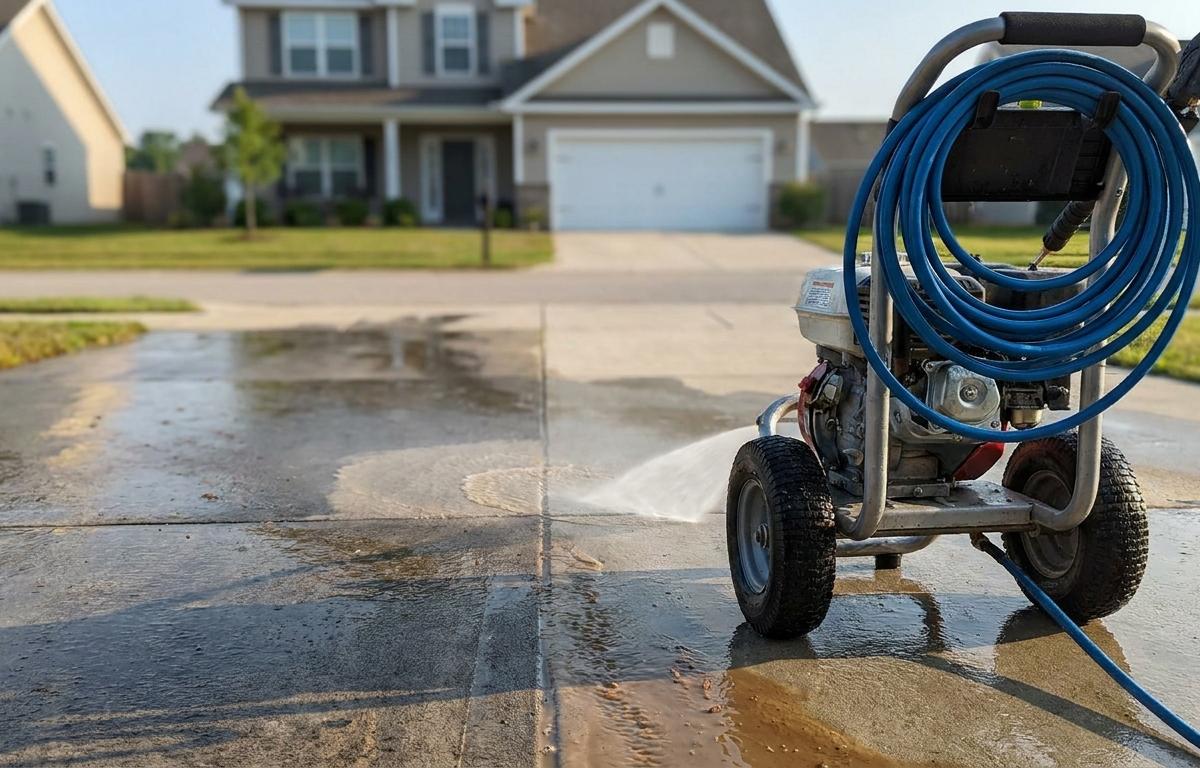
Pricing by the surface is the trade norm, and per 2026 side-work rate data the base rate for hard-surface work runs $0.30 per square foot, with the common jobs landing here:
| Job | Typical total |
|---|---|
| Driveway / concrete wash (600 sq ft at $0.30) | $180 |
| Deck / patio cleaning | $250 |
| House soft-wash | $350 |
| Roof soft-wash | $450 |
| Fleet / equipment wash | $400 |
| Rust / graffiti removal | $300 |
Notice what the $68 floor does to these numbers. A $180 driveway that takes an hour and a half of loaded time costs you about $102 to deliver — fine, that's real profit. The same driveway quoted at $100 "because it's small" is a coin flip against your own cost. The menu only works if the floor is under it.
The worked job: one driveway, dollar by dollar
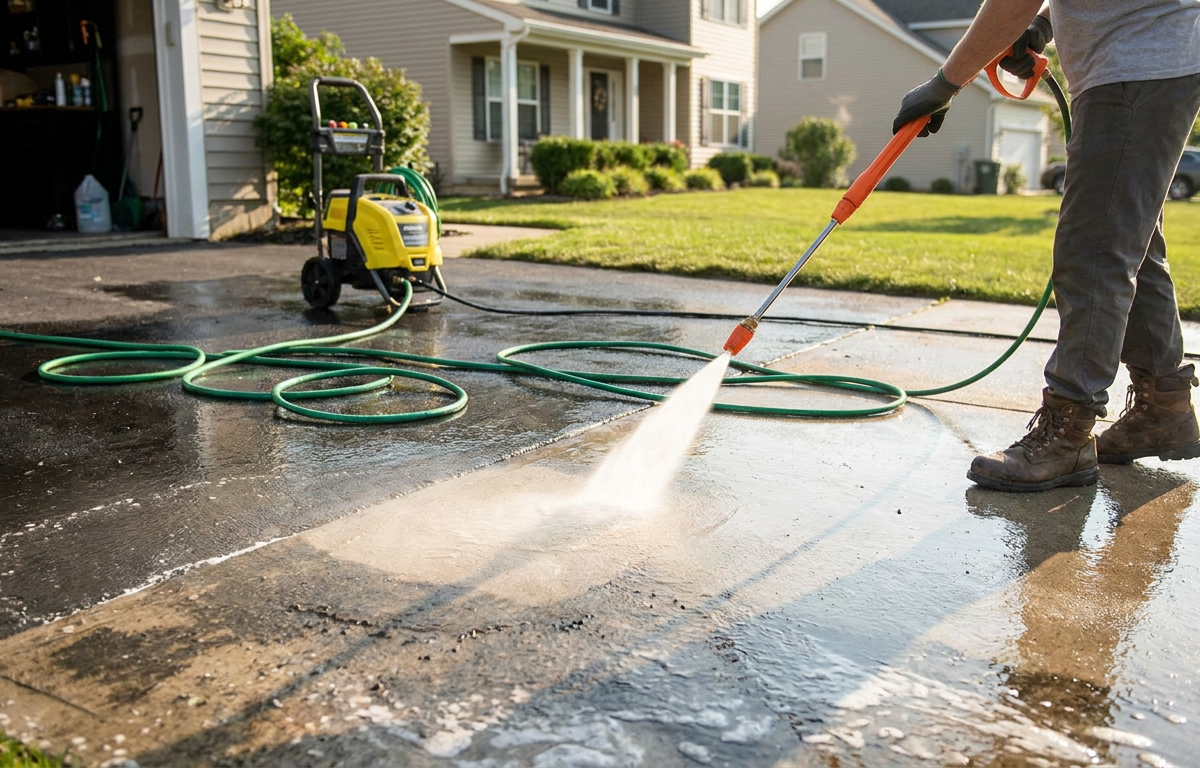
Take a hypothetical 900-square-foot driveway and walkway with a couple of oil patches by the garage:
- Surface wash — 900 sq ft × $0.30: $270
- Oil-spot pass — degreaser, dwell, second hit on the stained area: $40
Quote: $310.
Now the delivery side. Two hours on site, half an hour of drive — 2.5 loaded hours at $68 is $170 of true cost. You keep $140, and you know it's really $140, not "profit" with your insurance bill hiding inside it. That's the whole discipline of this trade in one job: quote by the surface, check it against the loaded hour, and never let the two lose sight of each other.
Why soft washing costs more than a driveway job
Soft washing — low pressure, chemical-based, for roofs and siding you'd otherwise strip — runs meaningfully above hard-surface rates, which is why the house wash bills $350 and the roof $450 while the driveway sits at $180. That's not padding. The mix needs sodium hypochlorite and surfactant, dwell time before the rinse, and slower, more careful application near windows, trim, and landscaping. A driveway is blast-and-done. A roof soft-wash is a different service with a different cost structure, and pricing it like a driveway is one of the most common ways operators underprice themselves.
Charge for the job you actually found
The menu number is a starting point. What separates a profitable operator from a busy broke one is charging for what shows up once the wand is in your hand.
Rust, gum, and heavy oil beyond a spot pass belong at the dedicated rate — rust and graffiti removal is a $300 job on its own, because oxalic acid, multiple passes, and pre-treating are real time. Height changes the math too: a second story means longer hose runs, ladder time, and slower work, and a steep roof adds harness gear and fall-protection setup on top. A steep two-story soft-wash can honestly run double a single-story job at the same square footage. Quote it like the different job it is, out loud, on the estimate.
Set a minimum before you load the machine
Drive, setup, teardown, and machine wear cost the same on 200 square feet as on 2,000. With a $68 loaded hour, a $100 minimum barely covers ninety loaded minutes — set your floor at $150 or better and add a trip charge past your normal radius. Without one, a small job three towns over is an unpaid morning.
And measure before you quote. Eyeballing from the truck is how a "quick little driveway" turns out to be 1,400 square feet with a walkway. Walk it or measure it off the satellite — the difference between 600 and 900 square feet is $90 at the base rate, and you find out for free before the price leaves your mouth.
The rule almost nobody budgets for
Pressure washing runoff — dirt, chemicals, oil, everything you stripped — legally counts as process wastewater under the Clean Water Act. A growing number of states and cities require containment, vacuum recovery, or sanitary-sewer discharge instead of the storm drain, and violations carry real municipal fines. Check your local rules before assuming the storm drain is fine. Containment gear and disposal are a compliance cost that belongs inside your loaded hour, not a surprise after a neighbor complains.
Insurance you've already seen in the build: roughly $600 a month for a real package is $10 of every billable hour. It's in your rate or it's coming out of your pocket — there's no third option.
Once your own numbers are in the stack, SideWRK's pressure washing cost calculator does the square-foot and surface math per quote, and the pressure washing trade page shows how the app tracks real profit — not just the charge — on every job, so you can see whether you're actually the $68-floor operator or still the $45 guy who thinks he's profitable.
Stacking services on the same driveway is the easiest growth move in the trade: a sealcoat right after a good clean is a natural pair — see what to charge for driveway sealcoating. Already running a reclaim tank and trailer rig? A monthly trash bin cleaning route uses the same equipment on the same streets.
Ready to see your real number on every job?
Quote by the surface, floor it with your loaded hour, and let every invoice show what you actually kept. See it working in a live pressure washing demo, then start your free 14-day trial — no card.
FAQ
How much should I charge to pressure wash a driveway?
$0.30 per square foot is the working hard-surface rate — about $180 for a typical 600-square-foot driveway, or $270 for 900 square feet with a walkway. Add for oil spots, heavy staining, or detail work around garage doors, and check the total against your loaded hourly cost before you commit.
What is a "fully loaded" hourly cost in pressure washing?
It's your real cost per billable hour once everything rides along: about $30 in fuel and chemicals, $10 in insurance, $8 in machine and pump depreciation, $9 in unpaid drive time, $7 in quotes that never book, and $4 in bookkeeping and callbacks — roughly $68 for a typical solo rig billing 60 hours a month. Price below it and you're paying customers to work.
Why does soft washing cost more than regular pressure washing?
The chemical mix, dwell time, and careful application near trim and landscaping make it a slower, costlier service — which is why a house soft-wash bills $350 and a roof soft-wash $450 while a driveway runs $180. Pricing a roof like a driveway is a margin leak, not a discount.
What's a fair minimum charge for a small job?
With a $68 loaded hour, $150 is a sane floor — a $100 minimum barely covers ninety minutes of loaded time once the drive is counted. Add a trip charge once a job falls outside your normal radius.
Do I need to worry about where my wastewater goes?
Yes. Runoff counts as process wastewater under the Clean Water Act, and many states and cities require containment or sanitary-sewer discharge instead of the storm drain, with real fines behind it. Treat containment gear and disposal as part of your hourly cost, not an optional extra.