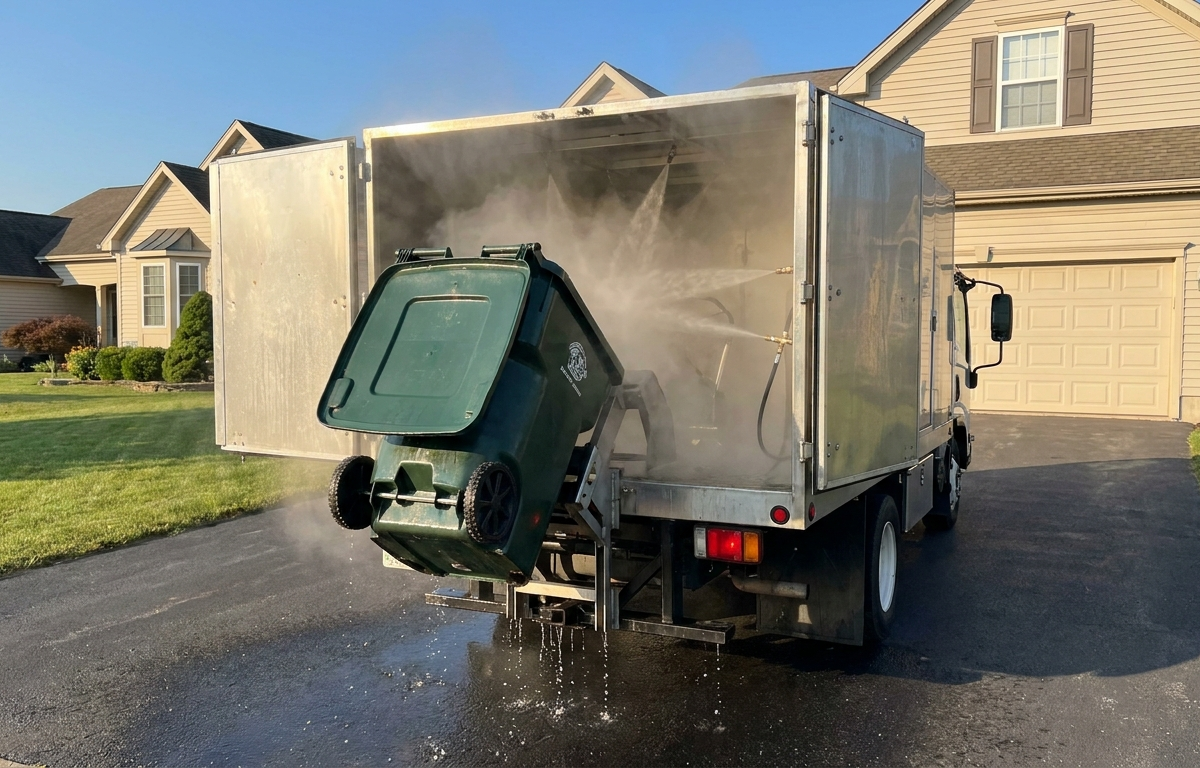
A single bin wash pays for itself in chemicals and forty-five minutes, but it won't pay your mortgage. Trash bin cleaning is a route business hiding inside a one-off service, and most people who start it price it like a one-off — then wonder why they're broke by September. The trick isn't charging more per bin. It's stacking enough bins on one street that the per-stop cost drops while the per-stop price doesn't.
What operators actually charge
Nationally, a standalone clean of two curbside bins runs $45–$99 — the 2026 side-work rate data books a one-time deep clean at $50. That's the "I saw your truck, can you do mine today" price, and it's fair — you're driving out for one customer, one stop, no density behind it. Recurring plans are a different animal: $27 a visit for two bins on a monthly plan, $22 a visit bi-weekly, with a quarterly clean at $35 and extras running $5–$15 a bin beyond the base two.
| Service type | Typical price | Why |
|---|---|---|
| One-time deep clean, 2 bins | $50 (up to $99 in some markets) | No route density, one trip for one job |
| Monthly plan, 2 bins | $27/visit | Bundled visits, predictable revenue, lower per-stop cost |
| Bi-weekly plan, 2 bins | $22/visit | Densest schedule, cheapest per visit |
| Each additional bin (plan) | $5–$15 | Marginal — you're already parked |
Notice the plan price is roughly half the one-time price. That's not a discount for loyalty — it's what the math allows once you're not driving across town for a single customer. If you price the monthly plan the same as the one-off, you'll lose every quote to a competitor who understands route economics. If you price the one-off the same as the monthly plan, you're subsidizing strangers who'll never book again.
Two prices, two purposes. Keep them separate on your quote sheet, and never let a customer negotiate the one-off down to plan pricing without actually signing up for the plan.
Your real cost per bin
Chemicals run $0.10–$0.50 per can when you're buying concentrate in bulk, and water at municipal rates is close to nothing. That's why this trade feels like it prints money: your consumable cost is a rounding error. The number that actually decides whether you're profitable is drive time and stops-per-hour, not soap.
One half-day route, penciled out
Here's what density is actually worth. Take a hypothetical Tuesday route — 35 stops, all two-bin monthly plans at $27, houses close enough that you're never driving more than a couple minutes between them.
- Gross: 35 stops × $27 = $945
- Chemicals: 70 bins at roughly $0.30 each = about $20
- Fuel for a tight neighborhood loop = about $35
- The rig — truck payment, insurance, reclaim tank, water — split across your route days = call it $90
- Net: right at $800, for about four and a half hours of work. That's in the neighborhood of $175 an hour.
Now run the same 35 customers scattered across three zip codes. The route takes all day instead of half of one, fuel doubles, and the same $945 gross nets out under $100 an hour. The bins didn't change. The map did.
Which is the real lesson of this trade: an off-route customer is a bad customer at almost any price. A stop fifteen minutes off your line at full price earns less than a plan customer at $27 who lives between two other plan customers. Most operators can't bring themselves to turn down a paying stop — the ones who build actual businesses do it every week. Try it with a live demo built for this trade and you'll see your real profit per route in the Money tab, not just what you billed.
Price the route, not the customer
Here's the shift that separates a hobby from a business: stop quoting jobs and start quoting streets.
- Cluster before you canvass. Walk a neighborhood, note which houses put bins at the curb on the same day, and pitch the whole block together — even a "sign up 3 neighbors, everyone gets a discount" flyer works, because density is worth more to you than the discount costs.
- Anchor to trash day, not calendar day. Your route should mirror the municipal pickup schedule block by block. If Tuesday is trash day on Maple, your whole Maple route runs Tuesday afternoon, right after the truck empties the cans.
- Sell the plan, quote the one-off high. Make the recurring price obviously the better deal — "$27 a month vs. $50 for just today" — so the plan sells itself instead of you having to push it.
- Bundle where the equipment overlaps. If you already run a pressure washing rig with a reclaim tank for driveways or siding, bin cleaning is nearly free equipment-wise — a lot of operators run both routes off the same truck.
Why summer is when this books
Heat plus a full week of trash sitting in the sun is when a bin actually starts to smell — and maggots in July are the single best sales conversation you'll ever have, because the customer already wants what you're selling before you knock. This is the season to be canvassing, not waiting for referrals to trickle in. A door hanger that says "your bin doesn't have to smell like that" in late June will out-convert almost anything you'd write in October.
Don't let the summer rush trick you into pricing everyone as a one-off, though. Every new customer you sign in July is a customer you want billing monthly through December — get them on the plan from the first knock, not after they've already paid you three separate one-time prices.
Handling the objection everyone gets
"I can just spray it with the hose myself." True, and some people will. But most people who say that also haven't done it in two years, because it's a genuinely unpleasant fifteen minutes that produces filthy runoff in their own driveway. Your answer isn't to argue — it's to describe the alternative plainly: a truck-mounted system that lifts the bin, blasts it with hot water, and captures the wastewater instead of dumping it on their lawn. That's a better outcome than the hose, and it's worth saying so without overselling it.
If a customer pushes back on the monthly price, don't drop it — drop the frequency. Every-other-month at a slightly higher per-visit price beats losing the account to "I'll just do it myself" once and for all.
There's also the wastewater question, and it comes up more than you'd think. A serious operator captures and disposes of the dirty runoff instead of letting it drain into a storm sewer — it's the difference between looking like a professional service and looking like someone who backed a garden hose up to a truck. Mention the reclaim system unprompted; it answers a concern the customer hadn't put into words yet.
Setting your numbers before you knock a single door
Before you quote anyone, run your actual numbers — stops per hour, fuel, chemical cost, truck payment split across routes — through the trash bin cleaning cost calculator so your monthly plan price reflects your real cost, not a guess copied from a forum post. Then set up your trash bin cleaning trade page and start logging routes: it tracks which customers are on a plan, when they're due, and what each stop actually nets you after cost, not just what you invoiced. If you're already running a route on soap and habit, our guide on building a recurring route in window cleaning covers the same density math from a different trade.
Get your first month of routes documented right — start free and see what your route actually earns once it's tracked instead of guessed at. Five jobs a year free, no card, then $19/mo or $190/yr.
FAQ
How much should I charge for trash bin cleaning?
A one-time deep clean of two curbside bins typically runs $50, reaching $99 in some markets, while a recurring monthly plan for two bins runs about $27 per visit and bi-weekly about $22. The plan price is lower because you're not driving across town for a single stop — keep the two prices separate and never let a one-off customer negotiate down to plan pricing without actually signing up.
Why is trash bin cleaning more profitable as a route than as one-off jobs?
Chemical and water cost per bin is nearly nothing, so drive time and stops-per-hour are what actually determine profit, not soap. A tight 35-stop half-day route of $27 monthly plans grosses $945 and nets around $800 after fuel, chemicals, and the truck's share — the same customers scattered across three zip codes net less than half that per hour.
What should I say when a customer says they'll just hose out their own bin?
Don't argue — describe the alternative plainly: a truck-mounted system that lifts the bin, blasts it with hot water, and captures the wastewater instead of dumping it on their lawn. Most people who say this haven't actually done it in years because it's an unpleasant job that produces filthy runoff in their own driveway.
Why does summer matter so much for trash bin cleaning sales?
Heat plus a full week of trash sitting out is when a bin actually starts to smell, and a customer with maggots in July already wants what you're selling before you knock. Get every new summer customer onto a recurring monthly plan from the first visit rather than letting them pay one-time prices repeatedly.
Do I need a special truck to start a bin cleaning business?
No. Start with a pressure washer, a garden-hose splitter and a shop-vac to prove the model in one neighborhood. An $8,000 tank-and-trailer rig runs about $258 a month financed, which eats ten $27 accounts before you have made a dollar. Buy it around the 60-account mark, when the payment falls under a fifth of route revenue.
What's the best way to find bin cleaning customers without paid ads?
Canvass on trash day when the cans are visibly dirty, post in Nextdoor and the local Facebook group with a photo and a specific date, and get your Google Business Profile live with real before-and-afters. Property managers and HOAs are worth a call too — one contract can be worth fifteen doors.
If the route doesn't exist yet
All the density math above assumes there is a route to densify. If you are staring at zero customers instead of 35 stops, the order matters more than the gear — and the usual failure is buying the rig first: a 500-gallon tank, a hot-water unit, a trailer wrap, eight grand in before a single can is cleaned.
Run that purchase against the route. Twenty accounts at the $27 monthly rate is $540 a month. Finance $8,000 of tank and trailer over 36 months and the payment lands around $258 — your first ten accounts exist to feed the trailer. Pay cash and $8,000 ÷ $540 is almost fifteen months of every dollar the route makes, before fuel and water, just to get back to zero. The break-even says the trailer is a 60-account decision: at 60 × $27 the route grosses $1,620 a month, the payment drops to 16% of revenue instead of 48%, and the hot-water system starts earning its keep in stops per hour. Until then a pressure washer, a garden-hose splitter and a shop-vac clean cans just fine.
A real first-route month is not only the recurring base either: twenty monthly accounts at $27 is $540, two one-time deep cleans off a Facebook post at $50 is $100, one move-out rental turn for a landlord is $45 — $685, nearly all of it labor and water, so most of it is yours after fuel. That resets the payback on a cash-bought rig to about twelve months. The one-timers matter twice, because a $50 deep clean is this trade's best sales call: about half convert to the $27 plan once the customer has seen the can come back white.
Finding the first twenty costs almost nothing. Canvass on collection morning, not the night before — you want the cans dirty, curbside, ideally with a fly working the lid, because a door hanger on a visibly rank can does the selling for you; the homeowner smelled the evidence an hour ago. Shoot before photos of the worst cans on the block, blur the house numbers, and use the before-and-afters later, because people do not believe "we clean bins," they believe a photo of a lid that used to have a brown ring around it. Nextdoor and the town Facebook group convert for this trade precisely because the problem is hyper-local and visible: post a photo, a flat two-bin price, and the specific week you will be in that zip code. Get a Google Business Profile live and push for five reviews, which is roughly where you start showing in local search, then keep going toward twenty. And call the property managers — dumpster corrals and bin rows on a schedule mean one conversation can be worth fifteen doors.
Once those first monthly customers sign, the plan has to actually re-bill itself, or the route dies of forgotten follow-ups. Recurring jobs shows how a plan customer gets a pre-filled job on the schedule every cycle without you rebuilding it from scratch — the boring plumbing that keeps a bin route billing while you're out running it.