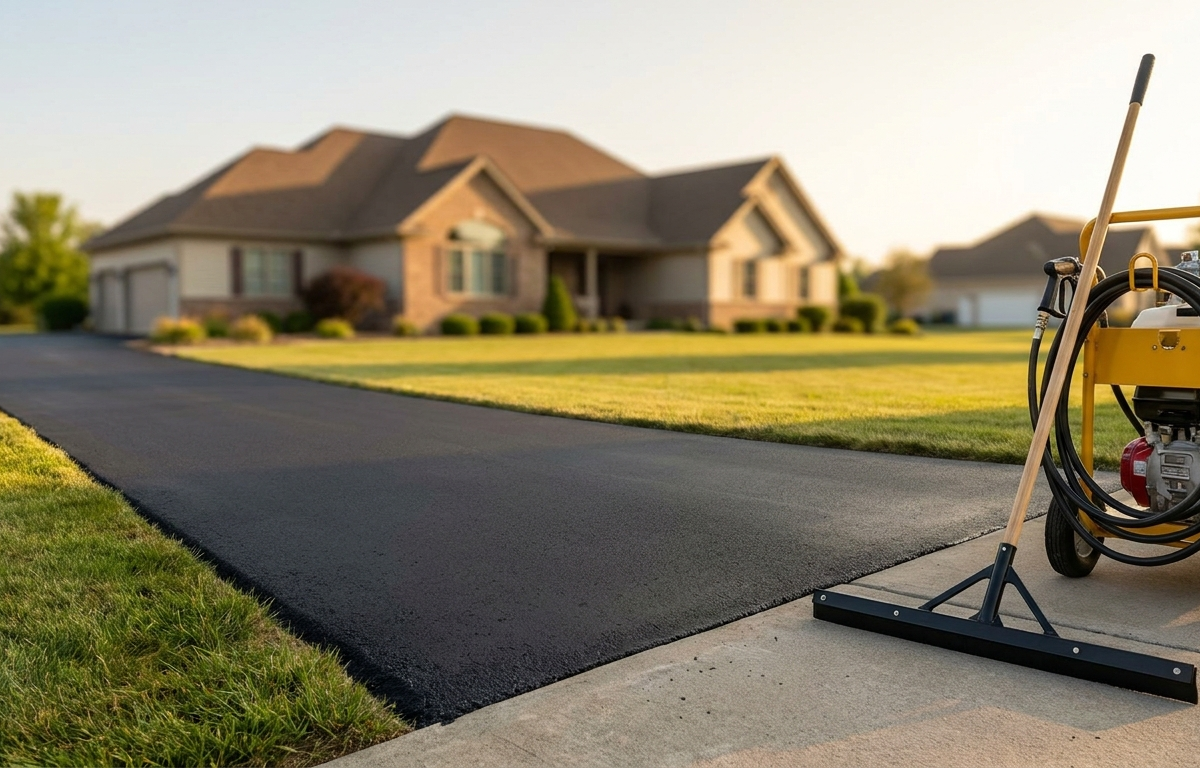
Picture a guy in a rented sprayer rig quoting a two-car driveway at $180, because that's what the flyer stuck in his own mailbox last spring said to charge. Run his numbers all the way down, because the flyer never does. Call the driveway what it was — about 1,250 square feet, a two-car with a parking pad. Sealer and crack filler for that much surface run about $88 at bulk-concentrate prices. The rented rig was $60 for the half day. So: $180, minus $88 in material, minus $60 in rental, leaves $32 — spread over three and a half hours door to door. Nine dollars an hour. That flyer wasn't wrong for whoever printed it. It just wasn't priced for his truck, his drive time, or his sealer cost.
Now price the same driveway the way the trade actually bills. The 2026 side-work rate data puts sealcoating at $0.20 a square foot, with materials eating about 35 cents of every dollar. Quote it as two lines: crack fill along the long joints, $40; sealcoat, 1,250 sq ft at $0.20, $250. Total: $290. Same materials, same afternoon, and the labor side of that ticket works out north of $50 an hour — with a two-coat premium job booking at $400 on the same math. Same driveway, same sweat. The only thing that changed is whose math he used.
Sealcoating has one of the tightest margins in side work if you price by feel. It also has one of the best margins in side work if you price by the square foot and know your real cost. Right now — peak season, warm dry pavement, driveways cracking from last winter — is exactly when that math needs to be locked in before you start knocking on doors, whether sealcoating is your main trade or the thing you added on after building a lawn or pressure washing route.
What sealcoating actually costs you
Before you can charge right, you need three numbers: material cost per square foot, labor cost per square foot, and your minimum job size. Skip any one of them and you're guessing.
Material. A gallon of sealer covers roughly 80 to 100 square feet on a typical residential driveway, less on rougher or more porous asphalt. Run the math on whatever you're actually paying per gallon — not what a supplier's website lists, what you paid last time you filled the tank — and that's your true material cost per square foot, usually somewhere in the $0.05 to $0.08 range on concentrate.
Labor and equipment. This is where most solo operators shortchange themselves. Blowing out debris, edging, taping off, mixing, spraying or squeegeeing, and cleaning your rig afterward isn't a twenty-minute job — a standard driveway runs two to three hours door to door once you count drive time and setup. Price your labor like you'd price your own hourly rate for any other job, not like it's free because you're "just spraying." And if you're still renting the rig, be honest about what that means: the rental fee comes straight out of the labor side of every ticket. You're not fully in the sealcoating business until the equipment is yours — until then, price like the rental is a real line on your cost sheet, because it is.
The line items that aren't optional. Crack filling isn't part of the base sealcoat price — it's prep work that belongs on its own line, priced off the cracked area, not thrown in. A driveway caked in mud, oil stains, or weeds growing through the joints needs extra cleaning before sealer will even bond, and an oil-spot primer-and-seal ticket runs around $220 on its own — a surcharge, not a favor you throw in to seem generous.
The number to actually quote
$0.20 a square foot is the working base for residential sealcoat. That puts a typical driveway ticket around $250, a patch-and-seal job around $320, and a two-coat premium seal at $400 — the right recommendation for pavement that spent last winter cracking. A standalone crack-fill-and-seal visit books around $180.
Set a hard minimum — $150 to $200 is standard — and hold it. A tiny driveway still costs you a full trip, a full setup, and a full teardown, so a $75 quote on a small slab isn't a discount, it's a loss with your name on it.
One more thing the flyer teaches wrong: a flat "driveway price" quietly subsidizes big driveways with small ones. At a flat $180, the 800-square-foot driveway pays you $0.23 a foot and the 1,400-square-foot one pays you $0.13. Price per square foot and every job carries its own weight.
| Job | Typical ticket at $0.20/sq ft |
|---|---|
| Driveway sealcoat (~1,250 sq ft) | $250 |
| Crack fill & seal visit | $180 |
| Patch & seal | $320 |
| Two-coat premium seal | $400 |
| Oil-spot primer + seal | $220 |
Commercial lots are a different animal entirely — bigger surface, different sealer, different equipment, and a parking-lot-and-striping job books around $1,500. The per-foot rate drops as the square footage climbs because the labor doesn't scale the same way it does on a driveway. Don't quote a parking lot off your residential number; it'll either scare off a good commercial customer or cost you money on every load.
Run your own numbers through a driveway sealcoating cost calculator before you quote — plug in the square footage and prep work and it'll show you where a given job actually lands against these numbers.
Quote it before you leave the driveway
The two-day-later callback where a customer's forgotten half of what you said, or found a cheaper number online in the meantime, kills more sealcoating jobs than bad pricing ever does. Walk the driveway, measure it on your phone, and hand them a real number — with crack filling and cleanup broken out as their own lines — before you're back in the truck. A written estimate they can approve from their phone closes the job while they're still standing there looking at their own cracked asphalt, instead of three days later after they've called around.
Sell the timing, not just the coat
Warm, dry pavement is the whole reason summer is sealcoating's season — sealer won't cure right on cold or wet asphalt, which is exactly why this window matters and exactly why you should be booking now instead of waiting for customers to ask. Frame the timing for them plainly: skip this summer and that driveway sits unprotected through another freeze-thaw winter, and next year's cracks cost more to fix than this year's coat would have.
If you're pressure washing driveways, sealcoating is the obvious next line on the invoice — wash off a winter of grime, let it dry, then seal it while your equipment's already parked in the driveway. Two jobs, one trip, and a customer with a reason to call you again next year.
Turn one driveway into a street
Sealcoating rewards clustering harder than almost any other trade, because setup and drive time are where your margin actually lives. Three driveways on the same street in one afternoon beats three driveways spread across town, even at the exact same price per job — you're not repacking the sprayer, re-taping, or driving twenty minutes between stops. When you finish a job, ask if the neighbors have been asking about their own driveway, and offer a small discount for booking together on the same day. You're not cutting your rate to be nice — you're passing along the time you're actually saving.
Don't let "the sealer guy" undercut the math
Every neighborhood has someone running a cut-rate sealcoating side hustle out of a home-mixed batch and a garden sprayer. You will lose some bids to that price. Let those go. The driveway that comes back peeling in eight months because the coat was too thin isn't your problem to fix for free.
Sealcoating isn't the only pavement trade where "just quote what it feels like" quietly wrecks a season's profit — the same math problem shows up in concrete pricing, for the same reason: real cost first, feelings second.
Get every sealcoating quote onto a real, branded estimate the customer can approve from their phone — build the quote, break out crack filling and cleanup as their own lines, and get paid the same day the coat goes down. Start free and run this season's driveways off real numbers instead of guesswork. Five jobs a year free, no card, then $19/mo or $190/yr.
FAQ
How much does driveway sealcoating cost?
At the going rate of $0.20 per square foot, a typical residential driveway ticket lands around $250, with a two-coat premium seal at $400 and a patch-and-seal job around $320. Crack filling and heavy cleanup should be their own line items — a standalone crack-fill-and-seal visit runs about $180, and an oil-spot primer-and-seal about $220.
What's a good minimum job charge for sealcoating?
A hard minimum of $150-$200 is standard and worth holding, since even a small driveway costs you a full trip, setup, and teardown. A $75 quote on a small slab isn't a discount to the customer — it's a loss with your name on it.
How much of a sealcoating quote should go toward materials?
Around a third — on a $250 driveway ticket, sealer, crack filler, and gas typically run near $88 when you're buying concentrate in bulk. If materials are eating half of what you're charging, your price is too low, not your material cost too high.
Why does sealcoating pricing need to be locked in before summer?
Sealer only cures properly on warm, dry pavement, which makes summer the entire selling season — a driveway that skips this window sits unprotected through another freeze-thaw winter, and next year's cracks cost more to fix than this year's coat would have. Booking clustered jobs on the same street during that window also protects your margin, since setup and drive time are where profit actually lives.
How many driveways can one crew realistically seal in a day?
Clustered on one street, a two-person crew can do four to six average residential driveways — roughly $1,000 to $1,500 of work. Scattered across town the same crew often manages one or two, because setup, breakdown and drive time eat the difference.
How do I get customers to book their next reseal without chasing them down?
Tell them the recoat timeline while you are still in the driveway — one to three years depending on traffic — and keep the address, date and square footage on record so you can reach out when it is due. A message a season ahead beats hoping they call first.
The keep-off window is part of the quote
A fresh seal needs 24 to 48 hours before feet and tires come back, depending on temperature and humidity — and that window is yours to set and disclose, not the customer's to guess at. Put it on the estimate in plain words: when they can walk on it, when they can park on it, where the cars go in the meantime. The customer who wasn't told is the customer who backs a truck across your work at hour six and calls it your fault.
Respect the sky the same way. Sealer put down on damp pavement, in the cold, or ahead of rain may not bond or last, and a redo costs you a second full material load on a ticket where materials already eat about a third. A written rain-check beats a gamble every time — build the reschedule right into the quote ("if the weather turns, we move to the next dry day, no charge, no drama") so a pushed date reads as professionalism instead of flaking.
One more line the flyer never mentions: the wash-out. Sealer and rinse water are regulated, and leftover product and rig wash-out follow local disposal rules — none of which involve a storm drain. Plan where the rig rinses before the first job of the day, not after the last one. It costs a few minutes. The shortcut can cost the whole season.
Some driveways need a no
Sealer maintains sound asphalt. It will not fix potholes, heavy alligator cracking, or a base that's failing underneath — that's patch-or-paving territory, and no coat of anything changes it.
Patching you can price: a patch-and-seal ticket books around $320, and it's honest work when the damage is contained. Past that — whole sections gone spongy, gator cracking across half the surface — say so plainly and walk if you have to. A $250 coat sprayed over a failing base looks great for a season and then peels into a callback with your name on it, and the homeowner won't remember that they insisted. Telling someone their driveway needs a paving crew before it needs you costs one ticket. It's also the reason they hand your number to the neighbor whose driveway you can save.
Write down the advice they didn't take
Some customers hear the two-coat recommendation, look at the price difference, and take the single coat anyway. Their driveway, their call. Your job is to write it down.
Put the disclosure right on the estimate as its own note — the app's sealcoating setup suggests the exact shape: "Sealed over minor cracks per customer budget — advised heavy cracks may telegraph back through; two-coat recommended next cycle." Ten seconds of typing. When a crack telegraphs back through in March, the record answers the phone before you do — it shows what you found, what you recommended, and what they chose. Pair it with before-and-after photos on the job and there's never a version of events to argue about.
When two coats is the honest call
The $400 two-coat isn't an upsell you push on everyone. It's the right recommendation for specific pavement, and knowing which is which is what separates you from the flyer guy. Gone gray and porous, three-plus years since the last seal, drinking the first pass as fast as you spray it: that surface needs a first coat to feed it and a second coat to actually wear. The second pass goes down over sealed pavement, so it spreads further than the first. That's why the two-coat books at $400 and not double the single-coat price. Your material cost didn't double. Your protection did.
The reverse call matters just as much. Brand-new asphalt has to finish curing before its first seal, so a same-summer coat on a freshly paved driveway isn't a ticket — it's a callback you scheduled in advance. Log it and come back next season.
Put the recoat on a calendar, not in your head
Every driveway you seal this summer is due again in one to three years, and "I'll remember" is not a system. Sealcoating is cycle work, and the app treats it that way: set a job up as a recurring plan and the next visit spawns pre-filled when it comes due, with the address, the square footage, and last year's notes already on it. The job-site record keeps the surface condition and when it was last sealed, so next spring's quote starts informed instead of starting over.
That is the pricing half of a bigger play. The other half is the calendar, because sealcoating has a short hard window — dry pavement, temperatures in the mid-50s to low-90s, a handful of usable months — and a season spent chasing scattered addresses burns your best weather on windshield time instead of squeegee time.
Run a day both ways at the $250 base driveway:
| One scattered driveway | Four driveways, one block | |
|---|---|---|
| Drive time | ~90 min round trip | ~20 min total, curb to curb |
| Setup and breakdown | Once per job | Once, shared across the block |
| Jobs completed that day | 1 | 4 |
| Revenue for the day | $250 | $1,000 |
| Yours after ~35% materials | ~$162 | ~$650 |
That is the floor. If two of the four take the $180 crack-fill add-on, the day grosses $1,360 on the same trailer setup and the same tank of fuel. Nobody paid a dime more — the day just stopped being spent on the road.
So work the block, not the driveway. The best lead-gen tool available is the finished driveway itself: before you leave, drop door hangers on the five houses either side, and post the before-and-after in the neighborhood group tagged with the street name, because "just finished up on Maple Ct." pulls in the people who live two minutes from your truck. A modest same-week discount for a neighbor who books while the rig is already on the street is not discounting the job — it is pricing in the drive you won't spend twice.
Then close next year before you pack up this one. A sealed driveway needs another coat in one to three years depending on traffic and climate; say so in the driveway and ask whether they'd like you to reach out next spring rather than having to remember your name in eighteen months. A $250 driveway on a two-year cycle is $125 a year per house at near-zero acquisition cost, and twenty of those across three streets is a route. That only works if the record is better than a truck notebook — address, date sealed, square footage, next-coat estimate — because the whole play is being able to pull every driveway from two Aprils ago and know exactly who is due.
That same list is what turns a rained-out week into income instead of a day off. Pull the driveways coming up on their recoat window and book them for the first dry stretch: you are not inventing demand, you are pulling forward work that was going to happen anyway. And commercial plans further ahead than homeowners — lot work with striping runs around $1,500 a job, so one phone call in a wet week can fill a day that would have sat empty at six times the residential ticket. If you want to watch the whole estimate-to-paid flow skinned for this trade first, the live demo runs it for sealcoating — nothing to sign up for.