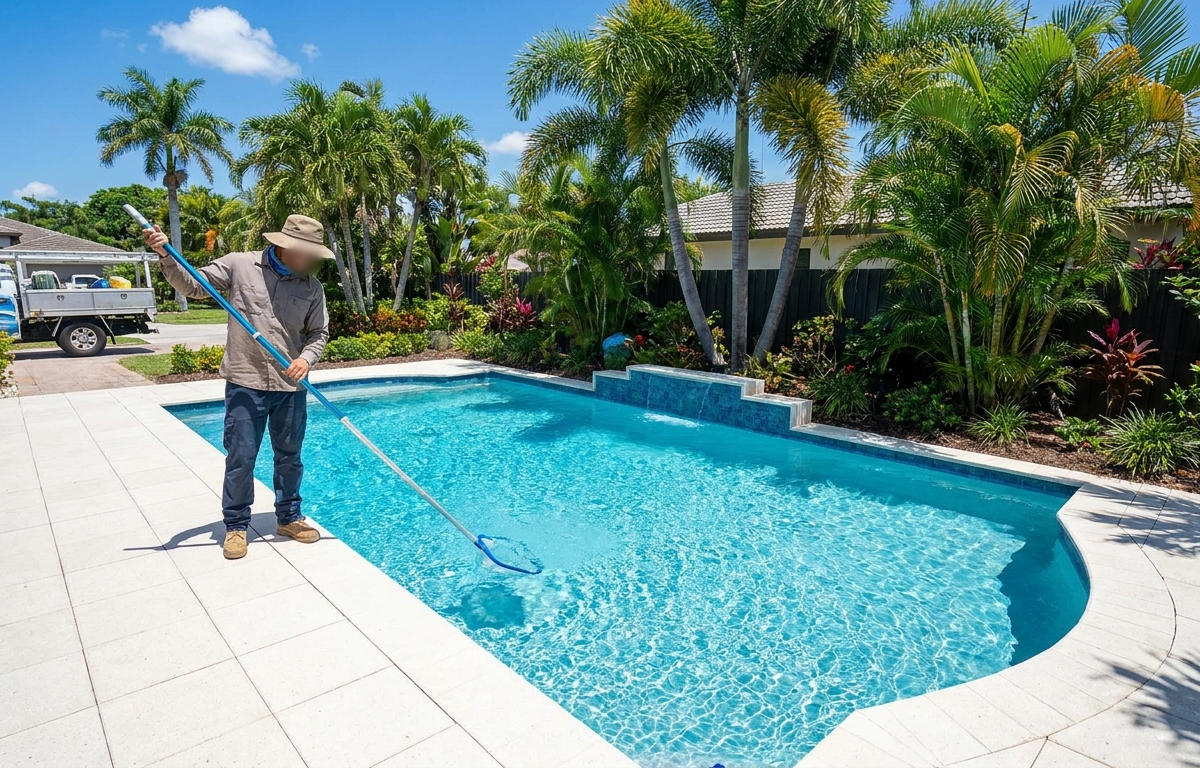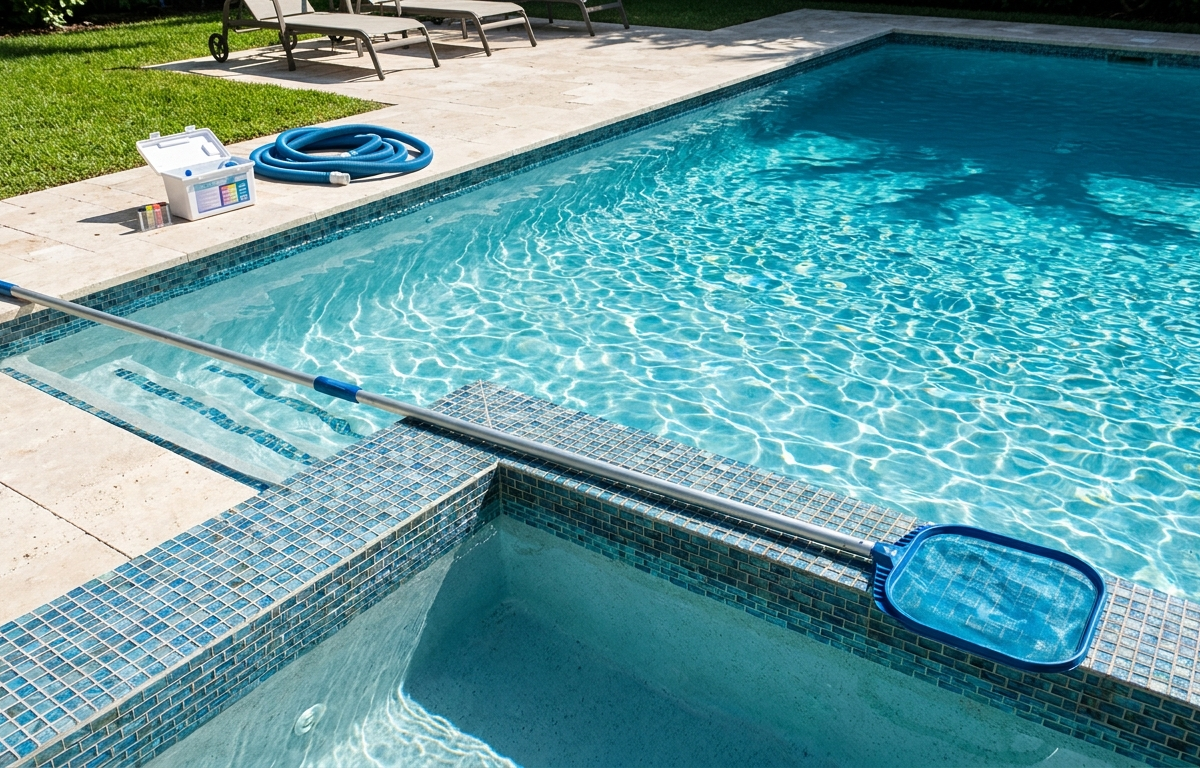
The truck is loaded, nets clean, job done. You pull out of the driveway with your money and a customer who says "I'll call you when I need you again." You never hear from them until the pool turns green in August.
That is not a business. That is a side job that burns fuel.
The operators who build real income in pool service are not finding new customers every week — they are converting the ones they already have onto monthly accounts, then mining each account for the work that actually pays. Because here is the part most route advice skips: the monthly fee alone is thinner than it looks, and you should see that math before you quote it.
One Account, Worked to the Penny
Take a hypothetical $130-a-month weekly-service account, since that is the number most homeowners expect to hear. Pull it apart:
- Revenue: $130 a month is $1,560 a year. Across 52 visits, that is exactly $30 a visit.
- Chemicals: a balanced pool on a maintenance dose — tabs, acid, the occasional bag of shock — runs about $12 a visit. Your margin over chemicals is $18.
- Time: 20 to 25 minutes on-site for skim, brush, empty baskets, test, and dose. Add the drive.
The drive is the whole game. On a dense route, the next pool is eight minutes away and the visit is 30 to 35 minutes all-in, so your $18 works out to roughly $31 an hour. Thin, but it holds the route together. Now put that same account 25 minutes across town: the visit costs nearly an hour, and your effective rate drops under $20 before the truck's gas. For reference, a one-off drop-in service visit bills $65 on its own in the current 2026 side-work rate data — so a scattered $30 stop is you working for less than half your own walk-up rate.
So here is the stance: $130 a month is a route price, not a pool price. It only pencils when the stop sits inside a tight loop. For a pool off your route, on old equipment, or oversized, quote $150 to $170 or decline. The cheapest thing in this trade is saying no to a bad stop; the most expensive is servicing one for three years because you didn't run this math.
Why the Account Is Still Worth Far More Than $1,560
If the weekly margin is that thin, why chase contracts at all? Because the monthly fee is the floor of the account, not the ceiling. Look at what a real year on one pool includes, at current rates:
- Weekly service contract: $1,560
- Filter cleans, two a year at $110: $220
- Salt cell clean: $180
- Pool opening: $250
- Pool closing: $225
- Full-year account value: $2,435
And the year the pump seizes, the repair bills $450 — handed to you without a single competing bid, because you are already the pool guy. A green-to-clean recovery, when a neighbor's DIY summer goes sideways, is $350 on its own.
That is the real model. The $30 visit buys you the standing relationship; the $875 of attached work each year is where the account earns. A one-time customer shops every one of those jobs around. A contract customer just says "fix it."
The Conversion Window You Are Probably Missing
The best time to pitch the contract is right after a one-time job, when the water is clear and the customer is standing there feeling good about it. Five minutes, no pressure.
What that sounds like:
"Pool looks great. Before I head out — I run weekly service for a few customers in this neighborhood, $130 a month. Water testing, chemicals as needed, filter and pump check, and you never think about it again. I've got one open slot on my Thursday loop. Want me to add you?"
One concrete offer with a price, a day, and a real availability hook. No speech about the science of water balance. Notice the "this neighborhood" part is not small talk — you are selling route density to yourself as much as certainty to them.
And certainty is what they are buying. Pool owners do not resist contracts because they enjoy testing water. They resist committing before they have seen you show up reliably. The monthly cost is not the obstacle; a green pool costs $350 to recover and a pump replacement runs $450, so $130 a month reads cheap against either. The fear is "what if this guy disappears." Kill that fear and the close is easy.
The Three Objections You Will Actually Hear
The lock-in worry. Offer 30-day cancellation, no penalty, and say it before they ask. Customers who leave do it in the first two months; past month three, almost nobody cancels — the problem is solved and switching is hassle. The clause costs you nearly nothing and deletes the hesitation.
The DIY threat. "I might just handle it myself." Do not argue. The homeowner who keeps water chemistry right through a full summer is a genuine minority; most miss a treatment, bloom, spend $350 on the recovery, and call in October. Say: "Totally fine. If you'd rather just have it handled, I'm here." Then stop talking. A good third come back.
The polite stall. "Let me think about it." Do not hand over a card and hope. "Of course — I'm in the neighborhood Thursday, I'll test the water free and we can decide then." You gave the out and booked the follow-up in one sentence. Show up, test, ask once more. Still undecided after that? Move on; you spent fifteen minutes total.
The Trial-to-Contract Play
Some customers need to watch you show up for two or three months first. Run them month-to-month at a premium and say why: "Month-to-month is $150; on a six-month agreement it's $130, because the consistency lets me plan the route." Honest, and it makes the lower rate feel earned instead of haggled.
Set a reminder for month three and ask one question: "Want to lock in the contract rate going forward?" If they pass, keep servicing them and ask again next quarter. After six months of reliable service, whoever has not converted will not — run them as steady accounts and stop pushing.
The Route Is the Business
Forty to fifty accounts is a solid one-person route. At $130, that is $5,200 to $6,500 a month in contract revenue — and with each account carrying $875 or so of openings, closings, filter and cell work, the true book runs well past that before any repair even happens.
Fill open slots from the streets you already service. A door hanger reading "neighbors of current customers get their first month half price" costs almost nothing and pulls, because the neighbor has watched your truck show up every Thursday for a year. That is proof no ad can fake.
For the mechanics of recurring pricing in other trades, the HVAC maintenance plan guide and the pest control recurring service guide run the same playbook on different equipment. More on growing a pool service operation is in the trade hub.
Estimates, invoices, recurring schedules, and payments from your phone — start your free 14-day trial — no card.
FAQ
How much should a monthly pool service contract cost?
$130 a month works for a standard pool inside a dense route — that is $30 a visit, about $18 of margin over chemicals, and it only makes sense when stops are minutes apart. Off-route, oversized, or aging-equipment pools should be $150 to $170 or declined; a one-off drop-in visit bills $65 by itself.
Is a $130/month pool account actually profitable?
The weekly visits alone are thin — roughly $31 an hour on a tight loop after chemicals. The account pays through what rides on top: two $110 filter cleans, a $180 salt cell clean, a $250 opening, and a $225 closing bring the year to about $2,435, plus repairs like a $450 pump job that never gets shopped around.
How do I get pool customers to sign a monthly contract?
Pitch right after a one-time job while the water is clear: a specific price, a specific day, one open slot on the route. Offer 30-day cancellation before they ask. Customers are buying reliability, not chemistry — remove the "what if he disappears" fear and the monthly fee sells itself.
What if a customer wants to maintain the pool themselves?
Let them, gracefully. Most DIY water-chemistry summers end in an algae bloom and a $350 green-to-clean recovery, and a fair share of those homeowners call back asking for weekly service. Leave the door open and follow up in the fall.