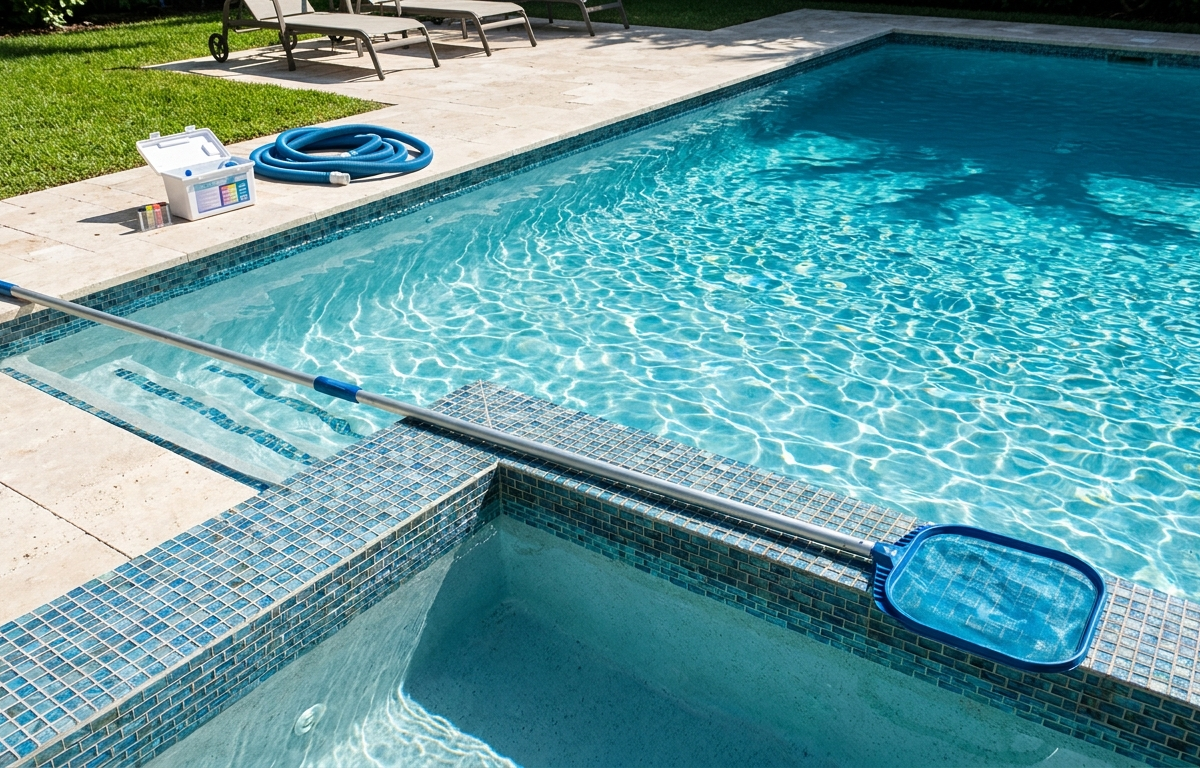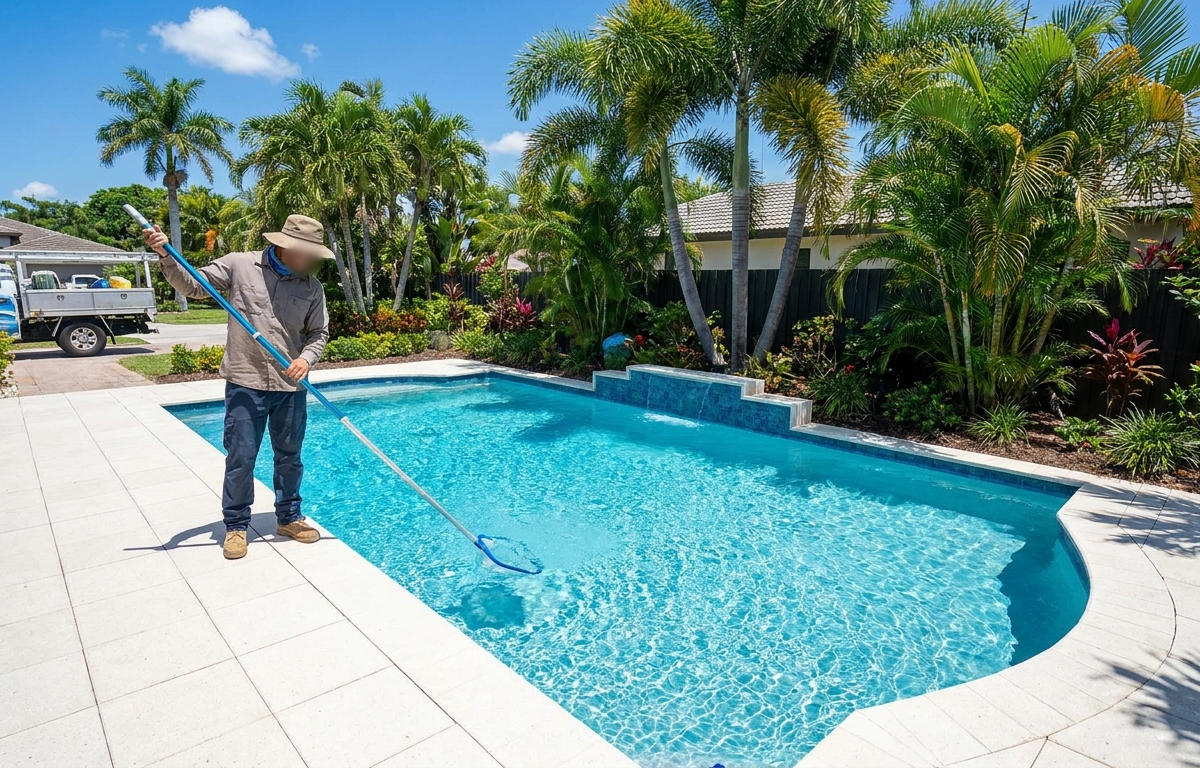
Run the math on what a pool route customer is actually worth before you decide whether the review ask is worth your time. A weekly service visit bills $65, per the 2026 side-work rate data. Call it 50 visits a year once weather and skips shake out — that's $3,250. Add the shoulder work the same customer hands you anyway, a $250 opening and a $225 closing, and the account runs about $3,725 a year. Keep them three years, which is unremarkable for an operator who just shows up, and one customer is worth roughly $11,000 before the first pump dies — and pump and motor repairs are $450 tickets when they do. So the thirty seconds you spend asking for a review or mentioning the neighbor's green pool isn't a marketing extra squeezed between stops. At these numbers it's the best-paying half-minute on the route.
The green-to-clean is the audition — price it like a job, not a favor
Summer cleanouts are where new accounts come from, and where solo operators give away the most money. The instinct is to treat a green pool as "a few extra visits" folded into the first month of service. Don't. A green-to-clean is its own job with its own price, and here's what a hypothetical swamp recovery actually invoices:
| Line | Price |
|---|---|
| Green-to-clean recovery — shock, brush, vacuum to waste | $350 |
| Filter clean (the media just ate a season of algae) | $110 |
| Return-visit chemical balance once the water clears | $120 |
| Job total | $580 |
Chemicals and materials on a job like this run about 40% of the ticket — call it $230 out of your pocket — which is exactly why "I'll just roll it into the weekly rate" is a donation. Price the cleanout full even when you're hungry for the route slot. Discounting the audition sets the price of the account: the customer who got the swamp handled for free is the same one who balks at $65 a week later, and you taught them to.
The photo you take of that transformation, though — that you give away everywhere.
The photo does more work than the pitch
A green-to-blue pair is the single most convincing thing you can put in front of a stranger deciding whether to trust you with their backyard. It's the difference between saying you do good work and showing water they can see. Post it to your Google Business Profile the same day, not in a monthly batch. A steady rhythm of "here's Monday, here's Wednesday" builds a portfolio that sells for you while you're at the next stop — and every $580 cleanout you priced correctly also produced the ad for the next one.
When to actually ask for the review
Timing beats wording. The window is somewhere between two hours and two days after a visible result: the green pool gone blue, the dead pump running, a first visit for a customer seeing the difference. Routine weekly maintenance, where the pool looked fine before you arrived, is a weak moment to ask — there's nothing for the customer to react to.
Ask by text, same day, while the water's still fresh in their mind. A text gets read standing in the kitchen; an email sits in a promotions folder next to the oil-change coupon. A few rules worth keeping:
- Ask after the dramatic result, not during routine upkeep
- Send it same-day, by text, from your own phone
- Never tie the ask to a discount or free service — Google prohibits incentivized reviews, and the account risk isn't worth it
- After any repair, follow up in two or three days to confirm it held before you call the job closed
Why route density beats a wider map
Ten pools on three streets grow a business faster than ten pools scattered across a city, and not just because of gas. Pool work happens where neighbors can see it. A truck skimming on the same street every Tuesday is advertising a plumber under a sink will never get. One good referral in a tight neighborhood ripples, because the next-door neighbor already watched you show up, work, and leave clean water behind.
The dollars agree. At $65 a visit, a stop three blocks from your last one is most of an hour's pay for well under an hour of work — the service rate in this trade is built on $75-an-hour labor, and a dense route actually collects it. The same stop across town, with twenty-five minutes of windshield each way, quietly pays half that. When two new customers call the same week, the close one is worth more than the invoice math shows, every time.
| Approach | What it does to the route |
|---|---|
| Dense cluster, same streets | Compounding referrals, visible truck, full $75/hr collected |
| Scattered territory | Every job stands alone, windshield time eats the rate |
Kill the algae complaint before it becomes a review
The most common one-star in this trade isn't about price. It's "the algae came back a week later." Sometimes that's a real service gap. Often it's a customer who cut their pump run-time, dumped in their own chemicals, or skipped the filter clean you recommended — and you have no record to point to. Photograph water color and log chemical readings at every stop. Note anything odd: the customer mentioning they added shock, equipment sounding off. When the complaint lands, that log is the difference between "let me look at what changed" and eating a one-star you didn't earn.
Make the ask part of closing the stop
Operators who collect reviews steadily aren't better at asking. They just never forget, because it's wired into how a stop ends: log the photo, send the text, done in thirty seconds. SideWRK's pool service tools keep the job photos, the customer history, and the chemical notes in one place so the habit doesn't depend on your memory at 4pm on a Friday. Before you commit a cleanout to the schedule, Is This Job Worth It runs the real numbers — the $230 in chems against the $580 ticket. See the whole setup for a route business at the live demo, and when the reviews start pulling new calls from the same block, pool cleanups turn into monthly contracts covers locking them in.
Want the photo, the ask, and an $11,000 account's whole history in one place? Start your free 14-day trial — no card and run the route from your phone.
FAQ
What is a pool service customer actually worth per year?
About $3,725: fifty weekly visits at $65 plus a $250 opening and a $225 closing. Over a typical three-year stay that's roughly $11,000, not counting repair work like a $450 pump or motor job — which is why a thirty-second review ask attached to a good result is worth more than it feels like in the moment.
What should I charge for a green-to-clean?
Price it as its own job, not extra visits: $350 for the recovery itself, $110 for the filter clean it forces, and a $120 chemical balance once the water clears — $580 all told, with roughly $230 of that going to chemicals. Folding it into the weekly rate hides real costs and trains the customer to undervalue the route.
When should I ask a pool customer for a review?
Within two hours to two days of a visible result — a cleanout, a pump repair, a first visit — and by text, same day. Routine maintenance where nothing dramatic happened is a weak ask; a green-to-blue photo pair is the strongest one there is.
Can I offer a discount for a Google review?
No. Google prohibits incentivized reviews, and a suspended business profile costs far more than the stars would've earned. Ask plainly and let the before/after do the persuading.
What do I do when a customer says the algae came back?
Check your visit log first. If you photograph water color and record readings at every stop, you'll know whether the pump schedule changed or chemicals got added between visits. Real gap: fix it and follow up in a few days. Not your gap: the documentation lets you have that conversation without guessing — or eating the review.