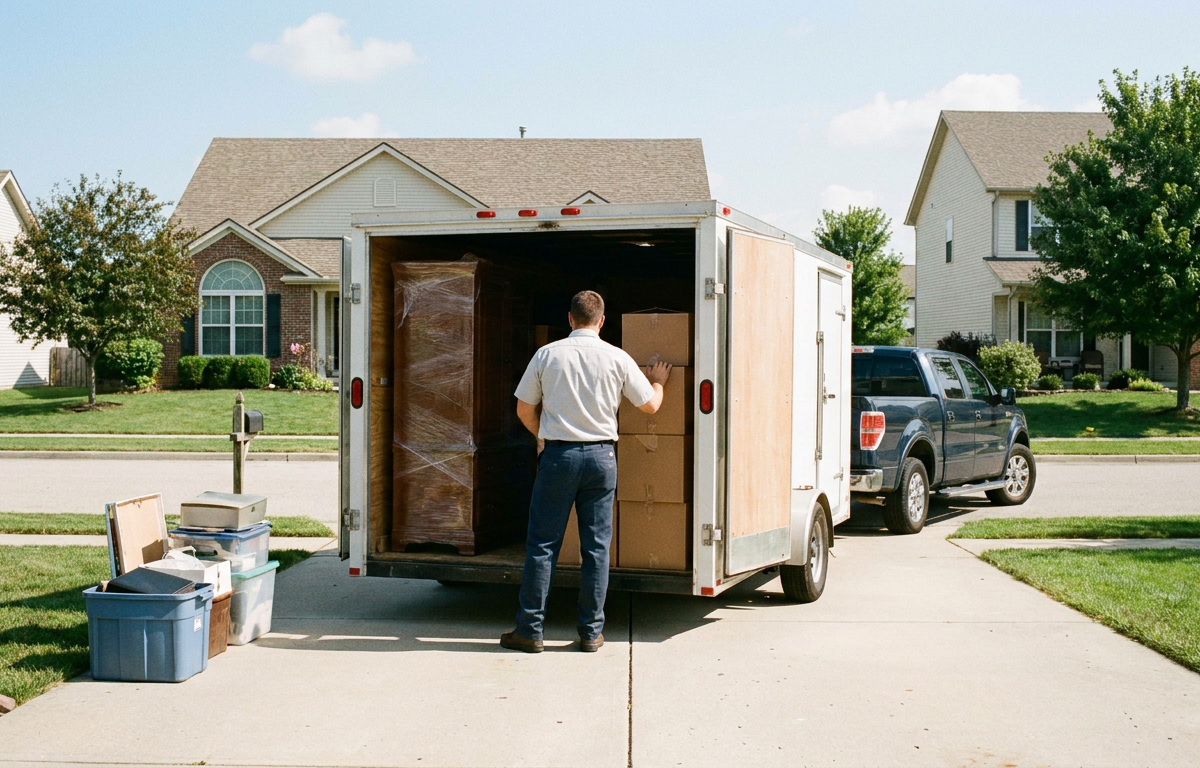
A full trailer of construction debris and a full trailer of couch cushions look identical from the curb. They do not cost the same to dump, and pricing them the same is one of the fastest ways a junk hauler turns an easy-looking job into a loss. Most pricing advice out there stops at "quarter load, half load, full load" and never asks what's actually in the load — which is exactly the gap that costs you money on the jobs that seem simplest to quote.
The Real Billing Unit: Load Fraction, Not Hours
Junk hauling doesn't bill by the hour, and treating it like an hourly trade is the first mistake. You're not selling your time — you're selling truck space and a dump run. The real unit is the fraction of a trailer or truck bed the job fills, and every serious hauler prices off that fraction, not a stopwatch.
Real ticket data from SideWRK's side-work rate report puts a full load at roughly $650, with about 70% of that going to labor and the remaining 30% covering dump fees, fuel, and truck wear. Smaller jobs scale down from there:
| Job type | Typical ticket | Load fraction | Labor (≈70%) | Dump/fuel/wear (≈30%) |
|---|---|---|---|---|
| Single-item pickup | $100 | ~1/8 | $70 | $30 |
| Furniture removal | $150 | ~1/4 | $105 | $45 |
| Appliance haul | $150 | ~1/4 | $105 | $45 |
| Garage cleanout | $375 | ~1/2 | $263 | $112 |
| Construction debris | $500 | ~3/4 | $350 | $150 |
| Estate / full cleanout | $650 | full | $455 | $195 |
That $195 dump allowance on a full load isn't a random number — it's what most municipal transfer stations actually charge per ton for a truckload of average household junk. Which brings up the part the "load size" pricing lists never mention.
Volume Lies. Weight Doesn't.
A cubic yard of couch cushions, cardboard, and old toys weighs somewhere around 150–300 pounds. A cubic yard of drywall scraps, tile, or broken concrete can weigh 800 pounds or more — sometimes north of a ton for the same amount of trailer space. The transfer station doesn't care how full your trailer looks. It weighs the load and bills by the ton, and that bill comes straight out of the 30% you set aside for dump costs.
Quote a "construction debris" job at the same $500 flat rate you'd charge for a garage full of boxes, and you can watch your margin disappear the moment the scale ticket prints. This is why the smart move isn't pricing by load fraction alone — it's pricing by load fraction, then asking what's actually in it before you commit to a number. Tile, concrete, dirt, roofing shingles, and old furniture with particleboard cores all deserve a heavy-material line item on top of the base fraction price, not a shrug and a flat rate.
A simple rule that holds up: if more than a third of the load is dense material (concrete, tile, dirt, shingles, drywall, cast iron), add 20–40% to the base fraction price before you quote it. That's not padding — it's the dump fee you're actually going to pay, priced in up front instead of eaten after the fact.
Why Undercutting the Big Brands Doesn't Work the Way People Think
A lot of pricing guides push local independents to charge 20–40% less than the national junk removal brands and call it a competitive advantage. It can be — but only if you understand what you're cutting. Your dump fee is fixed. The transfer station charges the same rate per ton whether you charged the customer $650 or $450 for that load. Cut your price without cutting your dump bill, and the 30% you need for disposal and fuel doesn't shrink — the cut comes straight out of the 70% you'd have kept as labor.
If you're going to price below the national-brand range, do it because your overhead is genuinely lower (no franchise fee, no call center, you drive the truck yourself), not because you're guessing a lower number sounds friendlier. Know your real dump-fee-per-ton before you decide how much room you have to undercut anyone.
The Minimum Charge Isn't Optional
A single-item pickup at $100 looks like the easiest money in the trade, and on paper it is — until you count the drive time. If a customer books one recliner from across town, you're burning fuel and thirty to forty-five minutes of your day for a ticket that barely covers it once you subtract gas. A trip minimum — most operators land somewhere in the $75–150 range — isn't about nickel-and-diming a small job. It's the floor that keeps a single-item pickup from being a favor you did for free.
Say the number plainly when you book the job: "There's a $100 minimum that covers the truck roll and disposal, even for one item." Nobody argues with a number stated up front. They argue with a number that shows up on the invoice after the fact.
Pricing the Job on Site
Walk the space before you commit to a number, not after. Eyeball the fraction of your trailer it'll fill, then ask yourself what's actually in the pile — furniture and boxes, or tile and drywall. A quick photo of the pile before you quote gives you a record if the customer adds a mattress or a chunk of concrete after you've already priced the job, and it's the kind of documentation that saves an argument later, not one that creates one.
Building the estimate on your phone before you start loading — rather than guessing a number out loud and hoping it holds — means the customer approves the actual price, including any heavy-material line, before you touch a single box. That's the difference between a number you can stand behind and a number you have to walk back.
FAQ
How much does junk removal cost per load in 2026?
A full truckload typically runs $500–$850 depending on region and what's in the load, with smaller fractions scaling down — single items run $75–$150, and a half load lands around $300–$450. Heavy material like concrete, tile, or roofing debris pushes the ticket higher because it costs more to dump by weight, not just volume.
Should I charge by the hour or by the load for junk hauling?
By the load. Hourly pricing punishes you for working efficiently and doesn't account for what the dump actually charges you, which is based on weight and volume, not time on site. Quoting the load fraction, adjusted for how heavy the material is, matches what you're actually being billed downstream.
What's a fair minimum charge for a single-item pickup?
Most independent haulers set a minimum somewhere between $75 and $150 to cover the truck roll, fuel, and disposal fee even for one item. Anything lower and a one-item job across town can cost you more in gas and time than it pays.
Why do construction debris loads cost more than the same size household cleanout?
Weight, not volume. A trailer full of drywall, tile, or concrete can weigh three to five times more than the same space filled with furniture and boxes, and transfer stations bill by the ton. Pricing debris jobs the same as a light cleanout of the same size is how haulers lose money on the jobs that look easiest.
How do I know what to actually charge without guessing?
Start from your real numbers — what a full load actually costs you in dump fees and fuel in your area — rather than copying a national price list built for a different market. SideWRK's junk removal cost calculator walks the load-fraction math for your job, and the side-work rate report shows real ticket data across the trade.
Ready to Price by the Load, Not by Guesswork
SideWRK's junk hauling tools let you build the estimate on site, add a heavy-material line when the pile calls for it, and get the customer's approval before you load the first box — so the number on the invoice is the number you actually meant to charge. See it running for your trade with the live demo, or start free. Five jobs a year free, no card, then $19/mo or $190/yr.
For more on pricing the job instead of the hour, see how pressure washers charge the job, not the hour and how trash bin cleaners price a route using the same real-cost-per-unit logic.