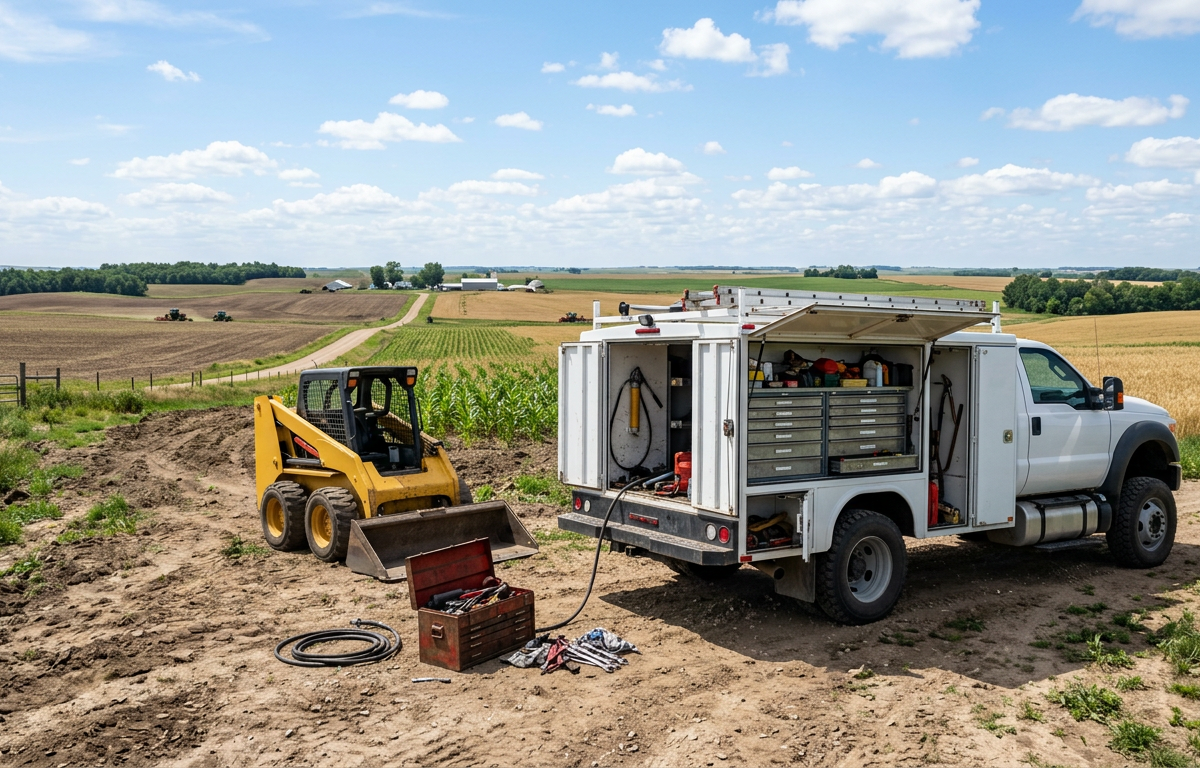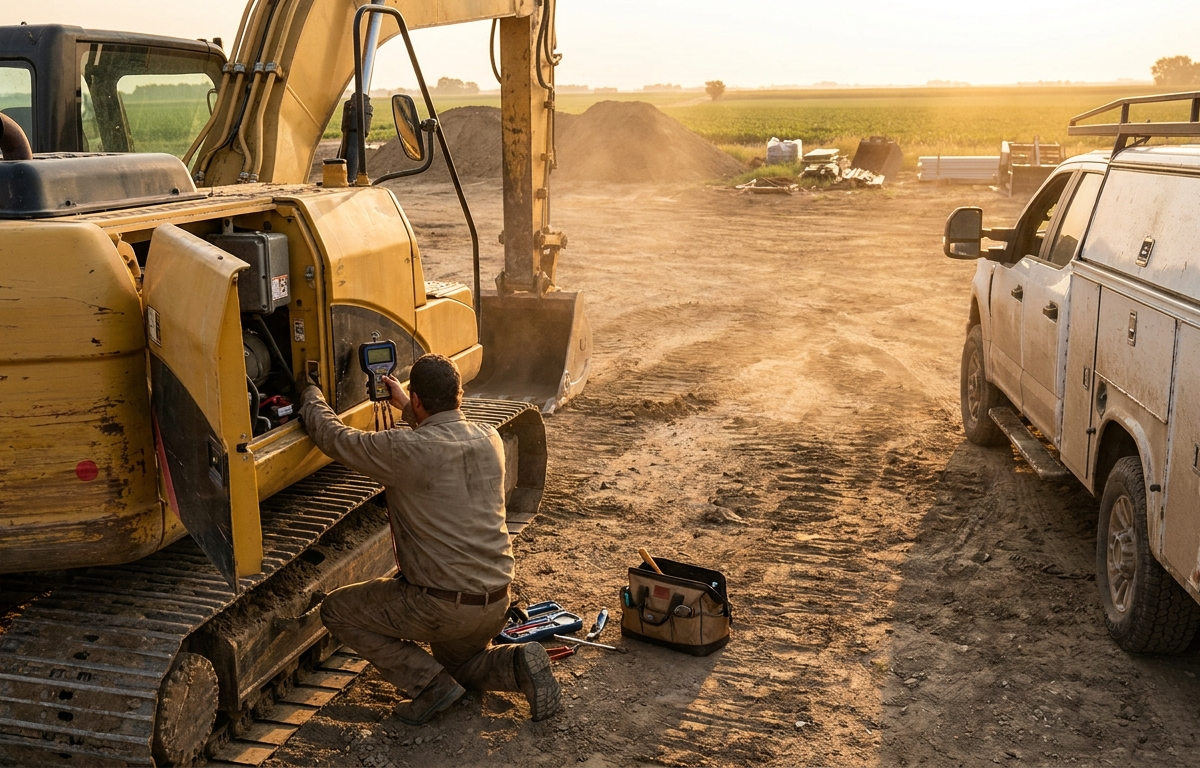
You fixed the hydraulic line on a rented excavator at six in the morning so the crew could pour concrete by nine, handed the site super a handwritten ticket, and got paid ninety-one days later — after your ticket sat at the bottom of an accounts-payable stack behind three vendors who submitted real invoices. That's not a cash-flow problem. That's a paperwork problem, and it's the one thing standing between a mobile heavy equipment mechanic and steady commercial accounts.
The low bid isn't what wins this work
Homeowners shop price. Construction companies, ag co-ops, and equipment rental yards shop reliability and paperwork, because somebody in an office has to justify the expense to someone else. A superintendent who calls you at 6 a.m. because a skid steer won't move dirt doesn't care that you're five dollars an hour cheaper than the last guy — he cares that the machine runs by lunch and that whatever you hand him won't get bounced back from AP for missing a PO number. Win the office's trust as hard as you win the operator's, and repeat work follows.
Which is why shaving your rate is the wrong lever entirely. Field rates for mobile heavy equipment work sit around $135 an hour in the 2026 side-work rate data, and the outfits paying it aren't comparing you to a cheaper hobbyist. They're comparing you to the dealer's field truck at $180-plus with a three-day wait.
What a real ticket looks like in dollars
Put numbers on it. Say a landscaping outfit's mini-excavator needs track work, and the owner wants the overdue service done while you're on the machine. The ticket that gets paid without a phone call reads like this:
- Undercarriage / track repair — labor, about 5 hours at $135: $700
- Parts — idler, hardware, seals (condition flagged: new): $700
- Preventive maintenance — labor, the balance of the visit: $240
- Filters and fluids: $180
Total: $1,820. Labor and parts split out, hours shown, every part flagged new, used, or reman — some outfits won't reimburse aftermarket or used components unless they're identified, and one unflagged reman starter can hold up the whole check.
What the office actually needs to see
A farm or a GC's back office runs on documentation, not handshakes. At minimum, a ticket that gets paid on the first pass includes:
| What's on it | Why it matters to them |
|---|---|
| PO or job-cost reference number | Lets them code the expense to the right project |
| Engine hours at time of service | Ties the repair to their own maintenance log |
| Itemized labor vs. parts, by condition (new/used/rebuilt/reman) | Some outfits won't reimburse aftermarket without it flagged |
| Business or license number | Required for their vendor file, even for non-motor-vehicle equipment |
| Photos of the failure and the fix | Backs up the story if a manager questions the bill later |
None of that is complicated. It's the difference between a ticket torn off a pad and a document that looks like it came from a vendor they can rely on for the next ten years, not the next ten days.
Net-30 is a loan, and you're the bank
Here's the part of commercial work nobody warns you about: on that $1,820 ticket, $880 of parts came out of your pocket at the supply counter on day one. If the invoice pays on net-30 terms — and "net-30" in construction routinely means day 45 or 60 in practice — you floated the parts bill for two months. Carry that $880 on a supplier card at a typical 24% APR and roughly $35 of your margin quietly evaporates in interest. Not catastrophic on one ticket. Now run four open tickets at once, which is a normal month once the accounts start coming, and you're floating five to seven thousand dollars of your own money so a company ten times your size can manage its cash flow.
So price the float or shorten it. Bill the $280 field service call on every roll-out — it covers the drive, the first hour, and part of the wait. Offer something for faster money if you want ("2% off for payment on completion" gets checks cut surprisingly fast). What you don't do is quietly absorb it. A mechanic who eats the roll-out and the float isn't the cheap option — he's the free bank.
The service history is the pitch for the next job
Every time you log engine hours and what you did at that hour count, you're building something more valuable than a receipt — a maintenance history tied to a specific machine's serial or PIN. Show up on the same lot six months later and pull up exactly what you did to a sibling machine at 1,200 hours, and you've just demonstrated you track equipment the way their own shop foreman wishes he could. That's the moment a one-off repair call turns into "call this guy for all of it."
A one-line note in your system — hydraulic leak, replaced fitting, hours in and out — costs you thirty seconds on-site. A stack of illegible carbon-copy tickets in a truck cab costs you the next contract when the farm manager asks "what did you do last time" and you genuinely don't remember.
Finding the first few commercial accounts
Rental yards are the fastest door in. They field repair calls constantly on equipment they have no in-house techs to service, and a mobile mechanic who shows up with a real invoice and photos becomes their go-to referral. Ask the counter staff directly — most yards keep an informal list of mechanics they'll point renters toward.
Ag co-ops and farm supply stores post bulletin boards that still work in 2026. A business card with "on-site repair, hour-logged invoicing, all makes" beats a handwritten "fixes tractors" note nine times out of ten. And once you've done clean work for one GC, ask who else on their bid list needs a mechanic — superintendents talk to each other more than they talk to their own office.
Get on the vendor list before the emergency call
Bigger outfits won't cut a check to someone who isn't already in their system. If a GC or co-op asks for a W-9 and a certificate of insurance before they'll add you as a vendor, that's not a brush-off — it's the same process they run for every supplier, and getting through it once means every future invoice moves faster. A short line on your invoice ("Net 30, questions to [phone/email]") signals you already know how their AP department operates.
Turn hour-meter data into a standing contract
Diesel engines and hydraulic systems fail on a schedule you can predict from hours, not calendar months. Once you've logged a machine's hours, you can tell the owner "this one's due for a hydraulic filter change around 1,800 hours" — and offer to be the one who calls when it's close. At $420 per preventive maintenance visit, a five-machine fleet on a standing schedule out-earns any emergency callout, and it's work you booked instead of work you hoped for.
Make the paperwork part of the job, not an afterthought
If you're running estimates and invoices out of a notebook, or texting photos with no system behind them, you're leaving commercial accounts on the table before you ever quote a rate. The heavy equipment side of SideWRK is built around exactly this — machines tracked by serial and hour meter instead of a VIN, labor and parts itemized by condition, and a branded document that reads like it came from a real business. If pricing the job itself is the part you're guessing at, our hourly rate calculator works for any trade, heavy equipment included — and the welding pricing guide covers a lot of the same fabrication-and-labor math when a repair turns into a weld job on a bucket. Want to see the whole workflow first? The live demo is pre-loaded for heavy equipment, no signup needed.
The mechanics who get the call every time a machine goes down aren't the cheapest. They're the ones whose paperwork made the last invoice easy to pay.
Start your free 14-day trial — no card and turn your next repair ticket into something an accounts-payable office actually wants to see.
FAQ
How do I get commercial accounts as a mobile heavy equipment mechanic?
Rental yards are the fastest door in — they field repair calls constantly and will refer you to renters once you show up with a real invoice and photos. Ag co-ops and farm supply bulletin boards are next, and one clean job for a GC often leads to referrals across their bid list.
What should a mobile heavy equipment mechanic charge per hour in 2026?
Field rates for mobile heavy equipment work run around $135 an hour, with a field service call of roughly $280 covering the roll-out and first hour. A typical hydraulic repair lands near $720 with parts, an engine service around $950, and undercarriage or track work around $1,400 — the parts share runs 40 to 50 percent of the ticket.
What does net-30 actually cost me on a big ticket?
On an $1,820 repair with $880 of parts out of pocket, payment landing at day 60 means two months of float — about $35 in interest if the parts rode a 24% supplier card, plus the whole ticket sitting idle. Several open invoices at once and you're floating thousands, which is why the roll-out fee and clean, fast-to-approve paperwork matter.
How do hour-meter logs turn into a maintenance contract?
Once you've serviced a machine and logged its hours, you can tell the owner when the next service is due — a hydraulic filter change around 1,800 hours, for example — and offer to call when it's close. At around $420 per preventive maintenance visit, a small fleet on a standing schedule out-earns emergency callouts and fills your calendar with booked work instead of breakdowns.