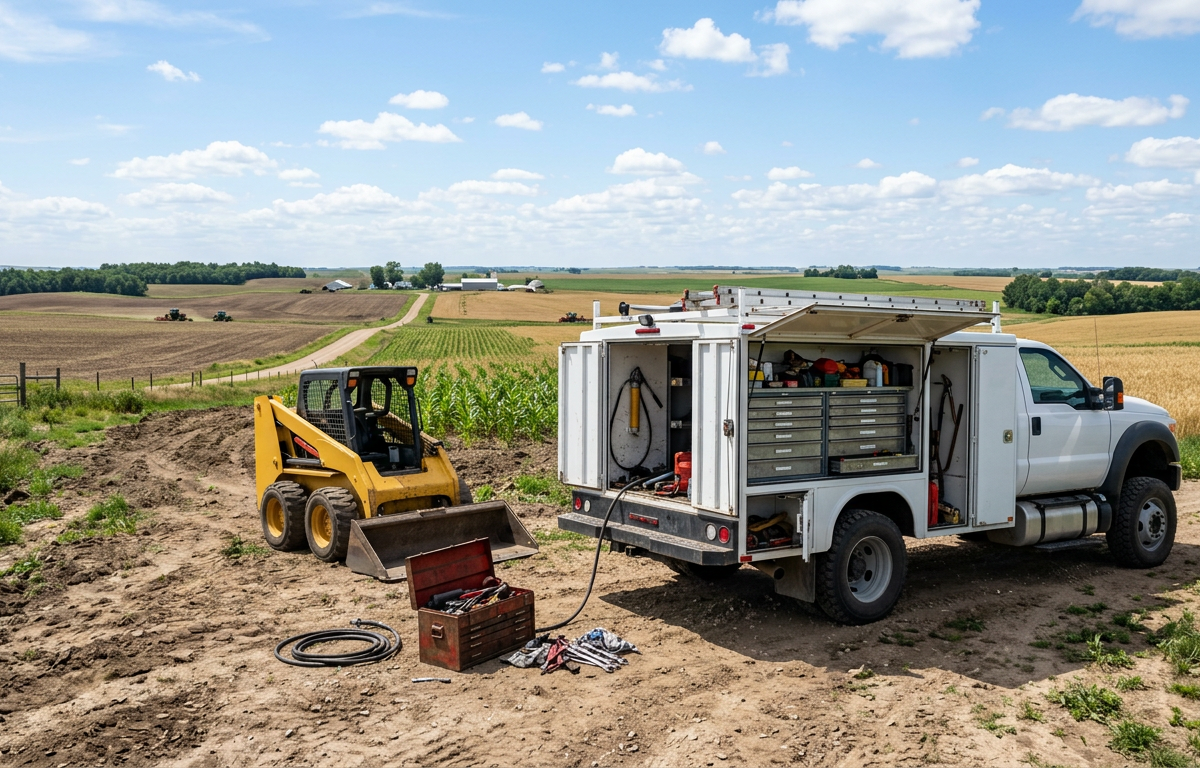
Say a hydraulic hose lets go on a skid steer at 6:40 on a Friday evening, mid-planting, and the farmer on the other end of the phone doesn't care what your week looks like. You drop everything, drive out, fix it in the dark under a headlamp, and he pays the invoice without blinking. Then you don't hear from him again until the next thing breaks — six months, a year, whenever the machine decides to fail next. That's not a customer relationship. That's a fire department.
Every mobile heavy equipment mechanic has a customer like that. The ones who get him on a standing maintenance contract instead of waiting for the next hose to blow end up with a calendar of scheduled work instead of a phone that only rings when something's already broken.
What that Friday call actually billed
Put real numbers on the emergency first, because the emergency is what you're pricing the contract against. Off the 2026 side-work rate data for this trade: a field service call runs $280, and the hydraulic repair itself another $720, roughly $300 of that in hose and fittings. That Friday night was a $1,000 ticket — before you count what the downtime cost the farmer in the middle of planting, which is the number he actually remembers.
A scheduled preventive maintenance visit, meanwhile, bills $420 — about $180 in fluids and filters plus roughly an hour and three quarters of your time at the $135 field rate. A diagnostic sweep is $220. Hold those four numbers — the whole contract pitch is arithmetic between them.
Skip the 10-15% rule
Most advice on equipment maintenance budgets leans on the old fleet-manager rule of thumb: spend 10 to 15% of a machine's replacement value per year on upkeep. My take: leave that rule to the fleet managers, because as a price it's useless to you. It tells a farmer with a lightly used $60,000 skid steer to budget $6,000 to $9,000 a year — a number that has nothing to do with what the machine needs and everything to do with what it cost, and it'll scare him off before you've opened the toolbox. Meanwhile it underprices the contractor running the same machine 1,200 hours a season, whose undercarriage alone is a $1,400 job waiting on the calendar.
Price off the hour meter and your own visit menu instead. A machine's usage tells you how many visits it needs; your rates tell you what those visits cost. Replacement value tells you neither.
Three tiers with actual dollars on them
Build the tiers as sums of real visits, so the customer can see exactly what each dollar buys:
| Tier | What's in it | Annual price |
|---|---|---|
| Basic | 2 PM visits (fluids, filters, greasing, visual inspection) | 2 × $420 = $840 |
| Standard | 3 PM visits + annual diagnostic sweep (belts, hoses, battery, hydraulic pressures) | 3 × $420 + $220 = $1,480 |
| Priority | 4 PM visits + diagnostic sweep + guaranteed 48-hour emergency response | $1,680 + $220 + $300 = $2,200 |
That $300 on the Priority line is the response guarantee itself, priced as its own item — and for a customer who's been through a mid-season breakdown, it's the most valuable line on the sheet. A guaranteed window during planting or paving season is worth more to him than the visits. Price it like it's worth something, because it is: you're selling him the right to jump your queue.
One machine, walked through a full annual quote
Take that same skid steer, running about 1,000 hours a year, on the Standard tier:
- Spring PM visit — fluids, filters, greasing, full walk-around: $420
- Mid-season PM visit, timed to the hour meter: $420
- Fall PM visit with cold-start prep before storage: $420
- Annual diagnostic sweep — hydraulic pressures, charging system, belt and hose wear: $220
- Annual contract total: $1,480, billed at $370 a quarter
Now hand the farmer the comparison, because it closes itself: one Friday-night hose failure already cost him $1,000 — two-thirds of the entire year's contract — and that was a cheap failure. The $1,400 undercarriage job, the $950 engine service that started as a $180 filter nobody changed: most of what fails catastrophically was throwing warning signs for weeks. Catching it on a $420 scheduled visit costs a filter and an hour. Catching it on the side of a field costs a tow, a rush part, and a planting window.
Quarterly billing matters as much as the total. $370 four times a year is a number a working farm plans around; a surprise four-figure invoice is a number it argues with.
What actually goes in the contract
Keep the scope concrete enough that both of you know exactly what a visit covers. A contract that just says "maintenance" invites arguments later about what should've been caught.
Write down what each visit checks, not just "PM service." A one-page checklist — hydraulic fluid level and condition, hose wear points, filter changes by hour meter, undercarriage and track tension, battery and charging system, greasing points — signed off at each visit gives the customer a paper record and gives you a defense if something fails between visits that wasn't on the list. HVAC operators run a nearly identical version of this pitch on furnaces and condensers — how solo HVAC techs sell maintenance plans is worth a read even if you've never touched a compressor.
Two pricing guards while you're writing it up. Base the visit count on the hour meter — a machine running 1,200 hours a year needs the Priority schedule; one that sits most of the season doesn't. And build in a trip fee for anything outside your normal radius, stated up front: a contract customer forty-five minutes out isn't the same cost to service as one down the road. If you're not sure the $135 field rate is even right for your costs, run it through what you should be charging before you lock a year of visits against it — a contract priced below your real cost per hour is worse than no contract at all.
When and how to bring it up
The worst time to pitch a maintenance contract is a cold call. The best time is five minutes after you've just fixed the emergency — the customer is standing right there, relieved, watching you put your tools away, and thinking about exactly how much that breakdown just cost him. That's when you say it plainly: "Tonight was a thousand dollars. I can catch most of this before it strands you — $370 a quarter puts you on a schedule." No hard close, no packet to sign on the spot. Just the offer, followed by a written estimate he can look over once the adrenaline's worn off.
Don't pitch it on every call, either. An alternator dead of old age is normal wear, not a preventable pattern. Save it for the failures that could have been caught: the long-standing leak, the visibly cracked belt, the filter nobody had touched in two seasons.
Turning one farm into a route
Two or three contract customers in the same rural stretch make a route, not a scattered client list. Schedule their visits back to back — that's what keeps the $420 visit profitable instead of half-eaten by the drive — and ask each one who else nearby runs similar equipment; farmers within twenty minutes of each other usually know exactly who's fighting the same aging fleet. The off-season matters too: winter is when neglected machines come out of storage and die on the first cold start, which is why the fall visit in that Standard quote exists — it also fills a month that would otherwise sit empty.
The estimate-to-approval flow you already use for the emergency call works the same for the annual contract — write it up, let them approve it from their phone, and get paid quarterly instead of chasing an invoice after every visit. See how it works in the demo, seeded for heavy equipment, or start free and set up your first contract customer this week. Five jobs a year free, no card, then $19/mo or $190/yr.
FAQ
How much should I charge for a heavy equipment maintenance contract?
Build it from your real visit prices instead of a percentage rule: with PM visits at $420 and a diagnostic sweep at $220, a two-visit Basic tier lands at $840 a year, a three-visit Standard tier with the sweep at $1,480, and a four-visit Priority tier with a guaranteed emergency response window at $2,200. Adjust the visit count to the machine's hour meter, not its sticker price.
What should be included in a heavy equipment PM contract?
At minimum: fluid and filter changes on a schedule tied to the hour meter, greasing all points, a visual belt and hose inspection, and a written checklist signed at each visit. Higher tiers add a full diagnostic sweep — hydraulic pressures, charging system — and, for customers who've been burned before, a guaranteed emergency response window priced as its own line.
How do I convince a farmer or contractor to sign a maintenance contract instead of just calling when something breaks?
Pitch it right after you've fixed an emergency, with the real numbers in hand: a Friday-night hose failure bills around $1,000 between the field call and the repair, which is two-thirds of a $1,480 annual contract that would likely have caught it. Lead with that math and a written estimate he can review later, not a signature on the spot.
How many contract customers can one mobile mechanic realistically service?
Clustering matters more than the raw count — three farms within twenty minutes of each other are far more profitable than three spread an hour apart, because the drive time comes out of the same $420 visit either way. Build the route before you build the customer list, and let referrals from existing contract customers fill in the map around them.