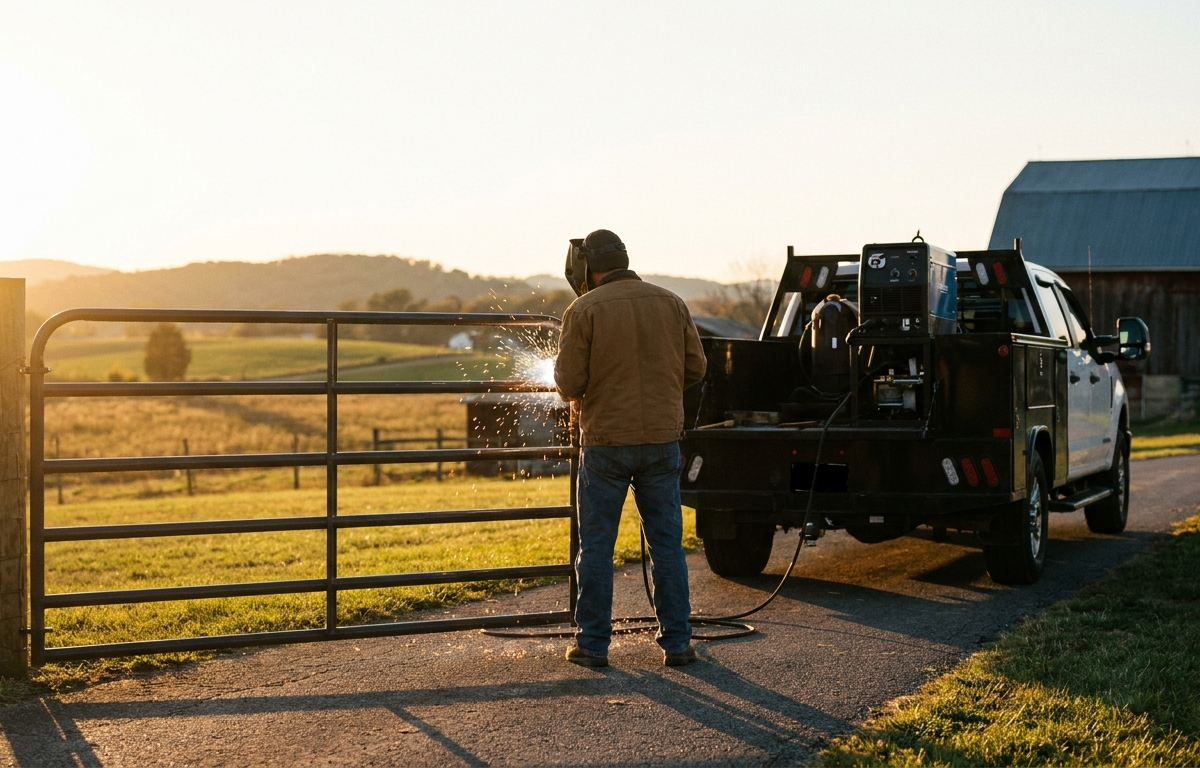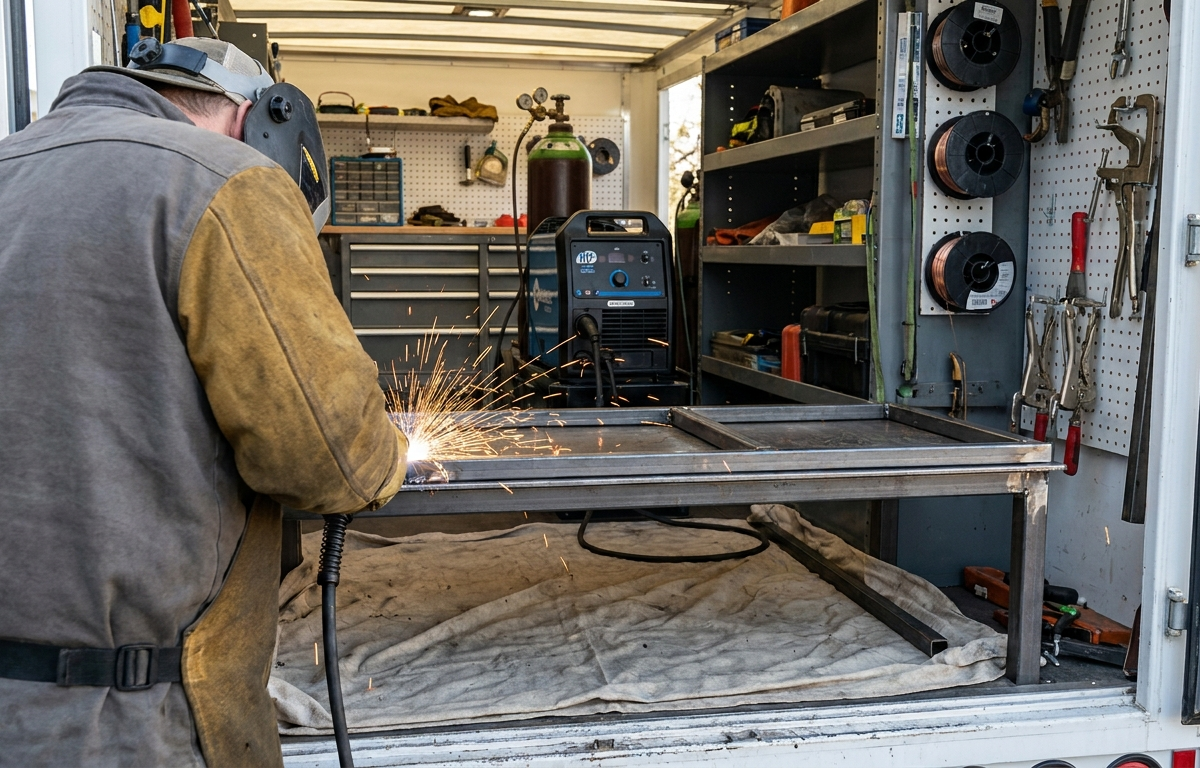
The classic side-gig pricing move for welders: think about how long it'll take, multiply by whatever feels reasonable, and hope the customer doesn't push back. It keeps you busy. Busy and profitable are different things, though, and a lot of skilled welders spend years confusing them.
The rate itself is usually not the main problem. The problem is everything that rate fails to cover — wire, gas, consumables, drive time, equipment wear, the 20 minutes you spent quoting and texting back and forth. When those costs go unaccounted across enough jobs, you end up working full weekends for money that barely covers what you spent on supplies.
Know Your True Costs Before You Quote
Most welders can tell you what they paid for a spool of wire. Fewer know their actual cost per job, including everything.
Tips, nozzles, grinding wheels, cutting discs, sanding pads, anti-spatter spray — a welder running regular side jobs burns through $60-90 in consumables most weeks. Argon/CO2 mix runs $40-50 per bottle at current prices, and depending on your work you might go through one every few days. A 30lb wire spool is around $40 and lasts about two weeks at moderate volume.
Equipment has a cost too. A $700 MIG welder running consistent weekend side work for four years means you're carrying roughly $15/month in depreciation before you strike an arc. Add your grinder, helmet, leads, clamps, and cart.
If you're mobile, your truck isn't running free. The IRS standard mileage rate is 72.5¢/mile for 2026. A 25-mile drive each way to a farm job is about $36 in vehicle cost before you add the 45 minutes you spent behind the wheel.
Add it up on your next job before you give a number. Most welders find they're carrying $40-60 in true overhead per job and haven't been accounting for any of it.
What Your Rate Needs to Be
Independent mobile welders typically charge $75-150/hr, depending on region, experience, and the type of work. General repair and light fabrication typically lands in the $85-110 range. Certified structural welders and pipe welders are at $110-150 and up.
When you run your own side work, your billable rate has to absorb taxes, self-employment contributions, insurance ($1,200-3,400/year for a basic welding business policy depending on your state and work type), consumables, equipment, and all the time you spend that isn't billable. The real multiplier from your target take-home to what you need to bill is closer to 2.5-3x. If you need to net $35/hr to actually be ahead, you need to bill around $87-105/hr. That's the math — not ambition.
If you're currently south of $75 right now, look carefully at what your rate is not covering.
Regional context matters. In smaller markets where you're the only mobile welder in 30 miles, you can hold the top of the range without much pushback. In a city with three welding shops and a dozen independents advertising on Facebook Marketplace, you'll compete more on speed, availability, and quality. Know your market, but don't let anxiety about competition push you to undercut yourself into a loss.
The Minimum Charge Problem
Every mobile welder needs a minimum service charge. Most don't charge enough for it.
A typical call-out: drive there, unload, set up, do 20 minutes of actual welding, clean up, drive back. That's 2-2.5 hours of your day. If you bill one hour at $90, you made $90 for a half-day's effort after gas.
A minimum of $75-150 as a flat trip charge, on top of your hourly rate, is standard for mobile tradespeople. Many welders charge $150 for the first hour and their regular rate after that. Some use a flat service fee of $150-250 for any quick job under a certain scope.
When customers push back: "That's what it costs to show up with the right equipment and do it properly." A customer who won't pay a fair call-out for skilled trade work on their schedule tends to be the same customer who calls at 6pm on Friday and expects Monday-morning rates.
Materials: Stop Passing Through at Cost
Charging customers exactly what you paid for materials leaves money on every job.
You sourced the material, drove to pick it up or paid for delivery, inventoried it, cut and fitted it, dealt with scrap and offcuts. A 20-30% markup on materials is standard across the trades. That means a $75 material cost shows up on the invoice as $90-97 — not because you're padding the bill, but because handling has real cost.
Add a 10% contingency on top of your material estimate for any job with complexity. Steel prices shift. You end up needing more material than estimated. A weld doesn't go right and you cut and re-fit. That buffer absorbs those realities without coming out of your labor margin.
For stainless or aluminum work, materials run 1.5-2x the cost of mild steel, and the welding itself is slower and harder. TIG work warrants at least a 25% premium on labor over standard MIG. Price it that way from the first quote.
Flat-Rate vs. Hourly: When to Use Each
Hourly pricing makes sense when scope is genuinely unclear: a crack repair that might run 3 inches or 12, a trailer frame where you don't know what's hiding under the rust until you start grinding. It protects you when jobs expand beyond the estimate.
Flat-rate pricing works better when you've done the job enough times to know what it takes. A standard ornamental gate hinge repair. A draw bar replacement on a tractor. A receiver hitch fabrication. If you've done 20 of something, you know it takes about 1.5 hours and $45 in materials. Charge a flat rate built around 2 hours and $55 in materials, give the customer one clean number, and when you finish in 90 minutes you've made a better effective margin without raising prices.
Track your actual time on every job for a month. Most welders find their common work falls into four or five repeatable categories with predictable time ranges. Build flat rates around the high end of each. As you get faster, your effective hourly rate climbs automatically.
A Working Quote Checklist
Before you give any customer a number, run through this:
- Labor: hours (realistic estimate, add 10% buffer) x your rate
- Materials: cost x 1.25 to 1.30
- Trip minimum: $75-150 if you're mobile
- Specialty premium: +25% for TIG, more for certified or pressure-vessel work
- Material contingency: add 10% to your material total for volatility
Add those up. That's your floor.
Then ask the second question: what does this problem cost the customer if they leave it unfixed today?
A broken loader arm shutting down a job site costs real money per hour. A cracked plow frame the night before planting season is a genuine emergency. When the value of the fix is much higher than your labor cost, you have room to price for urgency. A 25-50% premium for nights, weekends, or same-day availability is defensible and common in mobile trades. You're pricing scarcity, not being opportunistic.
Holding Your Number
Quoting is half the job. Holding the quote is the rest.
Most welders drop their price not because a customer made a compelling argument, but because the silence after they said the number was uncomfortable. "Is that your best price?" is a reflex, not a negotiation. You don't have to move.
If a customer says a shop quoted them less, ask when the shop can get to it. A two-week backlog and your availability Thursday are not the same service. Say that plainly.
The customers who push hardest on price tend to be the hardest to work for — slow to pay, always finding something after the job is done, calling Friday evening and expecting a weekday rate. Your best regulars are almost always the ones who paid fair the first time without much fuss.
Building a Side Business That Actually Pays
Good pricing and solid welds compound in the same direction. A clean bead, finished when you said you'd be there, with an invoice that shows exactly what they paid for — that's the whole marketing strategy for a welding side business. Most of your referrals and repeat calls come from customers who respected both the quality of the work and the way you ran the job.
Keep a simple record of every job: what it was, how long it took, what you charged. After six months you'll have a clear picture of your effective rate and which types of work pay you well. Cut the work that doesn't, build toward more of what does.
For more on running a profitable welding side business, including how to track jobs and get paid faster, see the SideWRK welding hub. If you want to see how this same pricing discipline applies to other outdoor trades, the landscaping pricing guide covers the same problem of knowing your true floor before you quote.
Sending a professional estimate before you start and a clean invoice when you're done sets you apart from most independent welders still texting numbers and collecting cash. SideWRK makes that part take about 60 seconds per job. Get your rate right, do the work well, and the customers who value it will keep coming back.
Start free — five jobs a year free, no card, then $19/mo or $190/yr.
FAQ
How much should a mobile welder charge per hour?
Independent mobile welders typically charge $75-150/hr — general repair and light fabrication in the $85-110 range, certified structural or pipe welding at $110-150 and up. To net $35/hr take-home after taxes, insurance, consumables, and non-billable time, you generally need to bill around $87-105/hr — roughly 2.5-3x your target take-home rate.
Should welders charge a trip or minimum service fee?
Yes — a minimum of $75-150 as a flat trip charge on top of your hourly rate is standard, since a call-out with drive time, setup, and cleanup can eat 2-2.5 hours for only 20 minutes of actual welding. Without a minimum, a one-hour bill at $90 barely covers gas for a half-day's effort.
How much should welders mark up materials?
A 20-30% markup on materials is standard across the trades, covering sourcing, pickup or delivery, and handling scrap and offcuts — not padding the bill. Add a 10% contingency on top of the material estimate for any job with real complexity, since steel prices shift and jobs often need more material than first estimated.
When should a welder use flat-rate pricing instead of hourly?
Flat-rate works once you've done a job enough times to know what it actually takes — a standard gate hinge repair or hitch fabrication you've done 20 times can be priced at a clean flat number instead of billed hourly. Hourly is better when scope is genuinely unclear, like a crack repair that might run 3 inches or 12.
Running the Math Without Redoing It Every Time
The checklist above works. The catch is running it fresh on every quote — most welders do the full math once, get a feel for their numbers, and drift back to gut pricing by the third job. That's not a discipline problem. It's a structure problem, and the fix is putting the math somewhere it runs itself.
Welding is one of the few trades where hourly billing is the honest structure. The work varies too much for a flat menu, and per-unit pricing falls apart the moment a grinder finds rust. SideWRK bills welding exactly that way: a labor line is hours times your rate, and every piece of steel, bottle of gas, or box of wire rides underneath it as its own line. The total builds while you type. A new welding account starts at a researched $95/hr default — you change it to your number once, and the work form prefills it on every job after that. No more inventing a rate in the driveway.
The Two Costs Only You Can See
Here's where the margin actually shows up. Every line on a SideWRK estimate carries a private "your cost" the customer never sees — and that field is the difference between knowing what you charged and knowing what you made.
Say a trailer hitch repair invoices at $350: about two and a half hours at $95, plus a $120 materials line. If the steel and consumables ran you $95, that materials line is carrying the markup this guide told you to build in, and the Money tab shows the job put roughly $255 in your pocket — not the $350 on the invoice. Charge without tracking cost and every job looks the same. Track both and you find out fast which work pays and which work just keeps you busy.
One more habit worth building: when the farmer hands you his own steel to weld with, log the material as customer-supplied at zero. The invoice stays honest, and your margin history doesn't get polluted by metal you never bought.
Paper That Protects the Price
A one-line scope note on the estimate settles arguments before they start. "Repair weld — not certified for structural / DOT use" is the classic for this trade — it's the exact example SideWRK suggests on a welding work note. Nobody's making you write it. But if a repaired gate ends up holding a load it shouldn't, that line is the record of what you sold and what you didn't.
The job-site log earns its keep the same quiet way. Base metal, structural or not, shop piece or installed on site — three fields, ten seconds. Next time a stainless call comes in, you can pull up what the last one really took and price from your own history instead of your memory. Your memory rounds down. The record doesn't.
The Other Half: What the Market Pays
Everything in this guide is about the floor — what a job costs you, and what your rate has to absorb before you keep a dime. The ceiling is a separate question: what mobile work actually commands out in the field. The mobile welding rates guide owns that story — why your field rate should sit above your shop rate, how to structure a trip charge so a half-day call never invoices at a loss, why quoting per inch over the phone is a unit invented to lose money, and where six common mobile jobs really land. Read them together. This one keeps you from quoting below your cost; that one keeps you from quoting below your market.
When you want the arithmetic done for you, the welding cost calculator runs the hours-plus-materials math free in your browser. And when the your-cost habit takes hold, knowing your numbers is where six months of tracked jobs turns into a clear answer on which welding work deserves more of your weekends.