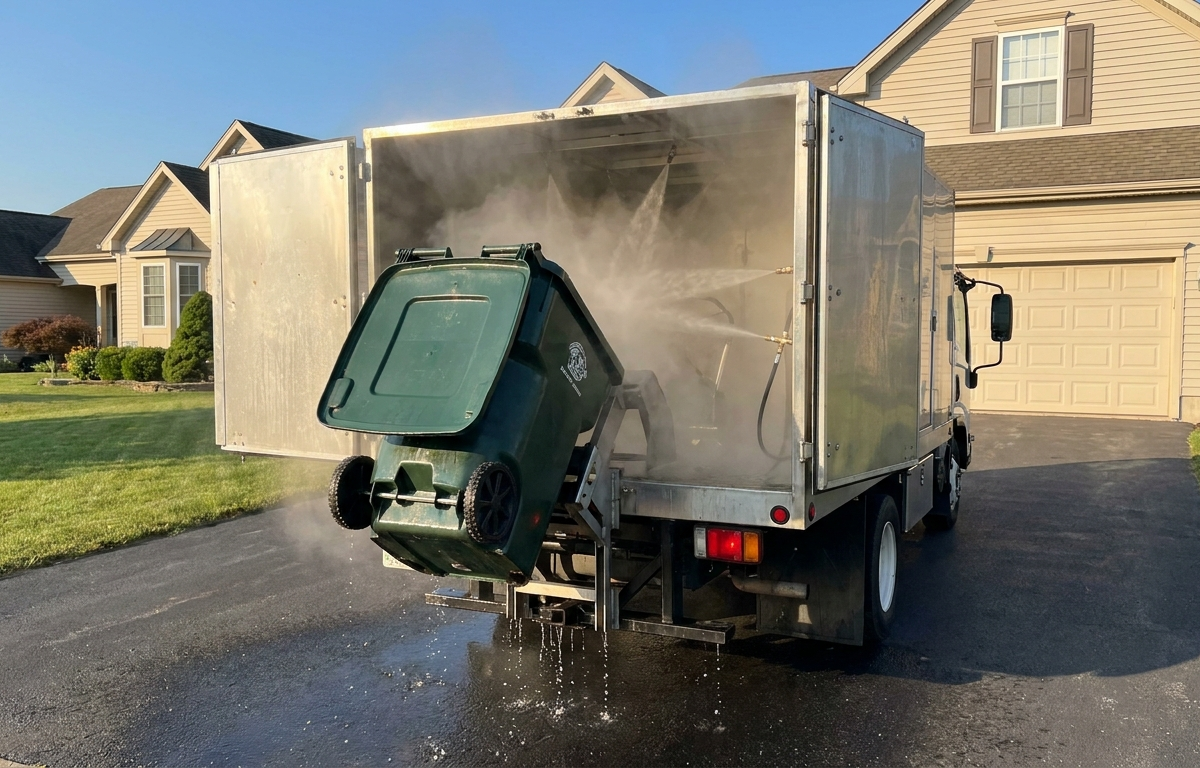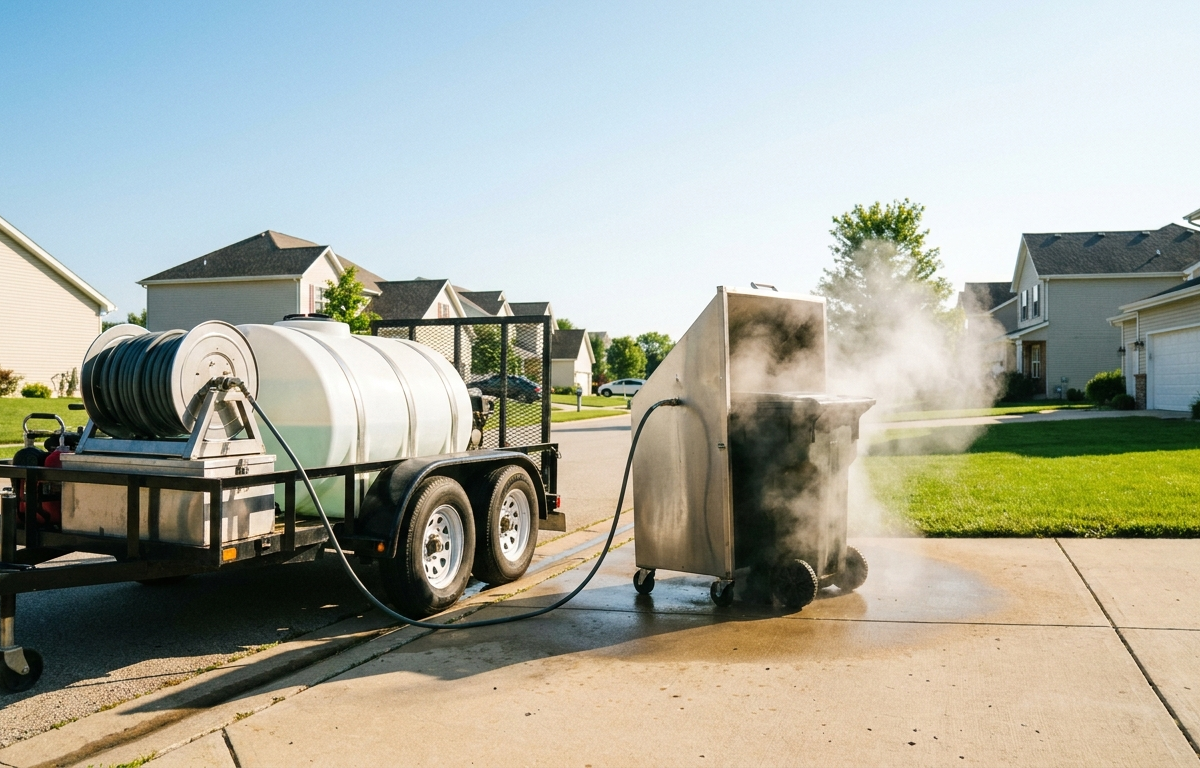
Picture the guy who buys the rig first — a 500-gallon water tank, a hot-water heater unit, a trailer wrap, business cards for a company with zero customers. Eight grand in before he's cleaned a single can. Six months later the trailer sells at a loss, because he built the truck before he built the route, and there weren't enough houses on his streets willing to pay to keep their garbage cans from stinking up the curb in July.
The operators who actually make bin cleaning work run that order backwards. They find the first twenty customers with almost nothing, prove one neighborhood will pay, and only then spend real money on a tank and a wrap. Summer is when this business either catches or doesn't — heat, food scraps, and a few days of maggots in a black can turn "maybe someday" into "come today." Here's how to get the first twenty paying accounts before the season's over, and the math that says exactly when the trailer earns its place — the trash bin cleaning trade page has the rest of the setup once you're past the first neighborhood.
Trash day is your best ad, and it's free
Every can on the street on collection day is a lead standing in plain sight, already showing you exactly how bad the problem is. Walk the route the morning of pickup, not the night before — you want the cans dirty, curbside, ideally with a fly or two working the lid. A door hanger on a visibly rank can does more selling than any headline, because the homeowner already smelled the evidence an hour earlier taking the bag out.
Bring a phone and shoot a quick before photo of the worst cans on the block, blur the house number, and use it later. Real before-and-afters on your listings do more for conversion than almost anything else you'll post. People don't believe "we clean bins." They believe a photo of a can that used to have a brown ring around the lid and doesn't anymore.
Where the actual leads are this summer
Nextdoor and the local town Facebook group are where this trade converts, because bin cleaning is a hyper-local, hyper-visible problem — your neighbor's stinking can is your ad. Post with a photo, a flat price for two bins, and a specific week you'll be in their zip code. Specificity beats a generic "now booking!" post nine times out of ten.
A Google Business Profile matters more than people expect for a route business. Get it live, get five reviews as fast as you can — that's roughly where you start showing in local search — then keep pushing toward twenty, where the phone starts ringing instead of you chasing it.
Don't sleep on partnerships either. Property managers run multiple buildings and need dumpster corrals and bin rows cleaned on a schedule; one conversation with a management company can be worth fifteen doors. And a pressure washer already in your truck bed is half the equipment this trade needs — cross-referring with a pressure-washing operator, or running both trades yourself, means two services out of one truck roll.
The route math: 20 accounts vs. the $8,000 rig
Here's the arithmetic the guy with the wrapped trailer never ran. The going monthly rate for a two-bin cleaning is $27 in the 2026 side-work rate data. Twenty accounts — a genuinely solid first summer — is:
20 accounts × $27/month = $540 a month
Now put the rig against it. Finance $8,000 of tank-and-trailer over 36 months and the payment lands around $258 a month — which means your first ten accounts exist to feed the trailer. Pay cash instead and $8,000 ÷ $540 is almost 15 months of every single dollar the route makes, before fuel and water, just to get back to zero.
That's the whole case for proving the route first, and it's worth saying bluntly: an $8,000 rig at zero accounts isn't a business purchase, it's a financed hobby. The break-even math says the trailer is a 60-account decision — at 60 × $27, the route grosses $1,620 a month, the payment drops to 16% of revenue instead of 48%, and the hot-water system starts earning its keep in stops-per-hour. Until then, a pressure washer, a garden hose split, and a shop-vac clean cans just fine.
What a real first-route month looks like
Price a 20-account month line by line, because the recurring base isn't the only money on the street:
- 20 monthly accounts, two bins each, 20 × $27: $540
- Two one-time deep cleans from Facebook posts, 2 × $50: $100
- One move-out rental turn for a landlord: $45
- Month total: $685
No materials line to speak of — this trade is nearly all labor and water — so most of that $685 is yours after fuel. It also resets the break-even: at $685 a month, the cash-bought rig pays back in about 12 months instead of 15. The one-timers matter twice, though: a $50 deep clean is this trade's best sales call, because half of them convert to the $27 monthly plan once they've seen the can come back white.
Turn the first clean into a route, not a one-off
A single $50 deep clean is fine money for the time. The $27-a-month subscription, billed automatically, is the business — because density is what makes the fuel and drive time worth it. Six houses on one cul-de-sac beat six houses across three towns even at the same price; you're paid for the job, not the windshield time between jobs.
Structure the offer around two cans from the start — trash and recycling — since that's the package almost every successful bin cleaner leads with. Monthly at $27 wins the most sign-ups because it's cheap enough to not think about; bi-weekly at $22 a visit fits the heavy-use houses; quarterly at $35 a visit is the easy first yes for someone testing you during peak stink season. The pricing guide for this trade walks the full per-bin math for rates you won't have to walk back later.
The follow-up that keeps the subscription alive
The account you lose isn't the one who complained — it's the one who quietly canceled because you never showed back up on the calendar and they forgot you existed. A route business lives or dies on the automatic re-bill and the reminder that goes out the week before the truck rolls. Set the expectation on day one — "we're back every four weeks, card on file, cancel anytime" — so nobody's surprised by a charge and nobody has to remember to call.
Ask for the review from the driveway, right after the last bin goes back against the curb, not by text three days later when the smell's forgotten. When a customer refers a neighbor, that's the cheapest lead you'll ever get — a free $27 clean in trade is nothing against what that door would've cost cold. To see how a recurring route gets scheduled and billed before you build one, SideWRK's demo seeded for this trade shows the whole flow with no signup.
A clean, professional invoice earns its keep here too — a branded receipt showing the recurring schedule reads like a real business, not a guy with a hose and a Venmo handle. SideWRK builds the estimate and the recurring invoice from your phone between stops, tracks what each route nets after gas and water, and sends the automatic payment reminders so you're not the one texting "hey, did that go through" — start your free 14-day trial — no card — and set the first route up before the season's over.
FAQ
How much should I charge for trash bin cleaning?
$27 a month for two bins on the standard recurring plan, $22 a visit on bi-weekly service, $35 a visit quarterly, and $50 for a one-time deep clean. Run those against your own water and fuel costs with the trash bin cleaning cost calculator before locking anything in.
Do I need a special truck to start a bin cleaning business?
No — start with a pressure washer, a garden hose splitter, and a shop-vac to prove the model in one neighborhood. An $8,000 tank-and-trailer rig runs about $258 a month financed, which eats ten $27 accounts before you've made a dollar. Buy it around the 60-account mark, when the payment falls under a fifth of route revenue.
How many bin cleaning customers do I need to make it worth doing?
Ten paying accounts in one tight cluster proves the price holds and the density works. Twenty accounts is a $540-a-month recurring base — $685 with a couple of one-timers mixed in — and sixty is where the route grosses $1,620 a month and justifies real equipment.
What's the best way to find bin cleaning customers without paid ads?
Canvass on trash day when the cans are visibly dirty, post in Nextdoor and the local Facebook group with a photo and a specific date, and get your Google Business Profile live with real before-and-afters. Property managers and HOAs are worth a call too — one contract can be worth fifteen doors.
Is trash bin cleaning a good side business in summer?
Yes — heat, food waste, and maggots make summer the peak signup season, which is exactly when a door hanger on a smelling can converts fastest. Just remember you're selling a recurring route, not a one-off clean: the money is in signing people up now and keeping them on the schedule into fall.