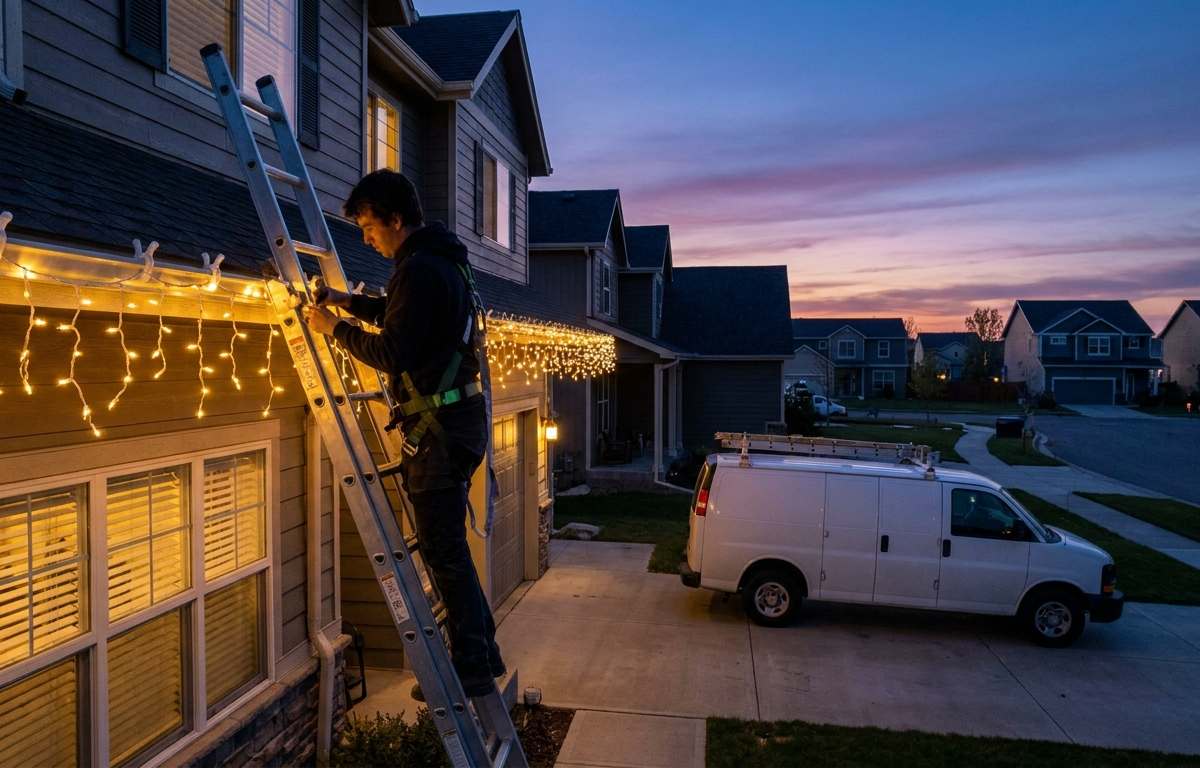
A 140-foot roofline at $6 a linear foot is an $850 ticket, and a two-man crew hangs it in an afternoon. That's the number that makes seasonal lighting worth taking seriously as a trade instead of a favor you do with a borrowed ladder. It's also the number almost nobody puts in front of a customer in August, when the calendar is wide open and the neighbor hasn't thought to Google anything yet. The install season itself runs a tight 60 to 70 days, roughly mid-November through the takedown push in January. A window that short doesn't forgive slow starts. The operator who books in August fills those days with confirmed work; the one who waits for the first cold snap fills them with phone tag.
What the work actually pays, foot by foot
Seasonal lighting isn't one price. It's a short menu, and each line bills its own way, per 2026 side-work rate data:
| Service | How it bills | Real number |
|---|---|---|
| Roofline lights install | Per linear foot | $6/ft — a 140-ft roofline runs $850 |
| Tree & bush wrap | Per item | $50 each |
| Wreaths & garland | Per piece | $50 each — five pieces, $250 |
| Halloween & fall decor install | Flat | $400 |
| Takedown & storage | Flat | $250 |
| Re-install next season | Per linear foot | $6/ft |
Two things jump out of that menu. First, the roofline is the anchor, but the add-ons are where the ticket grows — bushes, wreaths, and garland stack another $400 to $500 onto a house without adding much ladder time. Second, takedown and storage is its own paid line. If you're folding takedown into the install price "to be nice," you're giving away a $250 service and a January payday.
One house, priced line by line
Say the call is a two-story colonial with a 140-foot roofline, four bushes out front, and a customer who wants the full look:
- Roofline lights install: 140 ft × $6 = $850
- Tree & bush wrap: 4 × $50 = $200
- Wreaths & garland: 5 pieces × $50 = $250
- Takedown & storage: $250
That's a $1,550 season, quoted from the driveway with a tape measure and a calculator. Not a "somewhere between $800 and $2,000 depending" conversation. One number, one document, one approval.
Now stretch that across the window. The install crunch gives you maybe 35 working days before Christmas week. Hang one house a day at that average and you gross around $54,000; a strong operator doubling up on the small ones can push 40-plus installs and clear $60,000 gross in about ten weeks. That's the season economics nobody explains when they tell you to "get into Christmas lights" — the ceiling isn't the price per house, it's how many houses you locked in before the window opened.
Year one is your worst year on purpose
Here's the catch, and it's a real one: roughly 45% of a first-year ticket is materials. Commercial-grade LED strands, custom-cut to the roofline, plus clips, timers, and cords — on that $1,550 house, call it $700 walking out the door before you count fuel or ladder hours. Year one, you're building inventory, not getting rich.
Year two is a different business. The lights are cut, labeled, and sitting in your storage — that's what the $250 takedown-and-storage line actually buys you — and re-install bills at the same $6 a foot with almost no material cost behind it. The same house that netted you maybe $600 in year one nets closer to $1,100 in year two. Every season after that compounds the same way.
Which is why this stance is worth planting a flag on: never hang customer-owned lights. The tangled big-box bin from their garage pays you once, breaks mid-season on your reputation, and stores in their attic where it does nothing for next year's calendar. Install product you own or supply, keep it in your storage, and the customer isn't buying lights anymore. They're subscribed to a lit house, and you're the only one who can turn it back on next November.
August is when the season is actually won
Every customer on last year's list should hear from you before Labor Day. Not a pitch — a confirmation: "Locking in this year's dates. Your re-install is $6 a foot same as last season, want your same week?" A returning customer isn't comparison-shopping; they're saying yes to a date. Collect a deposit with the approval and that's money in the account months before the ladder comes off the truck.
New-customer marketing works the same calendar. A Google Business Profile filled out with last December's photos, a couple of dusk-reveal clips posted in September, postcards to the streets where you already hang — all of it is cheap in August and expensive in November, when every installer in the county is bidding on the same eyeballs. The season table stakes: whoever's proof is already posted when the first search happens wins the street.
The ladder you're already on
If you clean gutters in the fall, you're standing on the seasonal lighting customer's roofline in October holding their trust and their measurements. The gutter cleaning pricing guide covers that route; the short version is one ladder, one truck, and a customer who says yes to "want me to hang your lights while I'm up here next month?" at a rate no cold ad will ever match. October gutters, November installs, January takedowns. That's a route that pays from leaf-drop to the Super Bowl.
Price it off real footage, not gut feel — the seasonal lighting cost calculator builds the per-foot number for you, and the seasonal lighting trade page shows how an estimate carries the whole menu. When you're quoting six houses a week in the crunch, see it running in the live demo first, then start free and send last year's list a renewal they can approve from their phone in August. Five jobs a year free, no card, then $19/mo or $190/yr.
FAQ
How much should I charge per foot for Christmas light installation?
$6 per linear foot is the working 2026 number for roofline installs, so a typical 140-foot roofline runs about $850. Bushes and trees bill per item at around $50, wreaths and garland about $50 a piece, and takedown with storage is its own $250 flat line — a full house package lands near $1,550.
What does a seasonal lighting business gross in one season?
The install window is only 60 to 70 days, with roughly 35 working install days before Christmas. At an average ticket around $1,550, one install a day grosses about $54,000; operators who stack two smaller houses a day push past $60,000. Booking in August, not November, is what fills those days.
Should I install lights the customer already owns?
No. Customer-owned strands pay you once, fail mid-season on your reputation, and give the customer no reason to call next year. Supplying commercial-grade LED and storing it yourself costs you margin in year one — materials run about 45% of the ticket — but turns every house into recurring re-install revenue at nearly full margin from year two on.
When should I start booking holiday lighting customers?
Rebook last year's list in late August or early September, with a deposit collected at approval. New-customer marketing should be live by early October. Waiting until November means competing for attention during the most expensive, most crowded weeks of the whole season.
Does seasonal lighting pair with another trade?
Gutter cleaning is the natural fit — same ladder, same roofline, and a fall gutter route puts you in front of lighting customers in October, right before install season. Halloween and fall decor installs (a $400 flat service) bridge the gap between the two.