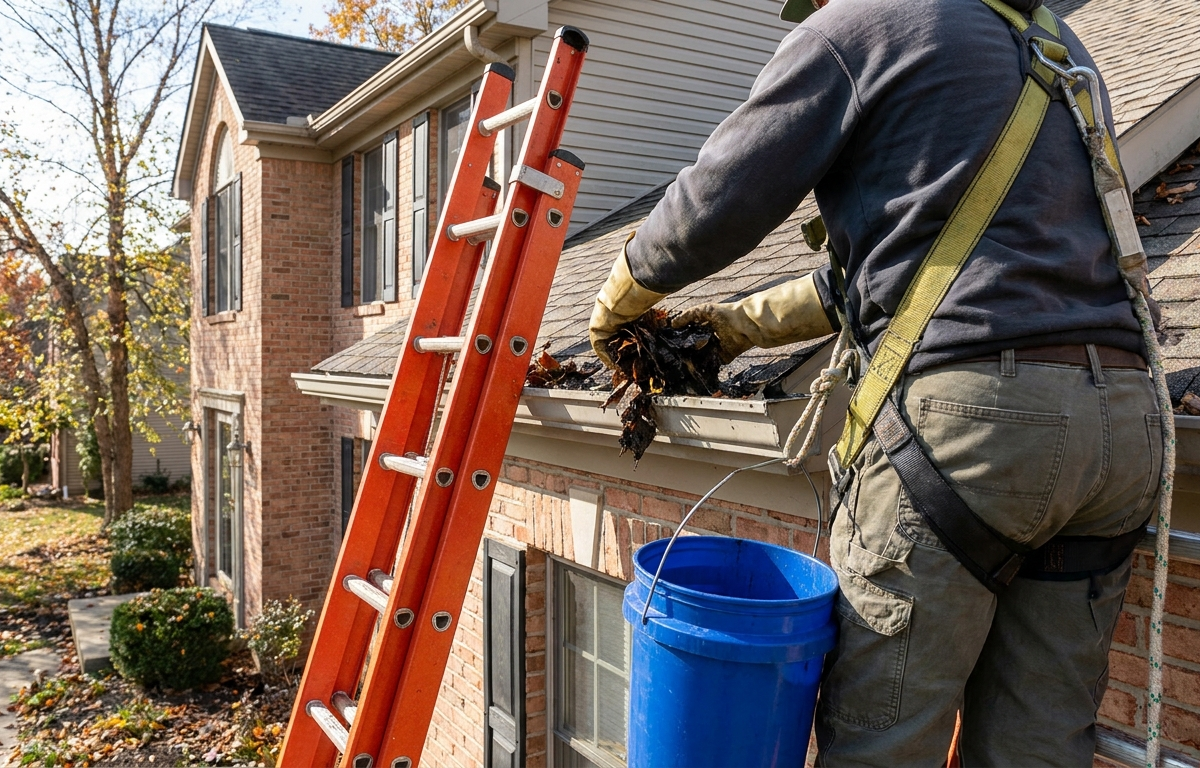
A two-story colonial with 180 feet of gutter and a season of maple keys packed into every trough is not the same job as a one-story ranch with 90 feet of clean aluminum and a leaf-guard system already installed. Charge them both $150 flat and you're either overcharging the ranch or working the colonial for less than minimum wage once you count the ladder setup, the extension pole, and the second trip for the downspout that's still backed up. Flat-rate gutter pricing feels simple until you've done fifty jobs and realize half of them lost you money.
Price by the linear foot, not by the house
The per-foot numbers that hold up across a season, pulled from the 2026 side-work rate data behind SideWRK's gutter defaults:
| Service | Rate | On a typical 150-ft run |
|---|---|---|
| Single-story clean | $1.00 / linear ft | $150 |
| Two-story clean | ~$1.67 / linear ft | $250 |
| Downspout flush | $45 per clogged downspout | $90 for two |
| Gutter guard install | $6.00 / linear ft | $900 |
| Minor realign / re-seal | $180 flat | — |
| Debris haul-away | $60 flat | — |
Your market may sit a little above or below those, but the structure is the point: the second story costs more per foot, not just more total, because every foot of it involves a taller ladder, more repositioning, and more risk.
Measure the actual run — front, back, and both sides — instead of eyeballing it from the driveway. A house that looks like a simple rectangle from the street often has an L-shaped addition or a dormer that adds twenty feet you didn't account for. Underestimate the footage twice on the same block and you'll start doubting every number you quote after that.
The 180-ft colonial, priced line by line
Here's what the math looks like on a real quote. Take that two-story colonial: 180 feet of gutter, nobody's touched it since the previous owners, and two downspouts packed solid.
- Two-story gutter clean — 180 ft × $1.67: $300
- Downspout flush — 2 clogged × $45: $90
- First-clean premium — 25% of the cleaning line: $75
- Debris bag and haul-away: $60
Total: $525.
Now put that next to the $150 flat quote the last guy gave. Same house, same ladder, same three hours of compacted maple debris — and $375 of difference. That's not gouging; the flat quote was the error. It priced a neglected two-story like a maintained ranch, and the operator who wrote it either ate the loss or cut corners to escape the job. Run that mistake across a fifty-job season and it's the difference between a business and an expensive hobby.
And here's the stance worth planting a flag on: the first-clean premium is not optional. Pricing a first clean like a maintenance clean punishes your loyal customers to subsidize the neglecters — the homeowner who books you every spring pays the same rate as the one who let small trees take root in the troughs. Charge the premium, say why ("this is a restoration, next time it's maintenance"), and the number becomes a selling point for the twice-a-year plan instead of a sore spot.
What actually moves the price
The linear-foot number is the starting point, not the whole quote. Adjust up for:
- First clean vs. maintenance clean. A gutter nobody's touched in three years has compacted debris, standing water, and sometimes small trees growing out of it. Charge the premium — 25 to 50 percent over your maintenance rate — and say so up front, not as a surprise on the invoice.
- Downspout clogs. A clogged downspout can eat twenty minutes with a plumber's snake or a garden hose and still not clear. Price it per downspout, not buried in your base rate.
- Gutter guards. Cleaning under or around installed guards takes longer per foot, not less — a lot of homeowners assume guards mean no cleaning ever, and correcting that expectation is part of the quote. Installing guards, on the other hand, is the best ticket in the trade: $6 a foot turns that same 150-ft house into a $900 job.
- Pitch and access. Steep roofs, no flat ground for ladder placement, gutters over a deck or pool — all of it adds time and risk. Price the risk, don't eat it.
- Debris disposal. Bagging and hauling wet leaves off-site is real time and a real dump fee on top of the cleaning itself.
Set a minimum job charge
A single-story home with sixty feet of gutter and light debris might price out under $100 on the linear-foot math. That's not enough to cover drive time, ladder setup, teardown, and the invoice you still have to send. Set a minimum — $125 to $150 covers most routes — and apply it every time, no exceptions for "it's just down the street." The jobs that feel small are exactly the ones that quietly wreck your day rate if you don't protect the floor.
Quote from photos when you can, walk it when you can't
For repeat customers or houses you can see clearly from the street or satellite view, you can often price accurately without a site visit — measure the roofline, apply your rate, send the number. For anything with unclear access, mature trees overhanging the roof, or a history of ice-dam damage, walk the property first. A five-minute look from ground level tells you more about compacted debris and guard condition than any photo the homeowner sends you.
Turn a one-time clean into two guaranteed visits a year
Gutters peak in spring, once winter debris and pollen settle, and again in fall, once leaves drop. That's not a coincidence you have to chase — it's a built-in reason to sell a twice-a-year plan instead of a one-off. Frame it plainly at the end of the first job: "I come back in the fall before the leaves clog things up again — want me on the calendar now while I'm here?" Most homeowners say yes on the spot because they're standing next to clean gutters and don't want to deal with this again in six months. And because you charged the first-clean premium honestly, the maintenance rate you quote them now genuinely is a better deal.
Raising your rate without losing the customer
If you've been underpricing — and a lot of operators find they have been once they actually run the linear-foot math — raise new-customer pricing immediately and give existing customers one season's notice before their rate moves. "Starting this fall, gutter cleanings are priced by the foot to cover fuel and materials" costs you almost nothing in goodwill if you say it plainly and don't apologize for running a business that has to cover its costs.
Getting the number right matters less than getting it consistent. A written estimate that shows the linear footage, the rate, and each add-on as its own line builds more trust than a verbal number scribbled on the back of a business card — and it's the number you'll actually get paid, instead of the one you meant to charge. SideWRK's gutter cleaning cost calculator runs the linear-foot math for you, and the gutter cleaning trade page is set up to turn that number into a branded estimate the customer approves from their phone. If you want to see how the estimate-to-invoice flow works for this trade specifically, the live demo is seeded with gutter cleaning jobs already loaded.
Once the pricing's dialed in, the harder part of the season is the calendar — the window cleaning recurring route guide walks through building a repeating route that keeps a truck full without cold-calling every week, and the logic carries over almost exactly to gutters.
Ready to stop guessing at the linear-foot math? Start free and see if it fits how you run your route. Five jobs a year free, no card, then $19/mo or $190/yr.
FAQ
How much should I charge to clean gutters on a two-story house?
Around $1.67 per linear foot for a standard two-story, which puts a 150-ft run at $250 and a 180-ft colonial at $300 before add-ons. Clogged downspouts ($45 each), a first-clean premium of 25% on neglected gutters, and debris haul-away ($60) stack on top of that — the 180-ft example above lands at $525 all-in.
Should I charge extra for clogged downspouts?
Yes — price downspout clearing as its own line item at about $45 per downspout rather than folding it into your base rate. A downspout that needs a plumber's snake or a hose flush can eat twenty minutes that your linear-foot price never accounted for.
What's a fair minimum charge for a small gutter cleaning job?
Set a minimum around $125 to $150 regardless of how short the run is. Drive time, ladder setup, and teardown cost the same on a small house as a big one, so the minimum protects your day rate on jobs the per-foot math would otherwise underprice.
How do I get customers to sign up for twice-a-year cleanings instead of one-off jobs?
Ask while you're still on site after the first clean, when the homeowner can see the results. Point out that gutters clog again with spring pollen and fall leaf drop, then offer to put them on the calendar now — and note that the maintenance rate is lower than the first-clean price they just paid, which makes saying yes easy.
Is gutter cleaning pricing different for homes with leaf guards installed?
Guards change the work, not eliminate it — debris still builds up on top of or inside most guard systems and takes real time to clear. Price guard-equipped homes close to your standard rate and explain why. If the guards are failing, an install or replacement at $6 per foot is often the better conversation for both of you.