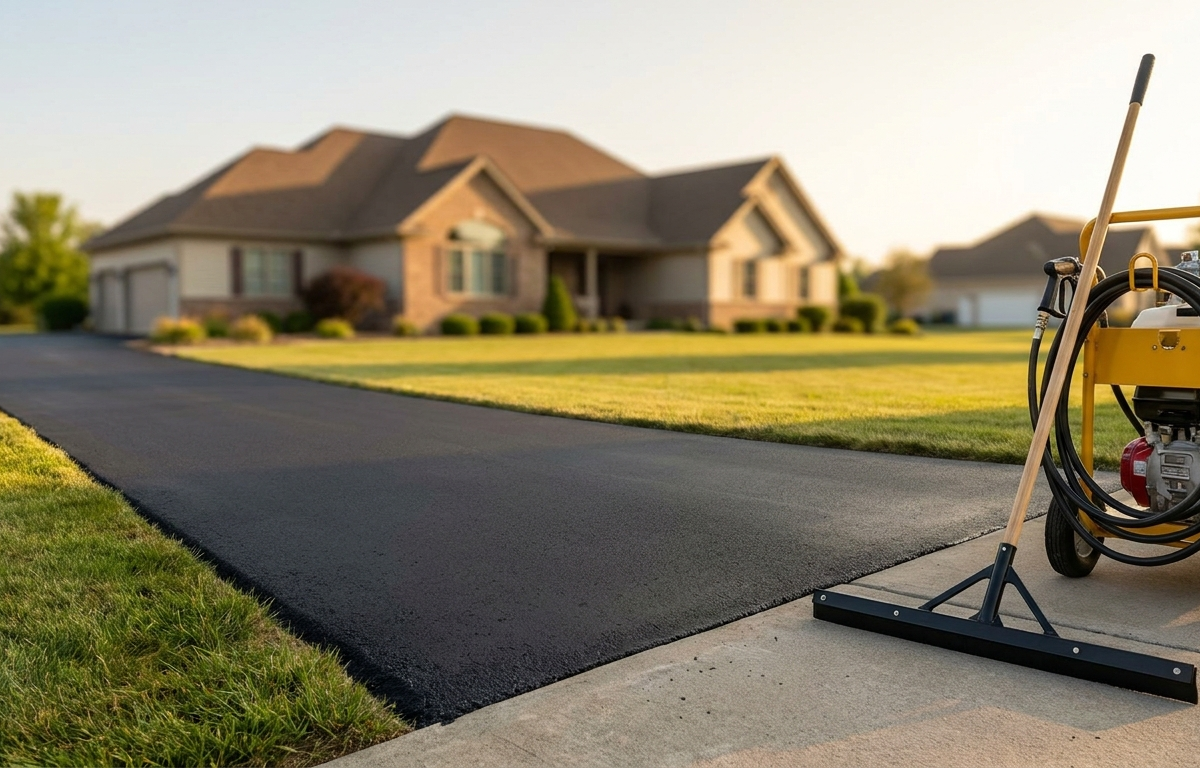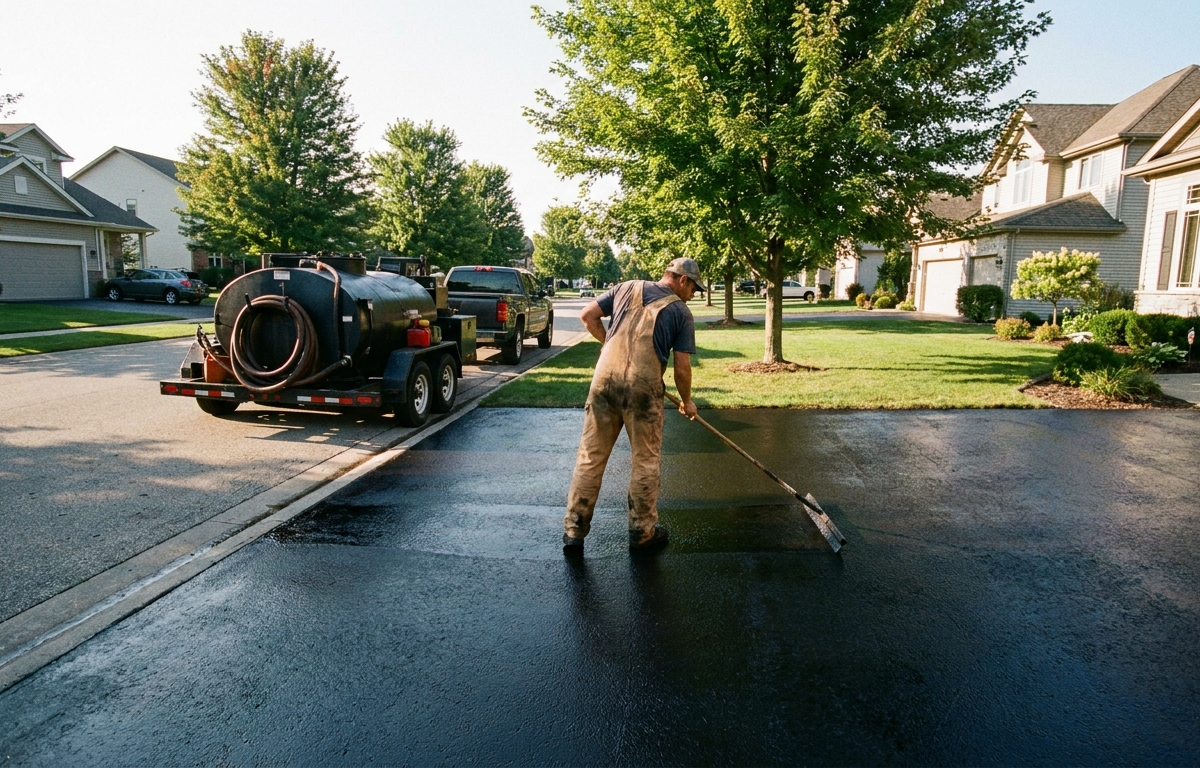
Picture a July like this: fourteen driveways sealed in a month, and eleven separate round trips to do it. A call comes in, you load the trailer, drive forty minutes, seal one driveway, break down, drive back, and wait by the phone for the next one. The weather holds, the work is steady, and you still finish the month running on fumes — tired, behind on fuel money, wondering why a full calendar doesn't feel like a full season. The work isn't the problem. That's a season built one phone call at a time instead of booked.
Sealcoating has a short, hard window — pavement needs to be dry, temps generally need to sit in the mid-50s to low-90s, and most regions only get a handful of usable months before fall tightens the schedule back up. If you're spending that window chasing scattered addresses across town, you're burning your best weather on windshield time instead of squeegee time. The operators who fill a season instead of a calendar do three things differently: they cluster jobs by street, they lock in next year before they leave this year, and they turn a slow week into cash instead of a day off.
Why one driveway at a time burns your best weeks
Drive time is the hidden cost nobody puts in their price. A thirty-minute trip each way on a single-driveway job means an hour of the day is gone before you've mixed a bucket. Do that four times in a week and you've lost half a workday to a road you didn't get paid to drive. Add the setup and breakdown — hauling out the tank, blocking the driveway, waiting on cure time before you pull the cones — and a scattered week can easily net half the jobs a clustered one would.
The fix isn't working harder. It's refusing to book jobs the way they come in — one at a time, whoever calls first — and building routes on purpose.
Know your per-driveway math cold
Before you can book a block, you have to price a driveway in under a minute, and here's an opinion that'll save you money: the operators who quote "couple hundred bucks" off an eyeball are underbidding this trade one driveway at a time. Sealcoating bills by the square foot. Measure it, every time.
The residential going rate sits around $0.20 per square foot per the 2026 side-work rate data, so a typical 1,250 sq ft two-car driveway prices at $250 for a single coat. Materials are the other number you need cold: bulk sealer runs about $5.50 a gallon in five-gallon buckets, and a gallon covers roughly 80 sq ft on a first coat over aged asphalt. That 1,250 sq ft driveway drinks about 16 gallons — call it $88 in sealer, and closer to $130–150 all-in once crack filler, sand additive, and oil-spot primer ride along. Materials on a sealcoating ticket land around 35%, which means that $250 driveway keeps you about $162 before fuel.
Here's a full ticket, priced line by line, for a 1,250 sq ft driveway with gator cracking and an oil stain by the garage:
- Driveway sealcoat, 1,250 sq ft × $0.20: $250
- Crack fill and seal: $180
- Oil-spot primer + seal: $220
- Job total: $650 — roughly $227 of that is material, about $423 stays with you
Notice the add-ons doubled the ticket. Cracks and oil spots aren't upsells, they're the reason the seal fails early if you skip them — and they're standing right there in the driveway making their own case.
Book the block, not the driveway
When you land a job on a street, the best lead-gen tool available is sitting right there: the finished driveway. Before you leave, drop door hangers on the five houses on either side. A fresh, dark, clean-edged driveway two doors down does more convincing than any ad — neighbors see it drying and start asking who did it.
Take before-and-after photos on that job specifically to post in the neighborhood's Facebook group or Nextdoor thread, tagged with the street name. "Just finished up on Maple Ct." pulls in people who live two minutes from the truck, which is exactly who you want calling. Offer a modest same-week discount to any neighbor who books while your rig is already on the street — you're not discounting the job, you're pricing in the drive time you won't spend twice.
If you already run a pressure-washing route, the two trades share more than a trailer. A driveway that's been pressure washed shows every stain and crack clean, and that's the exact moment a homeowner notices how much better it could look sealed. If you don't run that route yet, landing your first pressure-washing customers is most of the same door-to-door playbook.
The route math that actually pays you
Run the day both ways with the $250 base driveway:
| One scattered driveway | Four driveways, one block | |
|---|---|---|
| Drive time | ~90 min round trip | ~20 min total, curb to curb |
| Setup/breakdown | Once per job | Once, shared across the block |
| Jobs completed that day | 1 | 4 |
| Revenue for the day | $250 | $1,000 |
| Yours after ~35% materials | ~$162 | ~$650 |
And that's the floor. If two of the four block driveways take the crack-fill add-on at $180, the day grosses $1,360 with the same trailer setup and the same tank of fuel. The sealcoating cost calculator runs the per-driveway version of this with your own square footage and rates. The point isn't the exact number — it's that clustering turns the same eight-hour day into four times the take without charging anyone a dime more.
Get next year's job booked before you pack up this year's
The easiest sale of the season is the one you close while you're already standing in the driveway. A sealed driveway typically needs another coat in one to three years depending on traffic and climate — tell the customer that on the spot, and ask if they want you to reach back out next spring instead of them having to remember your name in eighteen months. A $250 driveway that rebooks every two years is $125 a year of near-zero-acquisition-cost revenue, per house, forever. Twenty of those on three streets is a route.
This is where real job records earn their keep. Log the address, the date sealed, the square footage, and the next-coat estimate somewhere better than a truck notebook, and you can pull every driveway from two Aprils ago and know exactly who's due. A branded estimate the customer approves from their phone does quiet work here too — it looks like a real business sent it, which matters when you're asking someone to trust you again a year later without seeing your face.
Turn a slow week into income, not a day off
Weather kills schedules — a rainy stretch mid-season can strand you with idle days. Rather than waiting it out, work last year's list: pull the driveways coming up on their recoat window and book them for the first dry stretch. You're not creating demand out of nothing; you're pulling forward work that's already going to happen and putting it on your calendar instead of leaving it to chance.
The same idea works bigger for commercial. Lot work with striping runs around $1,500 a job, and property managers plan further ahead than homeowners — a phone call in a rain week to line up a strip-mall lot for the next clear stretch fills a day that would've sat empty, at six times the residential ticket.
FAQ
How much should I charge to sealcoat a driveway?
About $0.20 per square foot for a single coat — $250 on a typical 1,250 sq ft two-car driveway. Crack fill and seal adds $180, an oil-spot primer adds $220, and a two-coat premium seal runs $400, so a driveway with real wear is a $500–650 ticket, not a $250 one.
How many driveways can one crew realistically seal in a day?
Clustered on one street, a two-person crew can do four to six average residential driveways in a day — roughly $1,000–1,500 of work. Scattered across town, the same crew often manages one or two, because setup, breakdown, and drive time eat the difference.
What do sealcoating materials actually cost?
Bulk sealer runs about $5.50 a gallon in five-gallon buckets and covers roughly 80 sq ft per gallon on a first coat, so a 1,250 sq ft driveway takes about $88 in sealer. All-in — crack filler, sand, primer — materials land near 35% of the ticket.
Should I discount driveways on the same street to book them together?
A modest same-week discount makes sense because you're not driving back a second time — you're pricing in the savings, not giving away margin. Frame it as "since we're already on your street this week," so it doesn't train customers to expect a cut every time.
How do I get customers to book their next reseal without chasing them down?
Tell them the recoat timeline while you're still in the driveway — one to three years depending on traffic — and keep a record of the date and square footage so you can reach out when it's due. A message a season ahead beats hoping they call first.
Booking a season instead of a driveway means treating every job like it points to the next one — the neighbor, the recoat, the rain week you fill instead of waste. SideWRK's sealcoating setup keeps the estimate, the job history, and the who's-due list in one place — see it running for sealcoating, then start your free 14-day trial — no card — and run next season's bookings off this season's work.