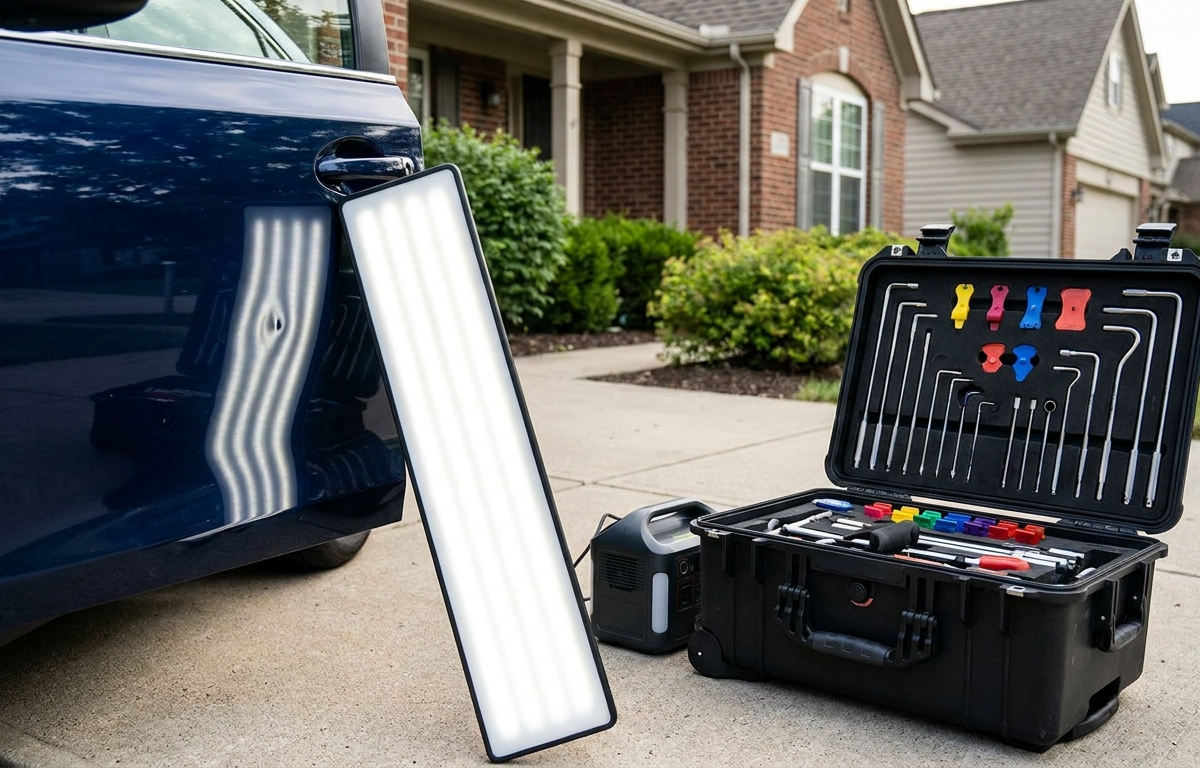
A coin-size ding on a steel door panel: $150, done in about an hour, no paint booth, no rental car, no three-week wait. That's the pitch that gets paintless dent repair in the door. But "it depends on the dent" isn't a price list, and if you're quoting off a gut feeling every time, you're leaving money on the table on the big ones and scaring off customers on the small ones.
PDR pricing runs on size, panel material, and access — in that order. Get those three variables locked into your head (and your invoice), and you can quote most jobs standing in the driveway with a flashlight, no callback needed.
The size scale, dent by dent
Every PDR operator prices off roughly the same coin scale. Here it is with real 2026 numbers on it, per 2026 side-work rate data:
| Dent | Typical price |
|---|---|
| Small (dime–quarter) | $150 |
| Medium (golf ball) | $250 |
| Large (baseball and up) | $450 |
| Crease dent | $300 |
| Additional dent, same panel | $75 |
| R&I — trim or headliner for access | $150 |
Two lines on that menu do quiet, important work. "Additional dent, same panel" at $75 means a door with three dings quotes at $150 + $75 + $75 = $300 — you're already set up on that panel, so the customer gets a fair stack price and you get paid for every pull instead of throwing in "the little ones" free. And R&I as its own $150 line means access stops being a surprise: if the headliner has to drop to reach a roof dent, that's on the estimate in writing, not an argument after.
Creases get their own price because they deserve it — a $300 crease is slower, riskier metal work than a $250 golf-ball dent, and pricing them the same is how a "quick job" eats your afternoon.
The aluminum surcharge — don't skip it
Aluminum panels (hoods, some doors and fenders on newer trucks and SUVs) don't behave like steel. The metal work-hardens faster, it's less forgiving of overworking a pull, and the tooling costs more to keep right for it. Add 25% and up over your steel price for aluminum, and say so on the estimate. If you eyeball an aluminum hood at your steel rate because "it looked about the same size," you'll find out the hard way forty minutes in, when the metal's fighting you.
Tell the customer why, too. A ten-second explanation — "this hood's aluminum, it pulls slower and less forgiving, that's the difference" — turns a surprise upcharge into a fact they now trust you for knowing.
Building the day-rate math
A mobile PDR operator isn't selling dents. You're selling hours in driveways, and the coin scale is just how those hours get labeled. Work one full day through the menu and you'll see what your prices are really paying you.
Take a three-stop Tuesday:
- Stop 1, 20 minutes out: door ding, dime-size, plus a second small dent on the same door. $150 + $75 = $225. About 1.5 hours on the tools.
- Stop 2, 25 minutes across town: golf-ball dent low on a door, trim panel has to come off for access. $250 + $150 R&I = $400. Call it 2 hours.
- Stop 3, 30 minutes: crease on a rear quarter. $300. Another 1.5 hours, then 35 minutes home.
The day bills $925. On the tools, that's five hours — $185 an hour, and since PDR consumables are pennies, nearly all of it stays with you. But add the 1 hour 50 minutes of windshield time and the real day is closer to seven hours, which drops the effective rate to about $132. Same skills, same prices — the drive is what taxed you $50 an hour.
That gap is the whole business. Three stops in one zip code and the effective rate climbs back toward $185; three stops across two counties and it falls under $110. Run each job through a real cost check before committing — not "does $150 sound right," but "does $150 survive ninety minutes of round-trip drive." Cluster by neighborhood, batch the far-out jobs into one loop, and hold a minimum stop charge equal to your small-dent price: if the trip isn't worth $150, it isn't worth the truck.
And here's the stance worth planting: quote the coin scale out loud, never your hourly. The day above works out to $185 on the tools — say that number to a customer and it sounds like robbery; say "$150 for that ding, done in an hour" and it sounds fair. They're the same number. The coin scale isn't just pricing shorthand, it's the only honest way to charge specialist rates without making every driveway conversation a negotiation about what an hour of your time is worth.
Hail work is a different animal
Hail season changes the math completely. Retail door-ding pricing goes out the window, and per-panel matrix pricing takes over — light hail on a panel around $150, moderate $200, heavy $300, graded by dent count and average size, with most of the work running through insurance direction-of-pay paperwork rather than a customer's pocket.
If you're doing retail work today and want a second revenue stream, hail is worth chasing — but it runs on its own rules. Learn supplement writing and adjuster communication before you take the first claim, and never quote hail dent-by-dent at retail rates: you'll either underbid the real scope or spook the adjuster with a number their software doesn't recognize.
Where operators leave money on the table
Quoting off a photo without checking access. A text photo tells you size. It doesn't show the brace behind the panel or the dent sitting on a hard body line. Build a buffer into phone quotes — "$150 to $225, final once I see it" — and confirm access in person.
Giving away the same-panel stack. The second and third dents on a panel are $75 each on the menu for a reason. "I'll just get those while I'm in there" is a $150 tip you didn't need to leave.
Eating R&I. If trim, a taillight, or a headliner has to come out for access, that's a $150 line item, not a favor. Write it down before you pull the first clip.
Not writing any of it down. A verbal "yeah, about $300" with no paper trail is how disputes start. A written estimate the customer approves before you touch the panel protects both of you — and it reads like a business, not a guy with a tool bag and a handshake.
Quoting it like a business, not a hobby
The fastest way to lose trust on PDR isn't the price — it's a number that changes after the fact with no explanation. Build the estimate before you start (size, material, access, the day-rate math) and send it as a real document, not a text-message guess. The PDR cost calculator walks the same size-and-material logic as the menu above and drops straight into an estimate the customer approves from their phone, so the aluminum surcharge and the R&I line are locked in before you touch a tool. Running PDR as one of several services from the same truck? The paintless dent repair trade page shows how the app speaks PDR's own vocabulary instead of forcing your invoices through a generic template. When you're ready to price the coin scale instead of guessing it, start your free 14-day trial — no card.
FAQ
How much does paintless dent repair cost for a small door ding?
A dime-to-quarter-size ding on steel runs $150 in 2026, with additional dents on the same panel at $75 each — so a door with three dings quotes $300. Expect a 25%-and-up surcharge on aluminum panels, and more if the spot needs trim removed for access.
What does a mobile PDR operator actually make per hour?
Depends almost entirely on the drive. A three-stop day billing $925 pays about $185 an hour on the tools, but with nearly two hours of windshield time the effective rate drops to around $132 — and consumables are pennies, so route density, not dent size, is what moves your real number.
Why does aluminum cost more to repair than steel?
Aluminum work-hardens as you shape it, so pulls run slower and punish a second attempt, and the tooling costs more to maintain. Charging 25% or more over your steel price covers the added time and risk — and explaining that in one sentence usually earns trust rather than pushback.
Is hail damage priced differently from a regular dent?
Yes — hail is matrix-priced per panel by dent count and severity, roughly $150 light, $200 moderate, $300 heavy, and it typically runs through insurance direction-of-pay paperwork. Quoting a hail claim at retail per-dent rates either underbids the scope or clashes with the adjuster's expected range.
Should I charge a minimum trip fee for small dent jobs?
Yes — set it at your small-dent price of $150. A single ding forty minutes away can't carry the drive at less than that, so either the job meets the minimum, or it waits until you've clustered two or three more stops in that neighborhood.