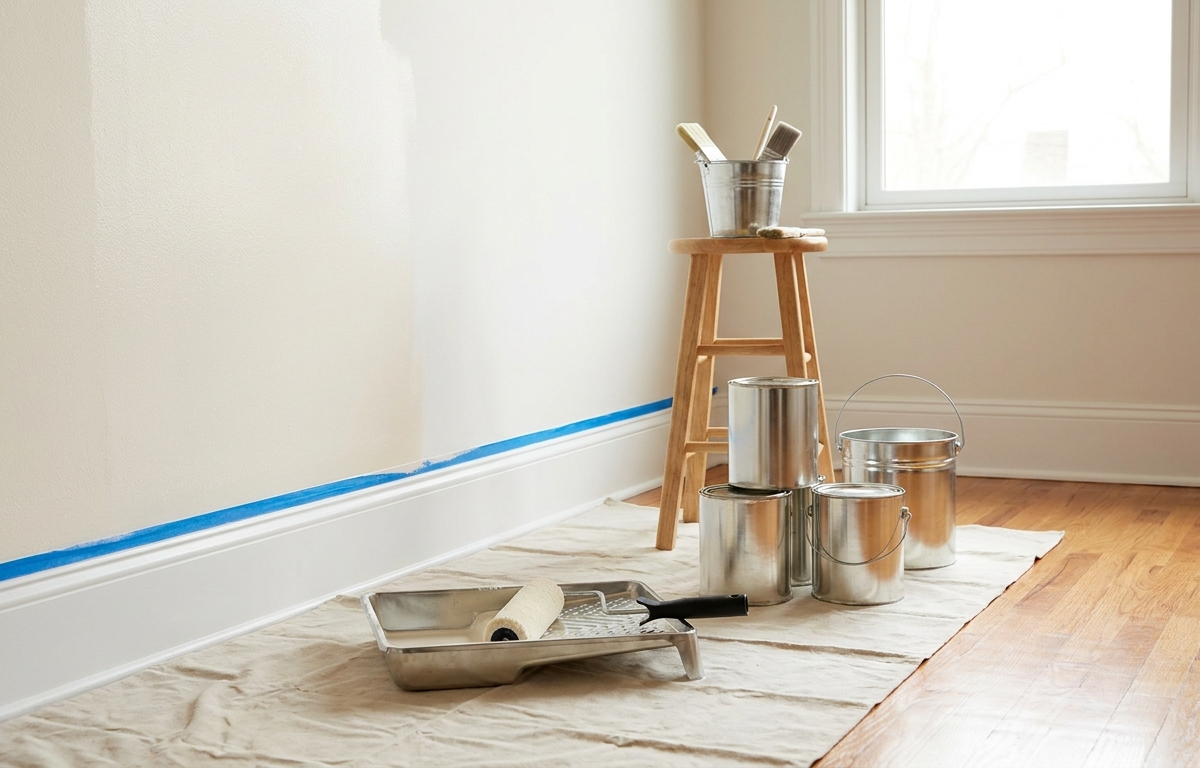
Your first painting job is the hardest sell you'll ever make. No reviews, no portfolio, no one who can vouch for your work to a stranger. Homeowners are letting you into their house with buckets of paint that will sit on those walls for 7-10 years — they're not clicking "hire" on a name they've never heard of.
You don't need a website, a Google ranking, or a marketing budget to book your first jobs. What you need is a plan that puts your effort in the right places first — and a quote you can defend to the dollar, which we'll build below.
Start With the People Who Already Trust You
Your warm network — friends, family, coworkers, neighbors — is not a fallback option. It's the correct first move for jobs one through ten.
Tell everyone you know you're taking on painting work. Call them or text them directly, not a Facebook announcement that scrolls past at 9pm. "Hey, I'm doing painting jobs on weekends. If your living room needs a refresh or you've been putting off that bedroom repaint, I'd love to do it at a fair price." Personal and direct beats a post every time.
Don't offer to do it free. Free work signals that the work isn't worth paying for — and free customers are the most likely to scope-creep you and skip the review. Price your first jobs fairly and ask upfront: "If you're happy with how it turns out, would you leave a Google review and mention me to a neighbor?" Most people say yes.
Treat these first jobs exactly like you'd treat a paying stranger: arrive on time, prep properly, clean up completely, and send a text two weeks later checking how the paint is holding up. Those four things are how word of mouth actually starts.
What a 12x12 Room Actually Costs — and Why the Quote Is $450
Before you can defend a price, you have to know where it comes from. So price one hypothetical room, line by line.
Take a standard 12x12 bedroom, two coats, proper prep. Per 2026 side-work rate data, the working painter rate is $3.50 per square foot all-in. A 12x12 room is about 128 usable square feet once you account for openings — call the quote $450.
Where does it go?
- Materials: two gallons of decent paint at $40 each is $80, plus tape, plastic, roller covers, and caulk at about $30. Materials line: $110.
- Labor: the remaining $340, spread over roughly 5.5 hours — 1.5 hours of prep (patch, sand, tape, drop cloths), 3 hours for cut-in and two coats, an hour for second-coat touch-up and cleanup.
That's about $62 an hour for your labor. A real wage for skilled work, not a hobby rate.
Now watch what happens when you knock $100 off to win the bid. The paint doesn't get cheaper. The tape doesn't get cheaper. Every dollar of that discount comes out of the labor line — $340 drops to $240, and your wage falls from $62 an hour to $44. Here's the stance, plainly: a painting discount is never a discount on the job. It's a pay cut you volunteered for. Underpricing painters aren't competing harder; they're just working the same hours for less.
Put a Yard Sign on Every Job
A yard sign costs $25-40 to print. A homeowner's front yard sits in front of foot traffic, car traffic, and curious neighbors for the entire duration of your job. When a neighbor sees your truck and your sign on Tuesday and again on Wednesday, they start wondering what you're doing inside. That curiosity has your phone number on it.
Ask every customer before you start whether a sign in the yard is okay. Frame it simply: "It helps me get more local work, keeps me doing jobs in this neighborhood." After you finish, ask if it can stay up another week or two. A lot of homeowners don't mind.
Keep the sign clean: your name, a number that goes directly to you, and a line like "Interior & Exterior Painting — Free Estimates." Skip the website URL at first. A number they can call or text converts better than a link they have to remember later.
Nextdoor and Facebook Groups Are Worth 20 Minutes a Day
Nextdoor is the most underused platform for solo painters starting out. It's hyper-local by design — posts and recommendations stay within your neighborhood — so you're not competing with every painter in the metro area. You're competing with whoever else is active in a few zip codes.
Set up a profile with your real name and a clear bio: what you paint, where you work, how to reach you. Post a short introduction once, honestly and without ad copy. Then watch the Recommendations and Services sections. When a homeowner posts "Anyone know a good painter?" be one of the first to respond. Speed matters here; the person who answers in 20 minutes usually gets the call.
Local Facebook groups work the same way. Join two or three in your service area and respond to requests instead of posting ads.
Before-and-after photos are the most persuasive thing you can post on either platform. A clean shot of a living room transformation does more convincing than three paragraphs about your qualifications. Shoot every job from the same angle before you open a can, and post — with the customer's permission — when someone asks for recommendations.
Set Up Your Google Business Profile Before Job Six
You won't rank in local search after your second job. That takes reviews and time. But a Google Business Profile is free, takes 20 minutes, and it's what converts every future customer who hears about you and immediately searches your name.
Set a service area if you work from home, pick accurate categories (Painter, House Painter, Interior Painter), and write a clear description. Then send every satisfied customer a direct link to leave a review.
By the time you have 8-10 genuine reviews, you'll start showing up for "house painter [your city]" without spending a dollar on ads. One real review from a real customer beats a polished website with zero social proof every time.
Build One Referral Relationship That Sends Repeat Work
Painting clusters around life transitions: people paint before they sell a house, after they buy one, when a rental turns over. Real estate agents and property managers are surrounded by people who need painting done, often on a short timeline.
Reach out to three or four local agents. A one-paragraph note is enough: "I'm a local painter in [area] who does thorough prep work and can often turn a room in a day or two for pre-sale refreshes. If you ever need someone reliable to refer, I'd appreciate being on your list."
A single agent who sends two referrals a month is 24 jobs a year. At $450 a room, that one relationship is worth over $10,000 annually — and property managers with multi-unit buildings are steadier still, since tenant turnover means regular repaints that skip competitive bidding once they trust you. Two reliable referral sources can carry a part-time painting business for years. The same logic runs in other trades — see how tree service operators turn one emergency call into year-round recurring customers.
How to Turn Your First Three Jobs Into Thirty More
The pattern is predictable. Your first three jobs come from people who already know you. Your next ten come from reviews, yard signs, and Nextdoor. After that, Google starts sending inbound leads. Each stage feeds the next — but only if you ask.
After every finished job where the customer is clearly happy, say: "I'm really glad it came out well. If you know anyone who needs painting done, I'd appreciate the mention. And if you have a minute to leave a Google review, it makes a real difference for a small operation like mine." That's it.
Most painters skip this because it feels uncomfortable. The painters who don't skip it are the ones with a 4.9 rating and a two-week wait list by the end of their first year.
For rate-setting beyond the single room, the painter resource page breaks down interior repaints, exteriors, and cabinet work. And keep the jobs organized from the start — quotes, schedules, follow-ups, customer contacts. Tracking it in your head works for job one and breaks down by job five. When you're ready, start free. Five jobs a year free, no card, then $19/mo or $190/yr.
FAQ
How do I get my first painting customers with no reviews?
Start with your warm network — call or text people you actually know and offer fair-priced work, not free work, since free jobs signal your work isn't worth paying for and attract the most difficult customers. Ask upfront if they'll leave a Google review and mention you to a neighbor if they're happy with the result.
How much should I charge for painting a room?
Work from $3.50 per square foot all-in: a standard 12x12 room with two coats and real prep quotes at about $450 — roughly $110 in materials and $340 in labor over 5.5 hours, or about $62 an hour for your time. Knock $100 off to win a bid and every dollar comes out of the labor line, cutting your own wage to $44 an hour.
Do yard signs actually work for getting painting customers?
Yes — a $25-40 yard sign sits in front of foot and car traffic for the one to three days you're on-site, and curious neighbors who see your truck two days running often call. Ask the homeowner's permission first, and ask if it can stay up an extra week or two after you finish.
How do I get repeat referral work as a painter?
Build a relationship with two or three local real estate agents or property managers — painting clusters around life transitions, and one agent sending two referrals a month is 24 jobs a year, worth over $10,000 at $450 a room. Two reliable referral sources can carry a part-time painting business for years.
When the Jobs Get Bigger Than One Room
The $450 room works because a 12x12 is a known quantity. The habit that grows out of it — "$450 a room, whatever the room" — is the one that eventually burns you. A 16x18 primary suite is roughly twice the square footage of that guest room down the hall. Quote them both "a bedroom" and the small one is overpriced while the big one quietly eats the difference: more wall, more cut-in, two coats of all of it.
Rooms are how customers talk about a house. Square footage is how the job gets priced.
Measure the space, or estimate it honestly, then multiply by your rate and translate back into a flat number at the end. The customer sees "Primary suite repaint — $900." You know it's twice the room you'd have quoted $450, at the same $3.50. Both things are true. Only one of them protects your margin.
The Rate Is a Ceiling. Your Hours Are the Wage.
About 75 cents of every dollar you quote at $3.50 a square foot is labor: call it $2.63, with the rest going to paint, primer, tape, and plastic. That split is why two painters charging identical rates don't take home identical money. Go back to the $450 room, where $340 of labor across 5.5 hours came out to $62 an hour. Now give that same room glossy walls that need a scuff-sand, a wall full of picture-hanger holes, and grease by the light switch. Two extra hours of prep at the same $450 and you're down to $45 an hour.
The rate never moved. The job did — and you found out after you'd already said the number.
The Three Places the Margin Leaks
It's rarely the paint. A gallon costs the same whether prep took twenty minutes or two hours. On a repaint, the margin disappears in three specific places: surface condition you didn't look at before quoting, a third coat you didn't price because the customer is covering dark red with light gray, and the furniture and fixture moves everyone assumed were included.
All three have the same fix. Walk the job before you price it, not after. Note what adds hours — gloss, water stains, wallpaper that has to come down — then give each its own line or build a prep allowance into the number before you quote. A surprise found on the walk becomes a line item. A surprise found on day two is a donation.
Prep and Patch Earn Their Own Lines
A drywall patch before paint isn't a painting problem, and it shouldn't come out of the painting margin. Priced on its own, patch-and-paint work runs around $250 per the same 2026 rate data. That's skilled work, and it gets its own line on the estimate. Same for trim and doors, about $700 as its own scope, and cabinet refinishing, closer to $1,800 — a different job that happens to involve paint.
The square-foot rate covers walls and ceilings. Everything else gets named and priced, which is what a line-item estimate is for: the customer sees exactly what they're buying, and you stop folding skilled work in for free.
Say the Number From the Estimate, Not the Doorway
"$450 a room" survives as a habit because it's fast. You can say it standing in the doorway without doing any math. But fast and wrong costs more over a year than the two minutes it takes to measure and multiply. Run the numbers through the free painting cost calculator if you want the multiplication done for you, then put the square footage, the rate, and the prep lines on an estimate the customer approves from their phone before the number ever leaves your mouth. No version of "but you said" survives a written approval.
And if you'd rather poke at it than read about it, the live demo is a working painter setup — no signup, nothing saved.