Getting junk hauling calls when you're just starting out is a timing problem more than anything else. Homeowners don't need a haul-away every month. They need one when they're moving, clearing out a parent's house, finishing a renovation, or finally getting the garage down to floor. You need to be visible at exactly that moment.
Most startup guides lead with "run Google Ads" or "sign up for Thumbtack." Both can work eventually. Here's the playbook for before you have a marketing budget — and the net-dollars math the guides never show.
Where the First Calls Actually Come From
The fastest free channel for a new junk hauler is Nextdoor, specifically the Recommendations tab where neighbors ask "does anyone know a good junk removal company?" Create a profile and post once in your neighborhood: "Local junk hauler, same-day service, free estimates. Just getting started and building my first reviews." Seven or eight calls from one post is not unusual in a suburban area. The phrase "building reviews" matters: it says you're motivated and you won't be the highest bidder.
Facebook Marketplace has a Services section almost nobody in this trade uses correctly. Create a listing under Home Services with actual photos: your truck, a completed job, a clear driveway where there used to be a pile. Plenty of people browse Marketplace before they reach Google, and it costs nothing. Local groups for your city are worth a single clean post with a job photo.
TikTok is building businesses fastest for new haulers right now, and it costs zero. The format that works: film the pile before you start, do the haul, film the clean space after, overlay your city name and phone number. Under a minute, unpolished is fine. Some operators with under 100 followers are booking 10-15 jobs a month from organic views alone.
Craigslist still drives calls in most markets. Services > Household. Refresh it weekly.
What One Job Actually Nets
Here's the section every "start a junk removal business" article skips, worked on one hypothetical job.
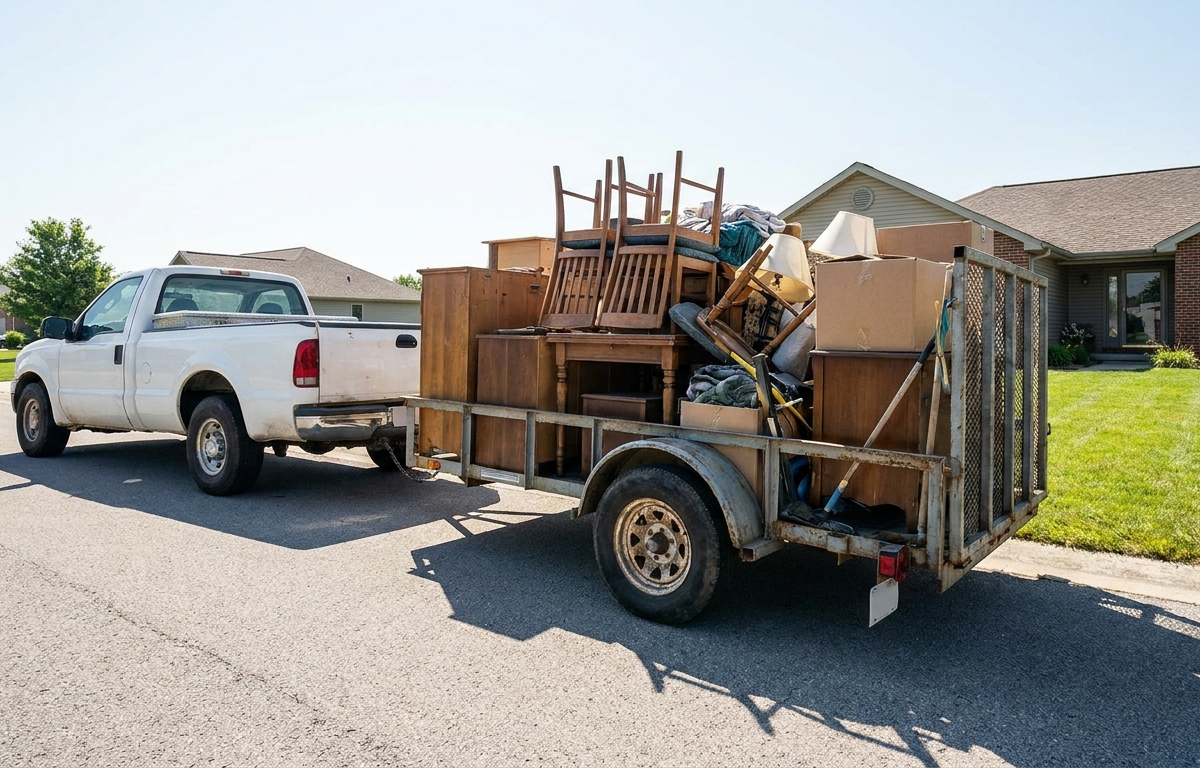
Say the call is a garage cleanout — a half-load-plus against the going full-load rate, billed at $375 per 2026 side-work rate data. Two hours of loading, then the run to the transfer station.
Now the outbound money. Dump and transfer fees eat roughly 30% of a load ticket — call it $110 on this one. Fuel for the round trip, $20. What's left: $245. Door to door the job took about three hours, so you kept roughly $82 an hour.
That's still good money. But notice what just happened: the transfer station made $110 for opening a gate. Which points at the truth of this trade — junk hauling looks like a truck business, and it's actually a disposal business. The operators who win aren't stronger or faster loaders. They're the ones who sort metal and appliances out for the scrap yard, run cardboard to free recycling, and donate what a thrift store will take — cutting that $110 outbound line by 20-30% on load after load. Every dollar you don't hand the transfer station is a dollar of pure margin, and it's the one cost your competitors aren't managing.
One observation from building the pricing data behind SideWRK: of every trade in the app, junk hauling has the widest gap between what the customer pays and what the operator keeps. Quote gross, think net — or this business will quietly disappoint you.
Set Up Your Google Business Profile First
Go to business.google.com, claim your profile, add photos of your truck and a completed job, write your service area, verify. About 15 minutes of work plus a 2-3 week wait for the postcard.
Once you're verified with a handful of reviews, you'll show up in local searches for "junk removal [your city]." The map pack — the three local listings above the regular results — shows before any website. Google weights proximity and review recency heavily — a fresh profile with 12 genuine local reviews often outranks a national chain's listing nearby.
1-800-GOT-JUNK has hundreds of reviews in your market; you won't beat that count in year one. You can still beat their map pack position close to your service area if you're collecting reviews and they've gone quiet. The same approach works across trades — new operators in adjacent work use the same playbook to get their first customers.
The Real Estate Agent and Property Manager Play
Homeowners are fine customers. They call you once.
Real estate agents call before listings when the house is cluttered — a cluttered home sitting on market costs them time and commission. One active agent who trusts you generates 3-8 jobs per year, and their customers come pre-motivated because there's a listing deadline.
Property managers are the other side of this. A manager with 50 units and moderate turnover generates 8-15 cleanout calls a year when tenants leave things behind. At garage-cleanout money — $375 a pop — one relationship is $3,000 to $5,600 in annual revenue. No marketing, no Nextdoor posts, no Google. If the work is clean and you invoice clearly, it keeps happening.
How to find them: your local apartment association meets monthly in most markets. Landlord meetups and real estate investor groups draw the same crowd. Estate sale companies are another strong connection: leftover inventory after a sale needs to go the same day, and they pay fairly for that.
Your pitch for all of them is the same: you show up when you say you will, you take before-and-after photos, you send a real invoice, and you can do same-day or next-day service. That last part is the edge — chains book out days, and a manager who needs a unit cleared before Thursday's new tenant can't wait.
Price by the Load
The standard in junk removal is load-based pricing, and it works because the customer can see it. Set your full-load rate at $650 and price the fractions off it: an eighth of a load — a single item like a couch or a fridge — at $100, a quarter load around $165, a half load around $325, a full load $650. A furniture pickup or an appliance haul runs $150; an estate or full cleanout starts at $650; construction debris around $500 because it's dense and the transfer station charges by the ton.
Don't quote by the hour; customers only ask because it's the framing they know. Price by the load so the total is known upfront — it closes calls, and it lets you quote from a couple of photos without visiting.
Keep the fee math above in front of you when you set these numbers: roughly 30% of every ticket is spoken for before you've paid yourself. A price that looks fat at the curb gets thin at the scale house.
The Review Flywheel
After every job, when the truck is loaded and the customer is satisfied, say this: "I'm building my business and reviews mean a lot right now — would you be willing to leave a quick note on Google? Takes about two minutes." Text them the direct link before you drive away.
Most happy customers will leave a review if you ask. Almost none do it without being asked.
Thirty genuine reviews over your first year makes your profile credible to anyone who searches you. At fifty, you're outranking franchises with weaker local scores in plenty of markets.
Skip the Paid Channels Early
Yellow Pages: skip. Angi and Thumbtack charge $15-25 per lead, and if you're converting 1 in 4, your acquisition cost is $60-100 a customer. The math works once you have reviews and close more of what you buy. In the first few months, free channels pay better.
Once you can afford it, wrap your truck. A truck with your name and number parked at a job is a neighborhood billboard. In areas where people actually do major cleanouts — older neighborhoods, estate-sale territory, near apartment complexes — passive calls come just from being visible.
The Referral Ask
After the review request, add one sentence: "If you know anyone who needs a cleanout — moving, clearing out a relative's place, anything like that — I'd really appreciate the referral."
One in six or seven customers sends someone your way within three months. At 10 jobs a month, that's one or two free referrals monthly, and referred customers close faster because the trust is already there.
SideWRK gives independent haulers load-priced estimates, invoices, and review follow-ups from one phone. More at the junk hauling page, or start your free 14-day trial — no card.
FAQ
How do I get my first junk hauling customers?
Post on Nextdoor's Recommendations tab and in local Facebook groups with real photos of your truck and completed jobs — a single well-placed Nextdoor post can generate seven or eight calls in a suburban area. Pair that with a free Google Business Profile so you show up in "junk removal near me" searches once reviews come in.
How should I price junk hauling jobs?
By the load, off a $650 full-load rate: about $100 for a single item (an eighth of a load), $165 for a quarter, $325 for a half, $650 full. A garage cleanout typically bills around $375 and construction debris around $500. Load pricing lets you quote a firm total from photos, which closes calls that hourly quotes lose.
How much does a junk hauler actually keep per job?
On a hypothetical $375 garage cleanout: dump and transfer fees take roughly 30% (about $110), fuel takes $20, leaving $245 for about three hours door to door — roughly $82 an hour kept. Sorting out metal, cardboard, and donatable items cuts the disposal line 20-30%, and that savings is pure margin.
How do I get recurring junk hauling work instead of one-off calls?
Property managers and real estate agents — a manager with 50 units can generate 8-15 cleanouts a year, worth $3,000-$5,600 at $375 each, and an agent clearing houses before listings sends 3-8 jobs a year. Same-day or next-day service is the edge the national chains can't reliably match.