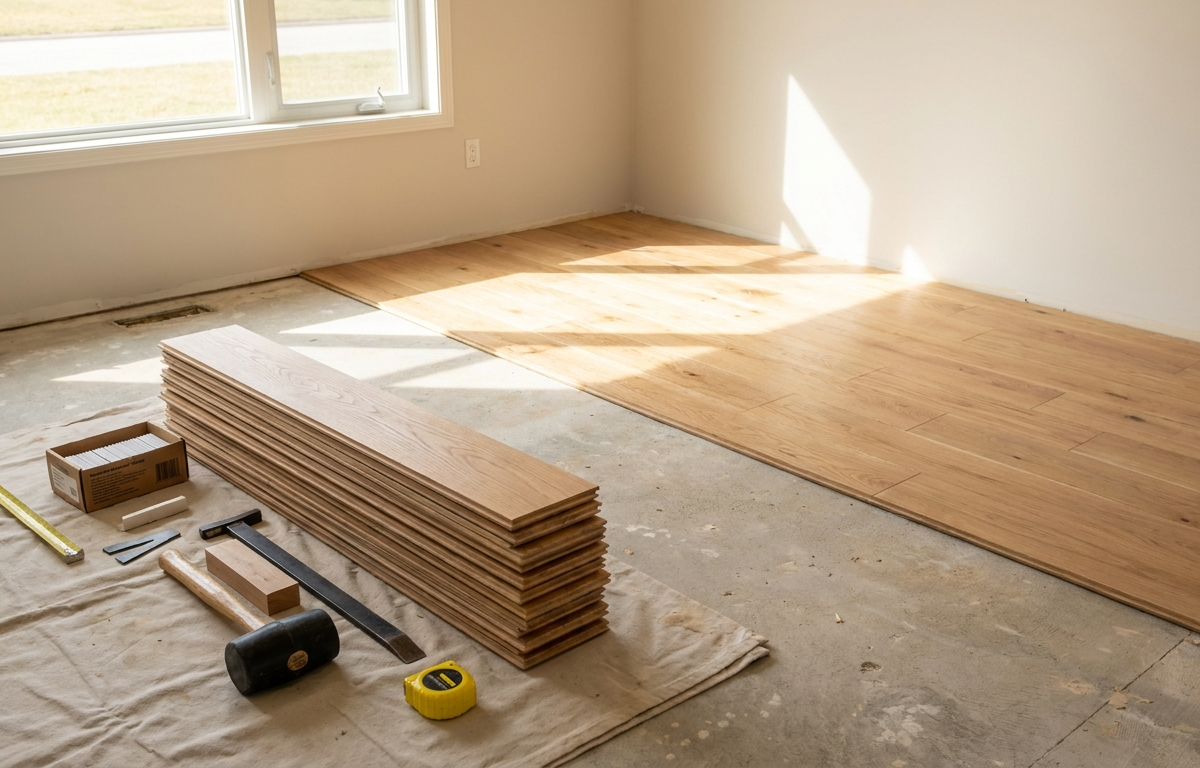
You finished a three-day hardwood job last month. Nine hundred square feet, a clean layout, good customers. You bid it at $4,200 and felt good going in. Then you pulled up the carpet and found two layers of old vinyl tile underneath. Demo took three hours you didn't price for. You made two runs to the dump. The subfloor had a dip that needed leveling compound. By the time you collected your check, you'd put in 31 hours and cleared about $1,800 after materials — $58 an hour before taxes, your truck, and the time you spent quoting.
That job didn't go wrong on the install. It went wrong on the estimate.
Flooring side work is real money if you price it right. But most independent installers either quote per square foot and absorb everything else, or tack on a few hundred dollars "for anything else that comes up" and hope for the best. Neither approach survives the first room where the old floor hides something. The customers with the nicest hardwood always seem to have the messiest subfloors.
The Floor You're Walking Into vs. the Floor You're Quoting
Every flooring job has two price tags: the installation, and whatever is hiding underneath.
The installation — materials, labor to lay them, transitions, trim — is what most installers quote. The subfloor condition is what actually determines whether you make money.
Before you write any number down, walk the room with your hand on the floor. A half-inch dip across a living room means leveling compound or planing. Old vinyl tile can mean asbestos content — not your job to abate, but something to name clearly in your estimate. Squeaky OSB means screws before anything else happens. A water stain near the dishwasher means you stop, flag it to the homeowner, and don't start until they've addressed it.
Build your estimate in two categories: what you can price now, and what you'll price after demo. The second category is your discovery clause, and it needs to be in writing before you touch anything.
Don't Buy at Retail and Pass It Through at Cost
The fastest way to lose money on flooring: let the customer pick material at a big-box store, pick it up yourself, and charge what you paid.
You are not a delivery service. Mark the material up. The standard for residential remodel work runs 20-35% over your cost. If a customer asks, the answer is honest: "That covers sourcing, delivery, and my warranty risk if anything arrives damaged."
Buy from a flooring distributor when you can. Pricing is better than retail, lead times are more predictable, and returns are handled like a trade account. On 800 square feet of LVP, the gap between distributor and retail pricing can be $300-400 — margin that disappears if you're running to the home improvement store every job.
A few things to price automatically on every ticket:
Waste factor. Ten percent for straight runs, 15% for diagonal or offset patterns, up to 20% for herringbone. Under-buying means a second order, a possible lot mismatch, and another pickup trip. Over-buying by 10-15% means the customer has matching material if a plank ever needs replacing — and they will want that someday, and they will call you for it.
Underlayment is not included in the flooring price; it's its own line. Moisture barrier on concrete, foam pad, acoustical mat — depends on the product and the substrate. Name it and price it separately.
Transitions and trim. Walk the job and count every doorway, every stair landing, every spot where the new flooring meets another surface. A T-molding between the living room and kitchen tile runs $25-45. Forgetting five of them costs real money and creates a conversation you don't want on the last day of the job.
What Your Labor Rate Is Actually Covering
The honest question on any flooring job is not "what's my square foot rate?" It's how many hours will this take, total, and what am I clearing per hour.
Your time is more than install time. Drive to the job, material pickup, demo, disposal runs, actual installation, cleanup, final walk, drive home. A 600-square-foot LVP install might be seven hours on the floor — but if you spent 45 minutes picking up material, drove 20 minutes each way, and made a dump run, that's closer to 10 hours of your day. Price the full day, not the floor time.
Residential remodel work should carry 40% gross margin or better. If your materials and direct labor are running 60 cents of every dollar you charge, you're in the right range. If they're at 75-80 cents, you're under-priced — working for yourself at a discount.
The Line Items That Disappear (And Shouldn't)
The most common pricing mistake in flooring side work: lumping everything into one labor rate and hoping it covers the ugly stuff. It won't.
Demo and disposal is its own job. Old carpet with pad, old vinyl, old hardwood — each is different. Carpet demo on 800 square feet means two or three truck loads to the dump, entry fees, and an hour of your time. Price it separately, per square foot or as a flat fee based on your local dump costs. In most markets, $1.50-$2.50/sq ft for carpet demo and haul is the starting range.
Subfloor prep needs a discovery clause because you can't know the full scope until the old floor is out. Write it plainly: "Subfloor preparation: assessed after demo at your rate per hour; estimated based on visual inspection, subject to change once substrate is exposed." Any customer who objects to a discovery clause has probably had an installer eat subfloor costs before. You're not that installer.
Stairs are never included in a square foot rate. Risers, treads, nosing, stringer work — count every tread on the walkthrough and price per step. Flooring customers often assume stairs are included. Get it in the estimate before job day.
Furniture moving: some guys do it, some don't. Either way, it belongs on the estimate. If you move furniture, $75-150 for a living room is fair and should be its own line. If you don't move furniture and the customer assumed you did, you have a problem on day one.
The Written Estimate That Protects You
A number texted to a customer is a liability. A written estimate with line items is a contract.
Every flooring estimate should cover: materials with waste factor noted; demo and disposal; subfloor prep with your discovery clause; installation labor; transitions and trim itemized by piece; furniture moving or a note that it's excluded; and payment terms.
On payment terms: get a deposit before you order material. Never float $2,000 in flooring on a handshake. A 40-50% deposit covers your material cost and confirms the job is real. If someone won't put money down, they're not ready to hire you yet.
Write it up, send it, get written approval before you touch anything. Two things happen: you look like someone who has done this before, and you have a paper trail if anything gets disputed later.
SideWRK lets you build flooring estimates from your phone, get written customer approval before the job starts, and track material cost against what you charged — so you know whether that $4,200 job actually paid $58/hr or $90/hr. That's the Money tab on every flooring job: the number you should always know, even when the customer never sees it.
When Someone Is Getting Three Quotes
Every homeowner in a remodel market gets at least two quotes. Fine. You will not be the cheapest, and you should not try to be.
The installer who sends a written estimate — itemized, with a discovery clause, with a deposit requirement — looks like someone who knows what they're doing. The person who texts a number looks like a risk. Most homeowners will pay 10-15% more for the person who seems like they've handled the surprises before, because the floor they're putting in costs $3,000-5,000 in material alone.
If someone pushes back on your price, don't drop it. Ask what they got quoted and walk through your line items. The other estimate often left out demo, subfloor work, or furniture moving. Some customers still go with the lower number — let them. The ones who read your estimate and understand what they're buying are the ones who leave a review and call you next year for the bedroom.
Turning One Flooring Job Into More
Most houses have more flooring than one room. If you do the living room and the work is clean, you're the obvious call for the basement, the hallway, the rental property next door.
At the final walkthrough, mention what you noticed: "The hallway is pretty worn — easy day's work whenever you're ready." You're not selling. You're being useful to someone who just spent real money with you and already trusts your eye.
Keep a simple job log: customer name, address, product installed, lot number if you can get it, date. When matching material shows up on clearance, you can reach out and ask if they want extras. That's how one job becomes a recurring customer without any marketing spend.
Pricing right is what makes this sustainable. The difference between flooring operators who stay in business and those who burn out is almost always whether they priced the whole job or just the square footage. Price the whole job.
---
Ready to write cleaner estimates and know what you're actually making? Start free — the estimate → approve → get paid flow built for independent installers. Five jobs a year free, no card, then $19/mo or $190/yr. If you run other trades too, the same discipline applies: see how other operators handle pricing landscaping jobs for profit.
FAQ
Should I quote flooring jobs per square foot?
A per-square-foot rate covers the installation, but it doesn't cover what's hiding under the old floor — subfloor damage, old vinyl, uneven leveling — which is what actually determines whether a job stays profitable. Build your estimate in two parts: what you can price now, and a written discovery clause for what you'll price after demo.
How much should I mark up flooring materials?
A 20-35% markup over your cost is standard for residential remodel flooring work, and it's a fair charge for sourcing, delivery, and the warranty risk you're taking on if material arrives damaged. Buying from a flooring distributor instead of retail also protects that margin — the gap on 800 square feet of LVP can run $300-400.
What's a good waste factor to add when ordering flooring material?
Add 10% for straight runs, 15% for diagonal or offset patterns, and up to 20% for herringbone. Under-buying risks a second order with a lot mismatch; over-buying by that margin means the customer has matching material later if a plank ever needs replacing.
How much deposit should I collect for a flooring job?
A 40-50% deposit before ordering material is standard — it covers your material cost and confirms the job is real. Never float a few thousand dollars in flooring material on a handshake; if someone won't put money down, they're not ready to hire you yet.
Where the Priced-Right Jobs Come From
Everything above assumes you have a job to walk. Worth covering where the good ones come from, because the channel that sends the best flooring work barely shows up in the marketing advice.
Lead-gen sites sell the same homeowner to four or five installers at once, and the job usually goes to whoever calls back first. When you're new, with zero stars next to your name, that's a race you lose on price. Meanwhile the flooring showroom across town — and the flooring aisle at the local lumber yard — has the same conversation every day: a customer buys the material, then asks who's going to put it down. Most showrooms want no part of the installation business. It's liability they don't need. So they keep a short mental list of two or three installers they trust and hand it out for free, all day, to people who already bought the product and are ready to schedule.
Getting on that list isn't a pitch. It's a relationship. Walk in on a slow weekday morning, not during the Saturday rush. Introduce yourself to the person who runs the flooring department, not whoever's at the register. Leave a card and a number that gets answered. Then do the unglamorous part: show up on time for the first referral, call if you're running behind, and never undercut the showroom's material pricing by steering their customer somewhere cheaper. Every referral you handle cleanly makes their own sale look better, which is exactly why they keep coming. Lumber yards with a design counter work the same way — the person picking out LVP samples usually needs an installer too.
The $30 Tool That Wins the Bid
One move almost nobody writing about flooring marketing mentions costs about thirty bucks: a pin-type moisture meter, used in front of the homeowner before you quote.
Say you're bidding a basement rec room — 267 square feet of LVP. At the $6-per-square-foot all-in reference rate, that's a $1,600 ticket. Before you write it down, you check the subfloor. The meter reads 14%, high for OSB, which should sit under 12%. That's not a sales tactic. It's a real problem. Lay LVP over a subfloor that wet and you get cupping or adhesive failure inside a year, and the callback won't be a warranty claim — it'll be a customer telling everyone they know not to hire you.
So the estimate gets two lines instead of one: $1,600 for the floor, $500 for the subfloor repair to dry it out and fix it first. A $2,100 total, priced honestly, line by line. That's the discovery clause from earlier in this guide, done live in front of them, and it's the moment a homeowner decides you're not just another guy with a nail gun. Often it's also the moment that gets you the name of their sister who's redoing her kitchen next spring.
Some homeowners will still pick the installer who told them what they wanted to hear. Let them. That redo costs him money once; the buckled floor costs him referrals for years, and he'll never even know it's happening. Whatever the meter says, record it — the reading, the date, a photo of the subfloor on the job. If a question comes up six months later, the record tells the story honestly, for both of you.
What Flooring Jobs Actually Bill
Your market moves every one of these numbers, but the shape holds: tile carries the biggest ticket, subfloor repair is billable work and not a favor, and none of it holds up if the demo, disposal, and trim lines from earlier get lumped in for free.
The priced list itself lives on how to price flooring jobs — six common flooring tickets at their app defaults, what each one works out to in square feet once you read it back through the $6 all-in reference rate, and the two-line estimate that comes out the other end. The flooring cost calculator prices a specific room from your own dimensions, and the flooring demo runs the whole estimate to approve to get-paid flow skinned to this trade, nothing to sign up for.