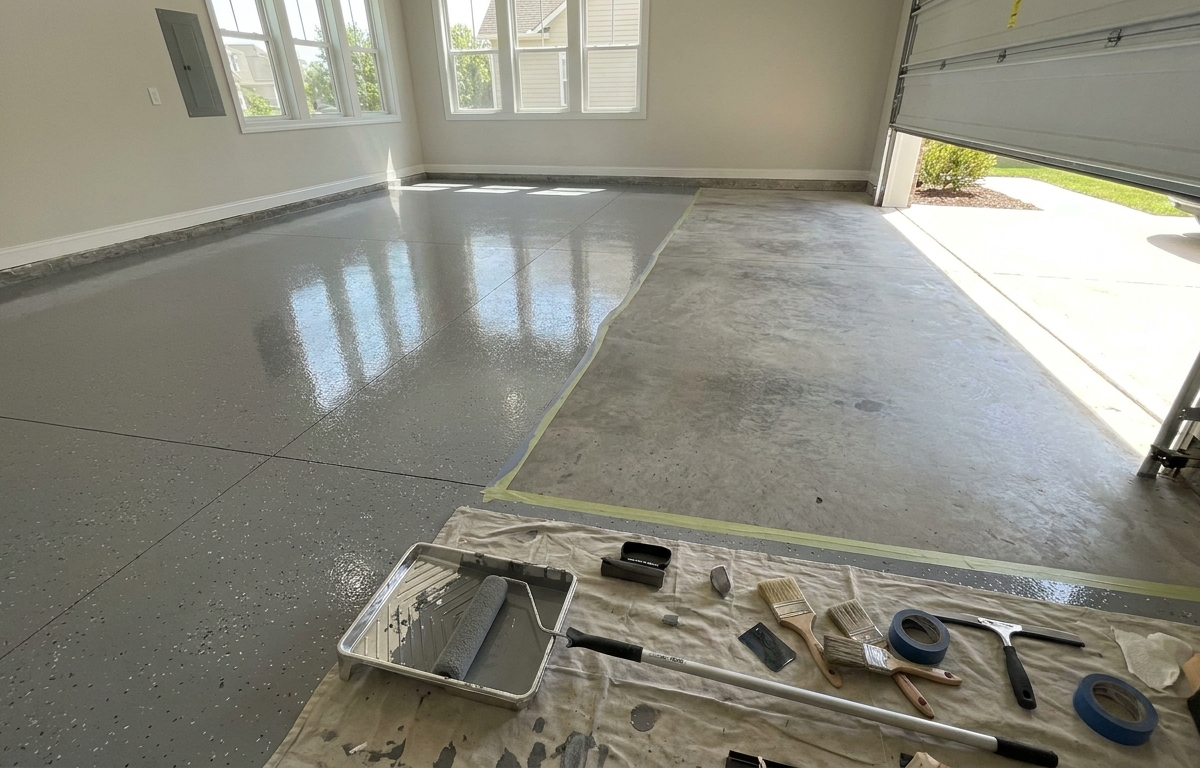
Quote a garage floor off the coating alone and you'll work a fourteen-hour weekend for less than it costs to be in business. The real spread in this trade — a straight garage epoxy at $2,200, a flake broadcast system at $2,600, a polyaspartic one-day coat at $2,900, per the 2026 side-work rate data — has almost nothing to do with which resin you roll. It's prep. Forget the grinding, the crack fill, and the moisture test when you price the job, and you're the guy whose floor peels in eighteen months. That costs more than any number you could've lost on this bid.
Here's how to price an epoxy or polyaspartic garage floor so the estimate covers the work you're really doing, not just the part that photographs well — full trade setup lives on the epoxy flooring trade page once the pricing clicks.
What you're actually pricing (it isn't the coating)
Say it plainly: the coating is a commodity. Any two installers can buy the same 100%-solids epoxy from the same supplier at the same price. The grind is the job. Diamond-grinding the slab to a real profile, patching cracks and pits, and degreasing a decade of oil drips is close to half your hours on a standard two-car floor, and it produces nothing the customer can see until the color goes down. If prep isn't one of the biggest lines on your quote, what you've written isn't an estimate. It's a peel warranty with your name on it.
Materials run about 40% of a typical epoxy ticket. The other 60% is your labor, and the labor is mostly prep. Price it as its own line. When a customer sees "concrete grind & prep — $850" and "crack & pit repair — $320" as their own rows instead of one lump number, they understand why a competitor's bare-bones quote came in $800 cheaper: that guy isn't grinding, he's rolling epoxy over dust and calling it done. It'll fail inside two years, and you want the customer to know why before they call around.
A 400-square-foot job, ledger to net
Take a hypothetical two-car garage, 400 square feet — ten years old, oil-stained, hairline cracks, some pitting near the door. The customer picks the flake system, which is where most of them land. Here's the whole ticket:
| Line | Price |
|---|---|
| Diamond grind & prep, 400 sq ft | $850 |
| Crack & pit repair | $320 |
| Flake system — basecoat, flake to refusal, clear topcoat | $1,430 |
| Job total | $2,600 |
That's $6.50 a square foot, all-in, sitting right on this trade's $6 baseline with a little room for the slab's condition.
Now the side the customer never sees. Materials — resin, flake, patch compound, diamond tooling wear — eat about 40% of the ticket, call it $1,040, leaving $1,560 for you. Hours: day one is grind, patch, and degrease, a full eight. Day two is basecoat, flake broadcast, scrape, and topcoat, about seven more. Add an hour for the walkthrough and moisture check. Sixteen hours on the floor puts your real rate just under $100 an hour, which is solid money — but only because prep got billed. Strip the $850 grind line to win the bid and the same weekend pays about $44 an hour, before the callback.
Then the calendar, because it's part of the price whether you write it down or not: epoxy wants 24 hours before foot traffic and 72 before a car parks on it. Days three through five belong to the cure, not to you, but the customer needs them on the estimate anyway.
Epoxy vs. polyaspartic — quote the right one, not the cheap one
Epoxy keeps the garage off-limits to vehicles for roughly three days. Polyaspartic takes foot traffic in hours and a car in about a day. For a one-car household, or a garage that doubles as the main way into the house, that difference is the sale. The gap between the $2,600 flake system and the $2,900 polyaspartic package is $300, and plenty of customers will pay it just to have their garage back tomorrow.
Polyaspartic also holds color under UV and shrugs off hot-tire pickup better — the soft, sticky marks summer tires leave on cheap coatings. Epoxy is still the better bulk fill for the money, which is why a lot of experienced installers run an epoxy basecoat under a polyaspartic topcoat. Whatever system you're quoting, name it on the estimate. "Premium 2-coat system" reads like filler. "Epoxy basecoat, polyaspartic topcoat" reads like you know what you're doing.
What actually eats your profit on this job
Cure-time promises kill more margin than any material cost. Tell a customer the garage is theirs in two days when humidity is going to make it four, and you're either eating an awkward callback or a discount to keep them quiet. Quote the real cure window up front, and if the weather that week is going to stretch it, say so before the deposit, not after.
The other killer is prep scope creep. You price a clean slab and show up to old paint, a failed prior coating, or moisture pushing up from below grade. Every one of those is its own line and its own charge — the $320 crack-and-pit line above assumes normal wear, not a slab that needs skim-coating. And on anything below grade or older than fifteen years, run a moisture test before you commit. A slab pushing vapor will bubble a coating from underneath no matter how well you applied it, and that's a $2,600 redo with your name on it, not the concrete's. Don't absorb any of it to protect a number you gave over the phone. If landing that first walkthrough is still the hard part, the guide on booking early epoxy garage floor customers covers that side of it.
How to present the quote so it doesn't scare off the homeowner
The three tiers in this trade aren't hypothetical — they're the price list. Straight epoxy at $2,200 for the budget floor. The flake system at $2,600 as the recommended middle. Polyaspartic at $2,900 for the customer who wants the garage back in a day, or a full basement and shop floor at $3,000 when the job grows past the garage door. Put all three on paper with the differences spelled out and most homeowners pick the middle on their own. That isn't upselling. It's showing them the floor they'd be unhappy with in two years and letting them dodge it.
A branded estimate with real before/after photos closes this trade better than any pitch, because a coated floor is the most visually obvious transformation in home services — before is stained concrete, after looks like a showroom. SideWRK's takeoff tool traces the garage footprint from a satellite photo or a quick phone measurement and drops the square footage straight into the estimate, so the number you hand over is built on real measurements, not a guess. A deposit at approval means you're not financing three gallons of material out of pocket either. See the whole flow seeded for this trade at the SideWRK demo, then start free and build your first epoxy estimate from the truck. Five jobs a year free, no card, then $19/mo or $190/yr.
FAQ
How much does it cost to epoxy a garage floor in 2026?
A standard two-car garage runs about $2,200 for a straight epoxy coat, $2,600 for a flake broadcast system, and $2,900 for a polyaspartic one-day package — roughly $6 to $7 a square foot all-in, moving with slab condition and your market. Run your own numbers on the epoxy garage floor cost calculator before you quote.
Is polyaspartic better than epoxy for a garage floor?
It depends on what the customer needs. Polyaspartic cures in about a day instead of three, resists UV yellowing, and handles hot-tire pickup better; epoxy is cheaper bulk fill. The $300 gap between a $2,600 flake system and a $2,900 polyaspartic package is mostly the customer buying their garage back two days sooner. Many pros run an epoxy basecoat under a polyaspartic topcoat to get both.
Why is surface prep such a big part of the price?
Because the coating only bonds as well as the concrete under it. On a typical 400-square-foot job, grinding and patching are their own lines — $850 for the grind and prep, $320 for crack and pit repair — and close to half the total hours, even though the customer can't see any of it once the color goes down. Skip it and the floor peels within a year or two.
How long does a garage need to be closed off after coating?
Epoxy needs about 24 hours before foot traffic and 72 before a vehicle parks on it. Polyaspartic takes foot traffic the same day and a car in about a day. Quote the real window, and pad it honestly if humidity or temperature that week will slow the cure.
Should I do a moisture test before coating an older garage floor?
Yes — on anything below grade or older than fifteen years, always. Vapor pushing up through the slab will bubble a coating from underneath regardless of how well it was applied, and redoing a $2,600 floor for free costs a lot more than the test that would have caught it.