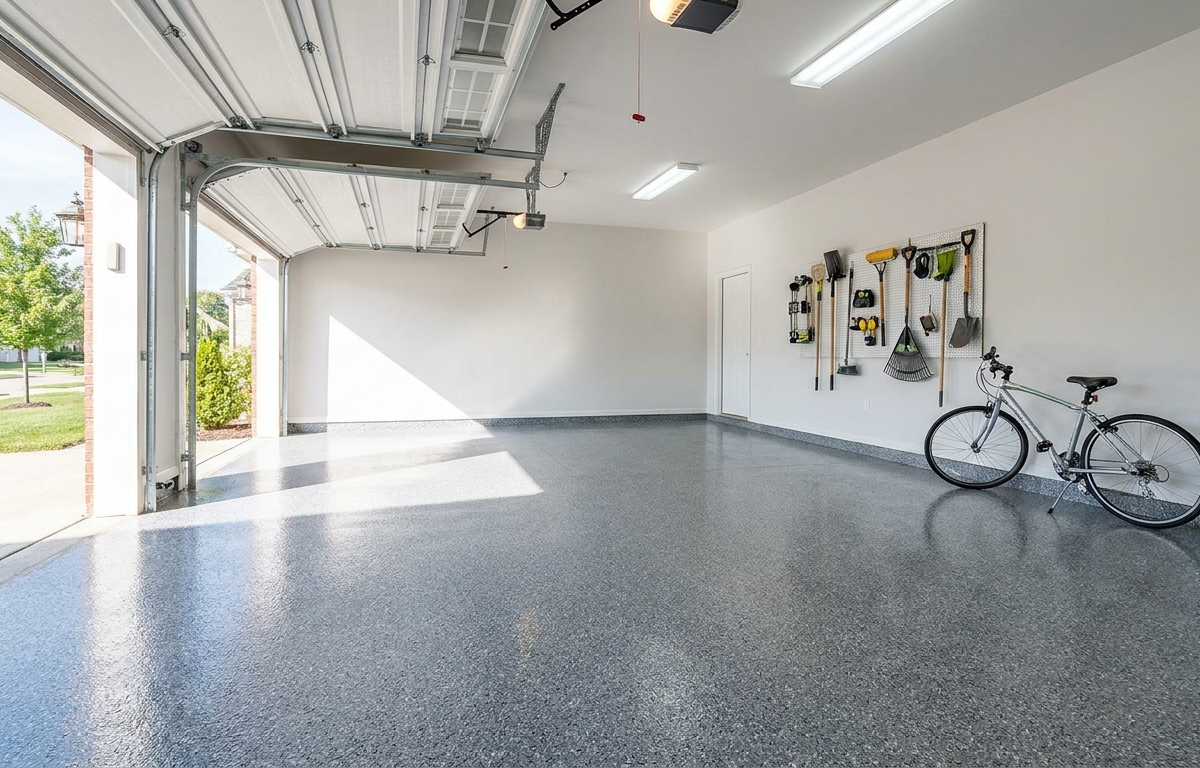
A two-car garage floor in a flake system is a $2,600 ticket, and about $1,040 of it walks out the door as materials. Those two numbers are the whole first-customer problem in this trade. You can't afford to coat floors for free, and you can't land full-price work with an empty photo roll. What you need between those two walls is a plan with actual dollars on it — how much the first five floors cost you, what they buy, and exactly when job six pays it all back.
Epoxy is one of the most visual trades there is. A cracked, oil-spotted slab turns into a showroom floor in a weekend, and that before-and-after sells harder than anything you could say in a driveway. The first five floors aren't jobs. They're the ad campaign you'll run for the next five years.
The real numbers before you discount anything
Per 2026 side-work rate data, coating work bills at $6 per square foot all-in, and the menu breaks out like this:
| Job | Typical ticket |
|---|---|
| Garage floor epoxy (solid color) | $2,200 |
| Flake / chip system | $2,600 |
| Polyaspartic 1-day coating | $2,900 |
| Basement / shop floor coating | $3,000 |
| Concrete grind & prep (standalone) | $850 |
| Crack & pit repair | $320 |
Materials run about 40% of the ticket — coating, flake, patch compound, diamond tooling wear. On the $2,600 flake job, that's roughly $1,040 in hard cost and $1,560 left for your labor and margin. Know that split cold before you touch a discount, because a discount comes out of the $1,560, never the $1,040.
The first-five plan, in dollars
Sell your first five floors at a flat $2,000 — a real number, not "20% off," which sounds like a coupon. Say exactly what it is: "My full price is $2,600. First five customers get $2,000 because I'm building my portfolio, and the deal includes before-and-after photos of the floor and a written review when it's done."
Here's what that plan actually costs and pays:
- Each portfolio floor: $2,000 collected, about $1,040 in materials, $960 in your pocket.
- Five floors: $4,800 cleared while you build the proof — this is not working for free.
- The plan's real cost: $600 of forgone margin per floor, $3,000 total across all five.
- Job six at full price clears $1,560 over materials. Jobs six and seven together clear $3,120 — the entire cost of the plan, recouped in two full-price floors.
By floor eight you're ahead of where five full-price jobs with no photos would have left you, because floors eight through fifty come from the portfolio the first five built. That's the whole trade: $3,000 of margin, spent once, for a photo roll that closes estimates while you sleep.
One hard line inside the plan: never do floor one free, not even for family. A free floor gets you a customer who values free, a review that reads like a favor, and a neighbor who now expects the same deal. $2,000 with photo rights attached is a discount with a job. Free is charity with a squeegee.
Who gets the five slots
The slots go to people who'll say yes without three quotes and a week of thinking: family, coworkers, the neighbor who's been embarrassed by his slab for years. But pick floors, not just people. You want at least one nightmare before — oil stains, cracks, spalling — because the dramatic transformation is the photo that sells. A pristine new slab makes a boring before no matter how good the after looks. If a candidate floor needs it, run the $320 crack-and-pit repair as its own visible line on the estimate; even at portfolio pricing, the customer should see what the work is worth.
Shoot the photos like they're the product
Because they are. Same spot, same angle, both shots, whole slab in frame — stains and all before you touch it. Post the pair together, never separately. Flake and metallic finishes photograph with the most pop against bare gray concrete, which is a real argument for steering your first five toward the flake system even though it costs you more in material than solid color: you're buying better ads with the difference.
A Google Business Profile is worth setting up before floor one cures, because "garage floor coating near me" is where the homeowner you've never met ends up, and profiles that post photos regularly outrank ones that sit still. Local Facebook groups and Nextdoor take the same before-and-after pairs without an ad budget. None of this needs money. It needs you to actually post the floors as you coat them.
The referral chain next to your slab
Concrete contractors pour the floors you'll coat someday; painters finish the garage around them. Both get asked "who do you know for the floor?" more than you'd think. A concrete guy who just poured a new slab has a customer already thinking about finishing it — and that lead is worth more than any homeowner group post, because it arrives pre-sold. Introduce yourself to two or three of each, send work back the other way, and the pipeline keeps feeding you long after the five slots are gone. If concrete work becomes part of that chain, pricing concrete jobs for real profit is worth a read.
Job six is where you act like the price was always the price
When the portfolio's built, the discount ends — no lingering "deals for friends of the first five." Quote job six with a good-better-best menu: solid color at $2,200, flake at $2,600, polyaspartic one-day at $2,900. Let the customer see all three side by side with the differences spelled out; the middle option closes most often, and the premium tier makes it look reasonable.
Say job six is a 430-square-foot two-car slab with a cracked apron. The estimate writes itself off the menu:
- Flake / chip system: 430 sq ft × $6 = $2,580
- Crack & pit repair: $320
A $2,900 ticket. Materials take about $1,160 of it, you keep roughly $1,740 — and that one floor just paid back more than half the entire first-five plan. Run your own square footage through the epoxy garage floor cost calculator so the numbers stay grounded in your real material costs, not what felt right on floor one.
And make the estimate look like the after photo, not the before. A branded document with your portfolio pairs attached and a deposit collected at approval reads like a company; on a $2,600 job where you're fronting a thousand dollars of coating, that deposit isn't a formality, it's what keeps a cancellation from costing you a pallet of material. See how the estimate looks from the customer's side, and the epoxy flooring trade page shows how the photo workflow lives inside the estimate itself. When you're ready to run the first five as real jobs — priced, approved, photographed, paid — start free. Five jobs a year free, no card, then $19/mo or $190/yr.
FAQ
How much should I discount my first epoxy floor jobs?
Sell the first five at a flat $2,000 against a $2,600 full price, with before-and-after photo rights and a written review built into the deal. You still clear about $960 per floor over the roughly $1,040 in materials, and the total cost of the plan — $3,000 in forgone margin — is recouped by two full-price jobs afterward.
Should I ever coat a floor for free to get started?
No. A free floor still costs you about $1,040 in materials, attracts customers who value free, and produces reviews that read like favors. A flat portfolio price with photo permission attached gets you the same proof while keeping every floor a real, paying job.
What does a two-car garage epoxy job actually cost in materials?
At $6 per square foot all-in, a typical two-car flake job bills around $2,600, and materials — coating, flake broadcast, patch compound, grinding consumables — run about 40% of that, or roughly $1,040. That split is why discounts have to be planned: every dollar off comes out of your $1,560 labor-and-margin side.
Is flake or solid color better for building a portfolio?
Flake. It photographs with more visual impact against a bare concrete before, hides dust and imperfections in the after shots, and at $2,600 versus $2,200 for solid color, the extra material cost on your first five floors is buying better proof. Offer all three tiers — solid, flake, polyaspartic — once you're quoting at full price.
Should I require a deposit on an epoxy floor job?
Yes, collected at estimate approval, before you order material. You're fronting four figures of coating on every job; a deposit on a branded estimate the customer approves from their phone protects that outlay and reads like a real business instead of a guy with a grinder and a Venmo handle.