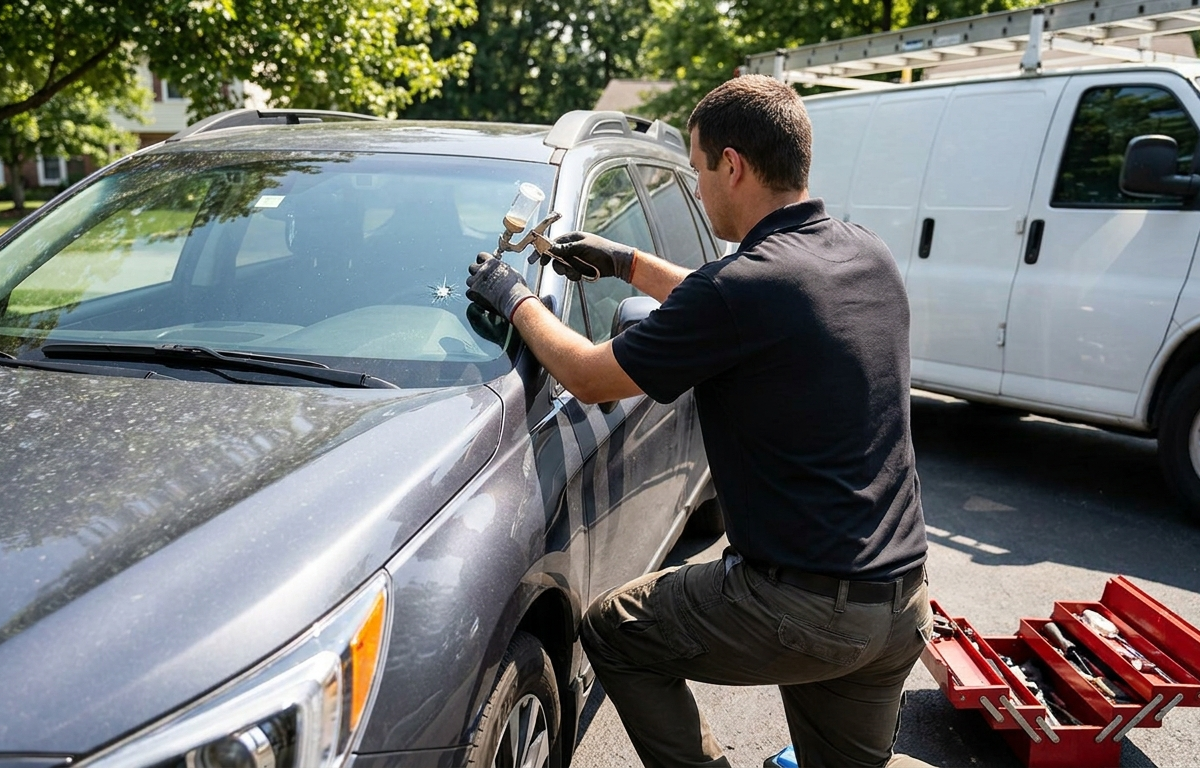
Most auto glass techs run the business the same way: fix a windshield, invoice it, wait for the next call. That works while the phone rings. It falls apart the second gravel season slows or a competitor undercuts you on a search ad. The techs who stay booked through July aren't better at chip repair than you are — they've built two or three referral pipelines that keep sending work whether or not anyone searches "windshield repair near me" that week.
The $90 chip and the $600 crack
Start with the economics, because they're the whole pitch. Per 2026 side-work rate data, a rock chip repair bills at $90. A windshield replacement bills at $350 — and on anything recent enough to have a camera behind the glass, ADAS recalibration adds another $250 to the ticket. So the same star-shaped hit is a $90 fifteen-minute stop today or a $600 job in October, when the first cold snap runs it into a crack.
Here's the part that does your selling for you: the $90 lands under most glass deductibles, which is why carriers routinely waive it rather than pay an adjuster to process a claim smaller than the deductible. Kentucky and South Carolina require zero-deductible repair by law. Most other states leave it to the carrier, and the outcome is usually the same — free to the driver. The $600 replacement is a different story. That one runs through a claim, and the customer often eats a real deductible on the way.
So your pitch was never "pay me to fix your windshield." It's "this costs you nothing today, or it costs you your deductible in the fall." Put that line on every yard sign, door hanger, and voicemail greeting you run this summer.
And hold this thought, because it's the stance the rest of the article hangs on: the $90 chip repair isn't the product. It's the audition. A tech who treats the chip ticket as the payday has it backwards — the chip is the cheapest customer acquisition in mobile auto work, and the insurance company is funding it.
The referral partners nobody else is calling
Search ads put you in a bidding war with every glass shop in your metro. Referral partners don't. Three worth building before peak season ends:
Used car lots and dealership recon teams. Every trade-in and lease return gets inspected before resale, and chips get flagged constantly. A recon manager who can call one number and get chips fixed same-day, invoiced properly, before the car hits the lot will keep calling that number. Show up in person. A recon manager doesn't answer cold emails, but he'll take a card from someone standing in his lot.
Mobile detailers and PDR techs. You're already in each other's lane. A detailer doing a pre-sale detail spots chips constantly, and a PDR tech pulling dents off the same vehicle sees the windshield up close too. Set up a two-way arrangement: you send dent and detail work, they send glass. No fee needs to change hands — a card exchange and a text when you spot something.
Independent mechanics. Techs doing inspections or general repair see cracked windshields on the lift every day and mostly don't want the glass side. Drop cards, follow up once, and reciprocate — you'll run into brake and suspension work to send back.
Turn the insurance angle into the sales pitch
Most drivers assume fixing a chip means a claims hassle and a deductible, so they let it spread. Correct that up front. Print one line on your material: "Most glass coverage waives the deductible on a repair — we handle the paperwork."
Then actually handle it. A clean invoice with the damage documented and photographed makes the claim, if one's even needed, a five-minute approval instead of a fight. A branded estimate listing make, model, VIN, and damage location reads as insurance-ready; a handwritten ticket doesn't. If the damage has already spread past repairable, walk the customer through the replace-versus-repair math — and where that $250 recalibration belongs on the ticket — using the windshield pricing guide instead of guessing on the spot.
Turn one chip into a fleet account
The real money in referrals isn't the one-off repair. It's the fleet account that calls every month without being asked. Landscaping crews, HVAC vans, delivery drivers — all running the same gravel roads you're already pulling chips from.
Run the numbers on one hypothetical account. Say a landscaping company runs eight vans on rural routes, and you're their standing glass guy. A typical month:
- Rock chip repairs, five across the fleet — 5 × $90 = $450
- One windshield replacement (a chip nobody texted you about in time) — $350
- ADAS recalibration on that replacement — $250
- One water leak / reseal on the oldest van — $180
That's $1,230 in a month, from one relationship, with zero marketing spend and no bidding war. Three of those accounts and your slow season has a floor under it. Notice what the chips are doing in that ticket: $450 of the work is the cheap, fast stuff that keeps you in front of the fleet manager, and it's what surfaces the $780 of replacement work you'd never have heard about otherwise.
After you fix a chip for any small business owner, ask one direct question: "How many vehicles does your company run?" Then offer a standing rate and a way to text you a photo of new damage instead of calling around. Three vans in the same lot beat three unrelated calls across town.
Make the follow-up automatic
None of this works if follow-up depends on memory. A short text three or four months after a repair — "checking if anything new has cropped up, happy to swing by" — closes more repeat business than any ad, especially heading into fall when temperature swings turn small chips into cracks overnight. Keeping customer records and job history somewhere other than a stack of invoices in the glovebox is what makes that possible. SideWRK's demo, seeded for auto glass work, shows how the history and the branded estimate connect without extra typing.
FAQ
Does insurance really cover windshield chip repair for free?
Usually, yes. A $90 repair lands under most glass deductibles, so carriers waive it rather than process a claim smaller than the deductible. Kentucky and South Carolina require it at zero deductible by law; elsewhere it depends on the policy, so tell customers to confirm with their carrier before the appointment.
How much more does a replacement cost than a chip repair?
A chip repair runs $90 and is often free to the driver. A replacement bills at $350, and if the vehicle has a camera or sensor behind the glass, ADAS recalibration adds $250 — a $600 ticket, often with a deductible attached. That gap is the strongest close in the trade: fix it now for nothing, or pay real money later.
How do I get dealerships to send me recon work?
Show up in person with a card, offer same-day turnaround, and make your invoice detailed enough to slot straight into their resale paperwork. Most lots don't have an in-house glass tech — they use whoever answers fastest and documents cleanly, and that's a bar you can beat with basic consistency.
Is it worth chasing fleet accounts as a one-person operation?
Yes. One eight-van account can produce north of $1,200 a month between chip repairs, the occasional replacement with recalibration, and reseal work — more predictable than the same dollars from random walk-ins, with no ad spend behind it. Start with the small businesses you already service and ask about fleet size directly.
How do I compete with big glass chains without racing to the bottom?
Don't compete on price. Compete on speed, mobile convenience, and insurance paperwork handled right the first time. Chains run on volume and phone trees; a solo tech who shows up same-day with a clean, insurance-ready invoice keeps the repeat business at the same price.
Referral partnerships take a few weeks to start producing, which is exactly why mid-chip-season is the time to plant them — they'll be paying off when things slow in the fall. SideWRK runs the other half: branded estimates, invoice history by customer, and a chip and windshield calculator to keep pricing consistent whether the job came from a walk-in or a recon lot. See it running for an auto glass business, then start free. Five jobs a year free, no card, then $19/mo or $190/yr.