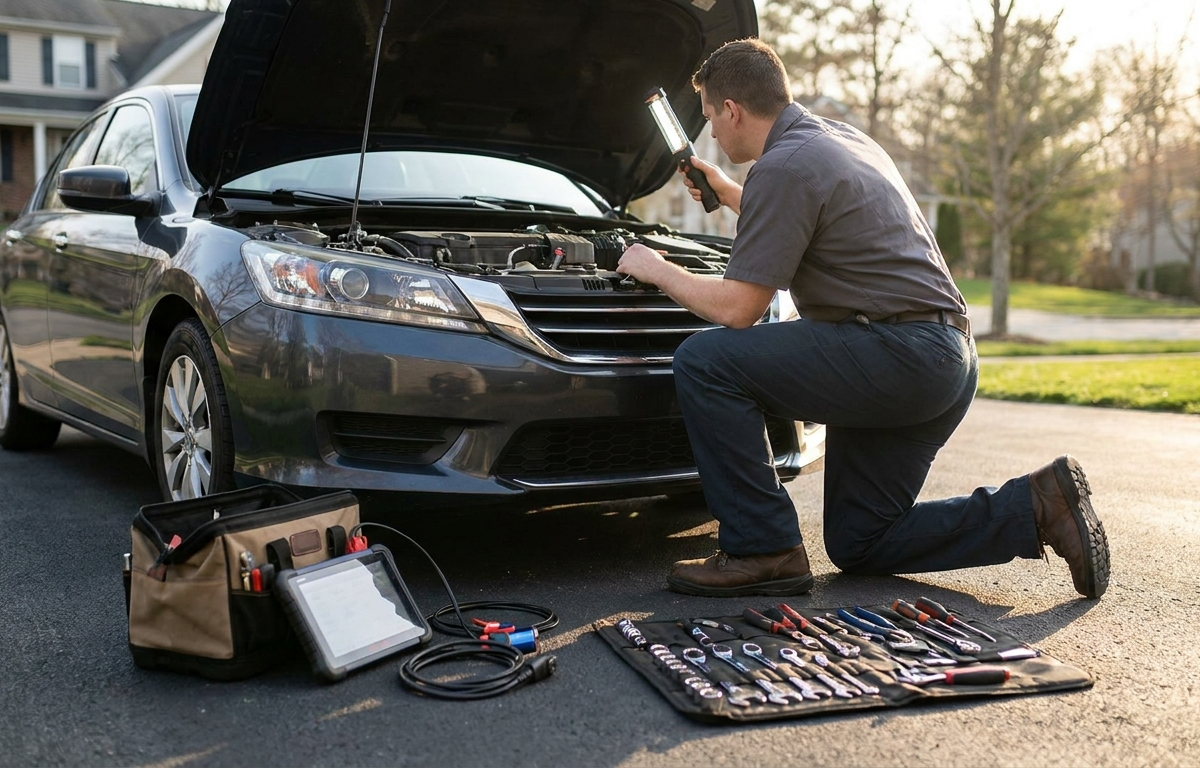
Say you're running a mobile diagnostic on a customer's Civic — a $120 scan call for a check-engine light — and while you're under there you spot the CV boot torn open, grease slung across the inside of the wheel. Not what you were called for. So you say nothing, button it up, and take the $120. Three weeks later the axle lets go on the highway, the customer eats a tow, and the shop that gets the car asks the obvious question: didn't somebody just have this thing up on a diagnostic? You weren't dishonest. You just didn't say the one true thing you noticed — and that customer, plus every referral they'd ever have sent, is gone.
That's the gap most mobile mechanics leave on the table. You're already under the hood or the car. You already see the worn belt, the weeping seal, the pad wear that's two months from metal-on-metal. Saying nothing isn't neutral — it just means the next mechanic gets to be the hero, and gets paid for it.
Finish that story with the math
Run both endings of the CV boot call in dollars, because the dollars are the argument.
The flagged version. You're already on site for the $120 diagnostic. You take a photo of the boot, show the customer, and quote the axle on the spot:
- Replacement axle: $130
- Labor, 1.5 hours at the $110 rate: $165
- Flagged quote: $295, booked for next week — no second trip charge, because you priced the return visit into a rate you already know covers your gas.
Those aren't fantasy numbers — $110 an hour and roughly half the ticket in parts is where mobile mechanic work actually sits in the 2026 side-work rate data, same data that puts a front brake job at $380 and a battery swap at $240.
The silent version. The axle finishes dying at 65 mph. Now the same repair runs through a tow bill, a shop's own diagnostic fee stacked on top of the one the customer already paid you, and shop labor north of $160 an hour — the customer's out double or more for the same axle, plus a day without the car. And your side of the ledger is worse: you saved thirty seconds of awkwardness and it cost you the $295 job, the customer, and every brake job, battery, and belt that car would have brought you for the next five years.
Silence isn't staying in your lane. It's a business decision — the wrong one, made quietly.
The trust you're actually selling
Nobody hires a mobile mechanic because it's the cheapest option. They hire you because a shop feels like a waiting room and a hustle, and you feel like someone who'll tell them straight. The second you find something real and stay quiet to "stay in your lane," you've traded that trust for nothing — the customer still needed the boot fixed; they just paid someone else to find it and someone else to fix it.
I spend my days in a dealership bay, and I'll tell you the pattern holds there too: the techs customers ask for by name are the ones who walk out holding the worn part, every time. Flagging what you see isn't upselling. Upselling is inventing a problem to pad the ticket. Flagging is doing the job you were already there for — looking at a car with your hands and eyes — and reporting what's true. Customers can tell the difference, and once they've caught you faking one, they assume you're faking everything.
What counts as a real find
Before you say a word, run it through three questions:
- Would I tell my own mother this, unpaid? If the answer's no, don't say it to a stranger for money.
- Can I show it, not just describe it? A torn boot, a cracked hose, a pad down to the wear bar — these are visible. "Your transmission feels a little off" is a guess, not a find.
- Is it tied to safety, a manufacturer interval, or a failure that's already started? Worn tie rod ends, a leaking brake line, a serpentine belt with cracks every half inch — that's a find. Nudging a $75 oil change three weeks early because you want the visit isn't.
If it doesn't clear all three, keep it to yourself or frame it as "worth watching" instead of "needs fixing now." Customers remember when you said something would wait and it did.
Photograph it before you touch it
Every real find gets a photo before you do anything else — phone out, part in frame, good light. It's proof for the customer that isn't your word against a stranger's, it protects you if they get a second opinion, and it gives you something concrete to send instead of a verbal pitch that sounds like a sales call. "Here's the boot, here's the grease pattern, here's what happens if it lets go on the highway" reads as information. A guy explaining it over the phone with no photo reads as a guy trying to close a deal.
Keep the photo attached to the estimate line, not buried in a text thread that gets deleted. That's the whole reason a written estimate with the photo on it beats a napkin number or a verbal "yeah, about $300" — the customer can look at it again before they decide, without you standing there.
The three ways to present it
How you say it matters as much as what you found:
- The direct flag. "Found this while I was under there for the scan — wanted you to see it before I left." No pitch, just information, photo attached, $295 in writing.
- The good-better-best. For anything bigger — say the $380 front brake job — show the fix now, the fix that also covers the related part while you're already in there, and the "here's what I'd do if it were my car" option. Let them pick.
- The honest pass. "This is worn but it's got another season in it. I'd watch it, not fix it today." Say this as often as it's true, because it's a pricing tool, not just good manners: the mechanic who's been heard saying "that can wait" stops getting his $380 brake quotes second-opinioned. The no's are what make the yes's land at full price.
And the line never moves: you flag what you find, you never manufacture what you didn't. If a customer asks about something specific and you don't see a problem, say so. If you're not sure whether it's urgent, say that out loud too — "I'm not 100% sure this is urgent, here's what I'd watch for" builds more trust than a confident wrong answer ever will.
Turn the flag into the next visit
The find you don't fix today is the appointment you book for next month. Note it on the customer's file with a rough timeline — "watch the CV boot, revisit in 60 days" — and follow up before they forget. That's how a single $120 scan call turns into a customer who calls you first for four years instead of googling a shop every time something rattles. SideWRK keeps that history on the vehicle, not in your head, so the next visit (even if it's future-you, six months out) shows exactly what was flagged, when, and what you said about it. The hourly rate calculator is where to work out what your driveway hour has to bill, before you're quoting axles from memory in front of the car. You can poke at the whole flow in the live demo — no signup.
Auto body techs run the same play on a teardown: flagging hidden damage the moment they see it, before the panel goes back together, works for the identical reason. The customer trusts what they can see.
Ready to stop pricing add-ons from memory and start showing your work? Start free and see what a photographed, written $295 quote does for how often customers say yes. Five jobs a year free, no card, then $19/mo or $190/yr.
FAQ
How do I upsell car repairs without seeming pushy?
Show the part, don't just describe it — a photo of a torn boot or a cracked belt reads as information, not a pitch — and put the number in writing: $130 part, 1.5 hours at $110, $295 total. Pair it with an honest "this can wait" on the things that genuinely can wait, so the things you say need fixing now carry weight.
What's the difference between flagging a repair and upselling?
Flagging is reporting something real you found while doing the job you were already there for — visible, tied to safety or a documented interval, something you'd tell your own family. Upselling crosses the line when you invent urgency on something that's fine, or push a repair that doesn't clear those tests just to grow the ticket.
How much should I charge for a repair I find during another job?
Price it like any standalone job at your real rate, not as a discounted add-on — a CV axle found during a $120 diagnostic still quotes at $295 ($130 part plus 1.5 hours at $110), because your rate has to cover the return trip, the part run, and the warranty on your work. The customer's savings is skipping the tow and the shop markup, not squeezing your labor.
What should I do if I find a problem the customer didn't ask about?
Flag it the same visit, with a photo, framed as information, not a sale: "found this while I was under there, wanted you to see it before I left." Let them decide whether to act now or later — your job is to make sure they're deciding with the full picture, not to decide for them.