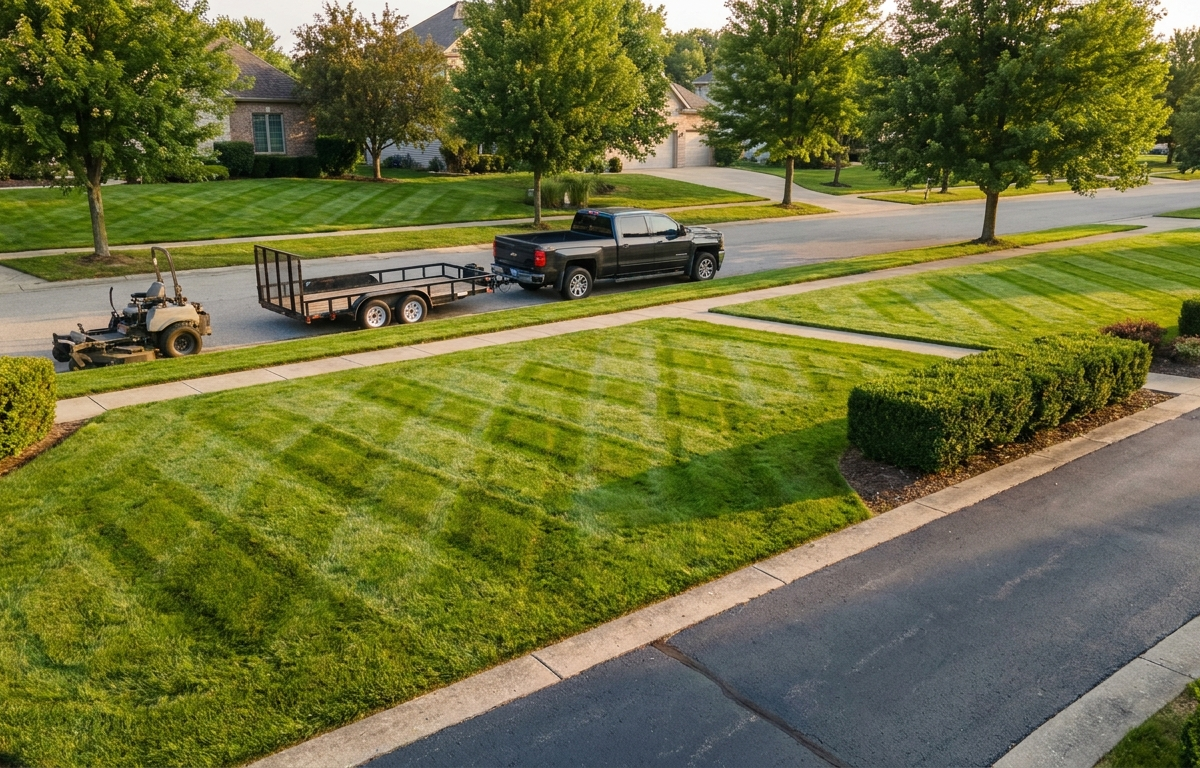
A landscaper running 45 lawns spread across three towns can end up no richer at the end of the month than one running 28 lawns packed onto eight streets — while working a day and a half more every week to do it. Same mower, same fuel prices, same $55 mow-and-edge rate. One of them is driving a paying job and the other is driving between them. Route density is the part of the lawn business nobody puts on a flyer, and here's the flag worth planting: a big service area isn't growth. "We serve the whole metro" is a cost center dressed up as a tagline, and the map — not the rate — is usually why a full schedule doesn't pay like one.
The drive time you're not billing for
Every minute between driveways is a minute the customer isn't paying for. Spread a route across a wide area and you're burning gas, stacking mileage on a truck and trailer that cost real money, and losing daylight you could've spent on the deck instead of the interstate.
Do the math on your own route right now. Pull up this week's stops and add up the drive time between them, not counting the drive from your house. If it's more than 20–25% of your total time on the clock, your rates aren't the problem — your map is.
The 45-vs-28 comparison, with dollars on it
Put real numbers on the two operators from the top. Mow-and-edge runs $55 a visit in the 2026 side-work rate data; assume weekly service, a truck-and-trailer combo drinking a gallon every 12 miles at $3.60, and about 45 minutes per lawn on the ground.
The scattered operator: 45 lawns across three towns, averaging 15 minutes of driving between stops. That's 11 hours a week of windshield time — about 340 miles — on top of 34 hours of mowing. A 45-hour, six-day week, every week, with no room left for anything else.
The clustered operator: 28 lawns on eight streets, two or three minutes between stops. Mowing wraps in about three days, and the freed two days book the rest of the menu each week — a $480 mulch install, a $350 cleanup, a $180 hedge trim.
| Monthly | 45 scattered | 28 clustered |
|---|---|---|
| Mowing revenue | $9,900 | $6,160 |
| Add-on work (mulch, cleanups, hedges) | $0 — no hours left | $4,040 |
| Fuel | −$408 | −$72 |
| Materials on add-ons | −$0 | −$600 |
| Net | $9,492 | $9,528 |
| Hours per week | ~45, six days | ~38, five days |
| Miles on the truck | ~1,360 | ~240 |
Read that bottom row twice. The clustered operator makes the same money off 17 fewer customers, works a shorter week, and puts 1,100 fewer miles a month on the rig — which is a second, quieter raise, because trucks and trailers wear out by the mile, not the year. And every open slot he fills from here is pure upside; the scattered guy is already maxed.
What a clustered Saturday actually grosses
One day, priced line by line, on two adjacent streets:
- 10 lawns, mow and edge, 10 × $55: $550
- One mulch install while the trailer's already parked: $480
- Day total: $1,030 — about $144 of that is mulch, a few dollars is fuel, and roughly $880 stays with you
That's a day that ends mid-afternoon. The scattered version of the same $1,030 is spread across two days and three zip codes.
Building density when you're starting from zero
If you're new to a town, resist the urge to take every lead that calls, wherever it is. Instead:
- Pick two or three target streets or subdivisions where you already have one job, a relative, or a referral, and price the first few quotes there aggressively — a thinner margin on the first three houses is worth the foothold.
- Ask every new customer who else on the street might need it. Not a generic "refer a friend" line — a specific "does the place next door need a cut too?" People will tell you.
- Turn down the far-away lead, politely, or price it to cover the drive. A job 25 minutes outside your cluster carries a trip charge or it goes to voicemail. You don't owe every caller a yes.
- Drop a door hanger on the four houses beside a new customer the same day you do the work. A fresh cut two doors down is the best advertisement you'll ever print.
Fixing a route that's already scattered
Most operators didn't plan their scatter — it happened one lead at a time over a couple of seasons. Fixing it doesn't mean firing customers. It means being deliberate about where you grow next and letting the far-flung ones go when they churn, instead of backfilling them with another random zip code.
Look at your customer list by street, not by name. If SideWRK is already holding your customers and job history, the pattern jumps out fast — where your real clusters are, and where you're carrying dead weight in drive time. When a scattered customer cancels, fill that slot with a lead near your densest streets, even if it means a slower month while the route tightens.
The recurring-route payoff
Density pays twice once a route is recurring. Twelve weekly lawns on three streets is one truck, one morning, $660, done — versus twelve lawns across the county eating a whole day. Your actual cost per lawn drops while the price stays put, which is what lets you hold the $55 rate against a scattered competitor who's quietly losing money at it. It's also what makes the seasonal menu an easy add instead of a special trip: the $350 fall cleanup, the $480 mulch refresh, the $900 sod job, even a $95 irrigation check — all sold to houses your truck already parks in front of.
Getting there without more trucks
You don't fix density by hiring a crew. You fix it by saying no to the wrong jobs, saying yes fast to the right ones, and keeping the estimate-to-invoice loop tight enough that a same-day quote for the neighbor two doors down doesn't sit in a notebook until next week. A landscaping setup built for route work — where the quote goes out from the driveway and the next-door referral gets the same clean, branded number the first house got — is what makes the compounding happen instead of staying a nice idea. Pricing a new yard? Measuring the lot from your phone beats walking it with a tape, especially on the fourth quote of the day.
FAQ
How much does route density actually save a landscaper?
In the comparison above, clustering cut fuel from $408 to $72 a month and windshield time from 11 hours a week to under two — and the freed hours booked about $4,040 a month of mulch, cleanup, and hedge work the scattered route had no room for. Same net, 17 fewer customers, a shorter week.
Should I turn down a lawn that's far from my other customers?
Weigh it against the cluster. If the drive eats more than 20–25% of a normal service day, add a trip charge that covers the miles and time, or pass — a lead that wrecks your route costs more in the jobs it delays than it pays on its own.
How do I start clustering a route in a brand-new town?
Pick two or three streets where you already have a connection, price the first few jobs to win the foothold, and ask every new customer directly who else on the block needs work. That's how one $55 lawn turns into a street.
Does neighborhood clustering really lead to more referrals?
Yes — a crew on the same block every week gets noticed by more than one household, and neighbors comparing notes over the fence is free advertising a scattered route never earns. The guy who mows three houses on a street becomes "the lawn guy" for the whole street.
What do I do with existing customers way outside my cluster?
Don't fire them — stop replacing them. When a far-flung customer churns, let that slot go to a lead near your densest streets, even if it means a slightly slower month while the route tightens up.
Ready to run your route the way it actually pays? Start your free 14-day trial — no card — and see it built for landscaping in the live demo.