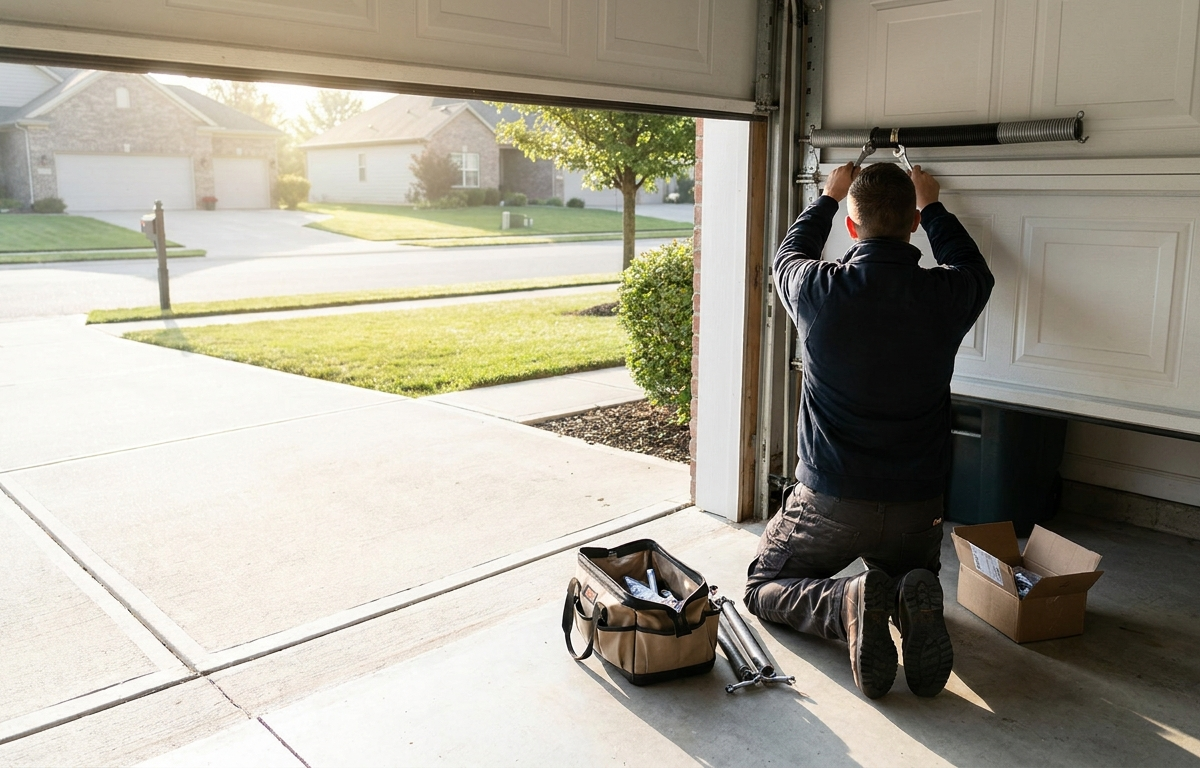
A broken torsion spring gives most homeowners about four minutes of patience before they start calling the next name on the search results page. That's the whole game in garage door repair when you're new: somebody's car is trapped, the door won't budge, and whoever answers first and sounds like they know what they're doing gets the job. You don't need a fleet or a showroom to win that call. You need to be findable, fast to respond, and backed by a few real reviews before the busy season hits.
Start with the calls nobody else is chasing
New garage door techs waste months trying to out-market the big regional outfits on brand searches. Skip that fight. The volume is in the panic calls: snapped springs, off-track doors, openers that quit mid-cycle. Those searches are hyper-local and time-sensitive, which is exactly where a one-truck operator beats a call center. Claim and fully build out a Google Business Profile with your service area, real photos of finished jobs, and your actual phone number answered by a human, not a menu. Local Services Ads run $6 to $30 a lead for garage door work in most markets — among the cheapest lead costs in home services, because the intent is so high. Someone searching "garage door won't open" at 7am is buying today.
Answer like it's an emergency, because it is
Roughly three out of four people book with whoever calls them back first. In garage doors that number probably runs higher, since a stuck door usually means a trapped car and a customer who's already late. If you're on a ladder when a call comes in, a five-minute callback window beats a same-day callback every time. Set up call forwarding to your cell, and if you truly can't pick up, a text back within minutes ("On another job, can call you in 20 — is this urgent?") keeps you in the running instead of losing the job to the next listing down.
What one panic call is actually worth
Run the numbers on a single spring swap, because this is the math that tells you whether the lead spend and the fast-callback discipline are worth it. Say a lead comes in mid-morning through Local Services Ads at $15.
What you bill, using the spring-replacement default from the 2026 side-work rate data:
- Spring replacement — matched pair of torsion springs, installed, door balanced and tested: $280
What it costs you:
- The lead: $15
- Pair of springs at the counter: about $90
- Fuel and consumables: call it $10
That's $115 out, $280 in — $165 of margin on roughly two hours door to door, or about $82 an hour real, not billed. And that's the floor, not the ceiling. The same customer's opener is usually a decade old ($450 installed when it dies), the rollers are original ($180 to sort out), and every garage on the street is the same age. One $15 lead, answered in five minutes, buys you a customer worth several tickets and a driveway's worth of neighbors watching you work.
That math is also why the panic call is the wrong place to discount. New techs knock $50 off to win the job, but the homeowner with a trapped car isn't shopping price — they're shopping speed and competence. Answering in five minutes at full book price beats calling back at noon fifty dollars cheaper, every single time. Speed is the discount. Give away margin on the one call where nobody asked for it and you've cut your real hourly rate by a third for nothing.
Build the trust signals before you need them
A homeowner staring at a stuck door and three garage door companies in the map pack picks the one with more reviews, not the cheapest one. Ask for the review in the driveway, right after you show them the door working and walk them through what broke and why. Don't wait for a follow-up text three days later — by then the relief has worn off and the review request feels like a chore instead of a favor. Photograph the old spring next to the new one, the rusted cable, the stripped gear on the opener. Those before-and-afters do double duty: they justify the invoice line by line, and they become the content that fills out your Google profile and any social page you're running.
Partner with the people who already see the broken doors
Real estate agents, home inspectors, and moving companies run into dead springs and off-track doors constantly, usually right when a sale or a move is on the line and nobody wants a delay. A short intro call or a stack of cards left with a local inspector can turn into a standing referral relationship that outlasts any single ad campaign. Same goes for the contractors already in someone's driveway — painters, handymen, roofers — who'll happily hand off a garage door problem they don't want to touch. Leave your info, follow up after the first referral with a thank-you, and you've got a lead source that costs nothing per lead.
Price the emergency honestly, and say so upfront
The working numbers: a service call and tune-up runs $110, a spring replacement $280, cable or roller repair $180, an opener install $450, a panel replacement $400, and a full new door install around $1,400, with custom work billed at $100 an hour. Run your own market through the garage door cost calculator before you quote so the range you give matches your actual rates, not a national average. Then quote the range on the phone before you roll — "most spring jobs land around $280, and I'll confirm the exact number before I touch anything" — so nobody feels ambushed by the invoice. That kind of upfront honesty is rare enough in this trade that it becomes its own referral generator. Send the estimate from your phone before you leave the driveway, let them approve it on the spot, and you've closed the loop without chasing a signature the next day.
Don't neglect the slow-lead channels
Door hangers on the ten houses next to a job you just finished cost almost nothing and work because a neighbor watching you fix a spring is already halfway sold. A small yard sign at a completed install, with the owner's permission, turns every job into a rolling billboard in a neighborhood where everyone's garage door is roughly the same age. None of this replaces the online lead flow, but it fills the gaps between service calls and keeps your name in front of the exact households most likely to need you next.
How SideWRK fits into the first ten jobs
None of this matters if the invoice looks like it came from a guy working out of his truck bed — even if that's exactly what's happening. SideWRK builds a branded estimate you can send from the driveway, the customer approves it and types their name right there, and you get paid by card or straight to Venmo without chasing a check. The garage door trade page shows how the app speaks your trade's language out of the box, and you can try the live demo seeded with garage door jobs before you ever touch the sign-up form.
The playbook above — fast response, reviews collected on the spot, referral partners who already see the broken doors — works the same way across other new-in-town trades. A handyman building their first customer base leans on nearly identical tactics: same urgency, same reliance on reviews, same crowded map pack.
If you want to see the whole loop — estimate, approval, payment — start free and run your next spring replacement through it. Five jobs a year free, no card, then $19/mo or $190/yr.
FAQ
How much does garage door repair cost in 2026?
A service call and tune-up runs about $110, a spring replacement lands around $280 with parts, cable or roller repair about $180, and an opener install around $450. A full new door install runs closer to $1,400, and after-hours emergency work justifiably adds to the standard rate.
What's the actual profit on a garage door spring replacement?
On a $280 spring swap, figure roughly $90 for the spring pair, $15 for the lead, and $10 in fuel — about $165 of margin on two hours door to door, or $82 an hour real. The follow-on work is where the account gets valuable: the same customer's aging opener and hardware are future tickets you didn't have to buy a lead for.
How do I get garage door leads without spending a lot on ads?
Build out a complete Google Business Profile with real job photos and a fast-answering phone number, since panic searches convert almost instantly for whoever responds first. Pair that with referral relationships — real estate agents, home inspectors, and other contractors who run into broken doors but don't want to fix them.
Should I quote a price over the phone before seeing the door?
Give a realistic number based on the symptoms — a snapped spring has a known cost, around $280 — and tell the customer you'll confirm on site before touching anything. Committing to a number upfront builds trust and kills the awkward moment when the invoice would otherwise surprise them.
Should I discount emergency calls to win them when I'm new?
No. The panic call is the least price-sensitive moment in the entire trade — the customer is buying speed, not savings, and a five-minute callback at full price beats a cheaper competitor who responds at noon. Save the goodwill gestures for the $110 tune-up that books the neighborhood, not the call where margin was never the question.