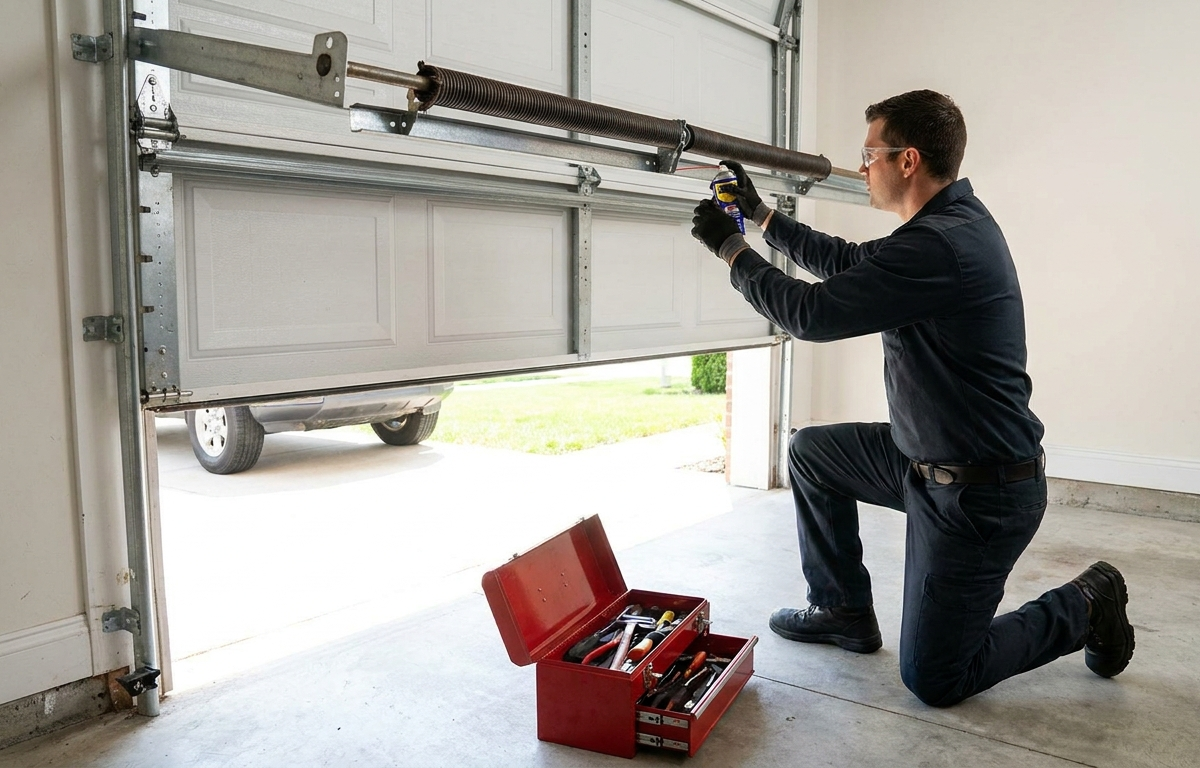
A standard torsion spring is rated for about 10,000 cycles. A family that opens the door four times a day burns through roughly 1,460 cycles a year, which means the spring you just replaced is due again in about seven years — and the rollers, cables, and opener sensors are all running their own shorter clocks alongside it. A garage door is one of the few things on a house that tells you, in math, when the next repair is coming. The only question is whether you're the one standing in the driveway when it does.
Most garage door techs replace the spring, take the check, and drive off. Seven years later, someone else gets that call. The annual tune-up plan is how you make sure it's you.
The numbers the whole plan sits on
Here's what garage door work actually bills, from the 2026 side-work rate data: a service call and tune-up runs $110. Spring replacement is $280. A cable or roller repair is $180. An opener install is $450, a panel replacement $400, and a full new door install $1,400.
Look at where those numbers sit relative to each other, because the plan's economics live in that spread. The $110 tune-up is the smallest ticket on the menu — and it's also the one with almost no parts in it. Lube, fasteners, a few dollars of hardware. On most garage door work, parts eat about half the ticket; a spring job at $280 has real steel in it. The tune-up is nearly all your time, at your $100 rate, on your schedule, clustered wherever you want it. Small ticket, best hour of the week.
But the tune-up isn't really the product. What you're selling is position. Every $110 visit is a standing claim on the $280 spring replacement when the cycle count comes due, the $180 cable repair you spot fraying before it snaps, and eventually the $1,400 door when the panels give up. Skip the plan and all of that work still happens — it just goes to whoever answers the search when the door won't close.
Emergency call versus plan visit, in dollars
Walk the same spring down both roads.
Road one: the customer's on your plan. At the annual visit you count the cycles — door installed 2019, four openings a day, call it 9,500 of 10,000 — and you tell them plainly: "This spring's about done. Let's schedule it before it schedules you." Two weeks later you do a $280 spring job at 9 a.m. with coffee in the cupholder. The customer has paid $110 + $280 across two calm, planned visits.
Road two: no plan. The spring lets go on a Tuesday night with the car trapped inside and work in the morning. The customer searches "garage door repair near me," takes whoever answers, and pays whatever the after-hours rate is — evening emergency calls routinely run half again the daytime price. And here's the part that matters to you: none of that money is yours. Not the emergency premium, not the base $280, not the next seven years of that address.
That's why I'd tell you the plan isn't a savings pitch and you shouldn't sell it as one. The customer's real win isn't a discount — it's never standing in a cold driveway at 9 p.m. Yours is that the future work at that address has your name on it already.
One price. No tiers. Don't discount it.
Plenty of trades run Basic/Standard/Priority maintenance menus, and for HVAC or heavy equipment the tiers earn their keep. For garage doors, I think the tier table is theater. A residential door under normal use needs one honest visit a year. So sell exactly that: $110, once a year, same price as the one-off tune-up, booked before you leave the driveway.
Notice what that isn't: a discount. The common advice says knock something off to sweeten the annual commitment, and it's wrong. The tune-up is already your smallest ticket — shaving $20 off it turns your calmest, highest-margin hour into charity, and it teaches the customer the visit wasn't worth $110 in the first place. What the plan customer gets instead of a discount is real: the visit happens without them remembering to book it, the cycle count on their spring is tracked year over year, and when something does break, the tech who shows up already knows the door.
A worked route morning
Here's what the plan looks like when it's built out on one street. Say three plan customers in the same subdivision, booked back to back on a Tuesday morning:
- 8:00 — annual tune-up: inspection, lube, hardware, sensor test — $110
- 9:15 — annual tune-up — $110; frayed cable spotted at the drum, customer approves the fix on the spot — cable and roller repair, $180
- 10:45 — annual tune-up, cycle count noted at about 8,000 on the spring — $110
Morning total: $510, one street, done by lunch, maybe six miles of driving all in. The $180 repair carries its parts cost, but the three tune-ups are nearly all labor — and the 10:45 stop just became next year's spring replacement, already flagged, already trusted. Three scattered one-off calls across the county can't touch that math; the drive time alone eats it.
That's the real reason to check the map before you push the plan. When a repair call lands in a neighborhood where you've already got one plan customer, that's the driveway where you pitch hardest — the second and third address on a street cost you almost nothing to serve.
What the visit covers — and the sentence that sells next year
Keep the visit under an hour and specific: spring tension and cycle estimate, cable condition at the drums, track alignment, roller and hinge lube, hardware tightening, opener force and safety-sensor test. Anything found beyond that gets quoted separately — a cracked panel is a $400 conversation, not a line you bury in a tune-up.
The cycle count is the piece most techs skip, and it's the best sales tool on the truck. Ask when the door went in, ask how many times a day it runs, do the multiplication out loud: "You're at about 8,000 of 10,000 on this spring." That one sentence — a number, about their door, that they can verify — sells next year's visit better than any flyer you'll ever print. Then pitch in the driveway, right after the work, while the evidence is still hanging over their car: "Want me to come back once a year and check the whole door before it becomes a repair call?" Leave a written estimate for the plan, not a business card.
Where SideWRK fits
A plan only pays if you actually run it — SideWRK's recurring job scheduling puts next year's tune-up on the calendar the day you close this year's, with the cycle-count note attached to the job so future-you knows exactly what was flagged. The garage door trade page is built around this repair-plus-maintenance rhythm, and what should I charge pressure-tests your rate before you quote a season of visits against it. Want to see a plan turn into scheduled, paid work instead of a mental note? The live demo is seeded for your trade.
Other trades run their own version of this — see how HVAC techs sell maintenance plans or how window cleaners build a recurring route — but few of them get a 10,000-cycle countdown doing the selling for them.
Start free and turn this month's spring calls into next year's booked route. Five jobs a year free, no card, then $19/mo or $190/yr.
FAQ
How much should I charge for a garage door annual maintenance plan?
Charge $110 — the same as a one-off service call and tune-up — once a year. Don't discount it: the tune-up is already the smallest ticket on the garage door menu, and the plan's value to the customer is the scheduled visit and tracked spring cycle count, not a coupon. The value to you is first claim on the $280 spring job and the $1,400 door install that address will eventually need.
How long does a garage door spring actually last?
A standard torsion spring is rated around 10,000 cycles. At four openings a day that's roughly seven years; a busier door gets there faster. Estimating the cycle count at each annual visit — install year times daily use — is how you replace the spring on a scheduled $280 visit instead of losing the job to whoever answers the customer's emergency search.
What should a garage door tune-up include?
Spring tension and a cycle estimate, cable condition at the drums, track alignment, roller and hinge lubrication, hardware tightening, and an opener force and safety-sensor test — under an hour, all of it. Bigger findings like a cracked panel ($400) or a dying opener ($450 to replace) get their own written quote, never folded into the $110 visit.
Is a maintenance plan worth it for a solo operator with a small service area?
A small area is exactly where it works best, because the plan pays through density. Three plan visits on one street in a morning is $330 before you find anything, and $510 the morning one of them turns up a $180 cable repair — with almost no windshield time. Scattered one-off calls can't produce that; check the map and push the plan hardest where you already have a customer.