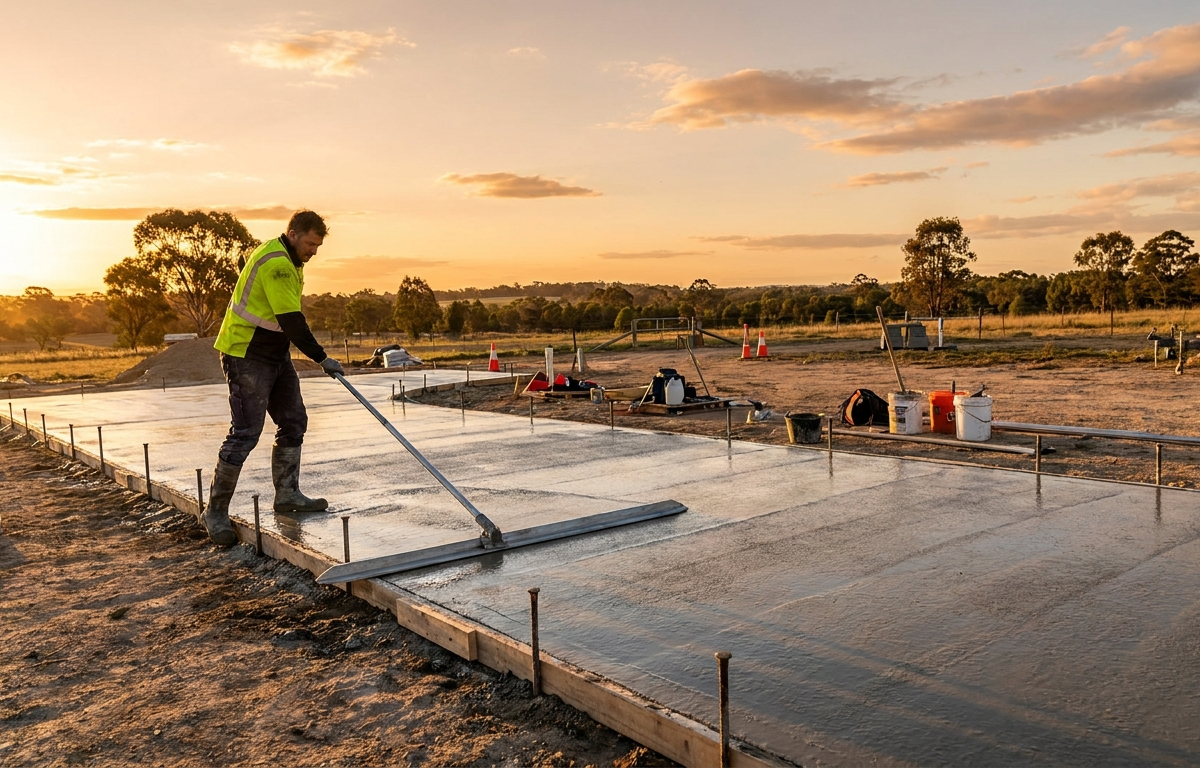
Picture a concrete guy who pours a patio, notices the customer's existing walkway has zero control joints and is already spider-cracking, and says nothing because he doesn't want to seem like he's drumming up work. Eighteen months later the walkway heaves in a freeze-thaw cycle, the customer remembers he was standing right there, and now he's "the concrete guy who didn't say anything." The opposite mistake costs just as much: quoting rebar, a thicker slab, and a sealer on every job whether it needs them or not, until "upsell" starts to mean "upcharge" in the customer's head. Both guys lose the repeat customer. The one who keeps it tells the truth about what the job needs — and puts three real prices on paper so the customer can see the truth costed out.
One number makes you a commodity
Here's the stance, and it's the whole article: a single flat price is you volunteering to be shopped. Quote "$4,800 for the driveway" and the customer has exactly one thing to compare against the next guy's number — the number. You made the decision price-only. They didn't. A three-tier quote changes what the conversation is about, from "who's cheapest" to "which slab do I want to live with," and that's a conversation the guy with the lowest bid and no wire mesh can't win.
The three tiers, in real dollars
Take a hypothetical 600-square-foot driveway — a common two-car layout. Baseline concrete work prices at $8 a square foot, per the 2026 side-work rate data, and the tiers build up from there:
Good — $4,800. The code-minimum done honestly: 600 sq ft at $8. Standard 4-inch slab, wire mesh reinforcement, broom finish, control joints cut at standard spacing. This is a legitimate driveway, not a decoy priced to make the upgrades look good. Plenty of driveways are perfectly served by it, and you should say so.
Better — $5,550. The line items that earn their keep, at $9.25 a square foot:
| Line | Price |
|---|---|
| Base: 4-inch pour, forms, broom finish, joints (600 sq ft @ $8) | $4,800 |
| Upgrade to 5-inch pour (600 sq ft @ $0.50) | $300 |
| Fiber-reinforced mix in place of plain mesh (600 sq ft @ $0.75) | $450 |
| Tier total | $5,550 |
Fiber mix resists cracking better where tree roots or heavy loads are in play, the extra inch matters for anything that'll see a truck or trailer, and tighter joint spacing than code requires rides along free — joints cut too far apart are the most common cause of random cracking, and that's a decision you make, not the customer, so explain it.
Best — $6,300. Rebar in place of mesh for real structural load, a decorative or stamped finish, and a penetrating sealer after cure — $10.50 a square foot on the same 600 feet. For scale, a standard-size stamped driveway is a $4,500 ticket against $3,800 plain; the decorative premium is real but not wild. The sealer deserves its own sentence on the quote: unsealed concrete in a freeze climate drinks water, freezes, and spalls within a few winters. That's not an upsell. That's a maintenance item most customers have never heard of.
One more line worth knowing before you present any of these: on concrete, roughly half the ticket is material — the ready-mix, the steel, the forms. Of that $4,800 Good tier, about $2,400 leaves your hand before you've finished troweling. Which is why the deposit section below isn't optional reading. And if there's an old slab in the way, tear-out is its own money — demo and haul-off on an existing drive is a $3,600 job by itself, never a favor you fold in.
Present all three side by side with the differences spelled out. Customers who see the gap and the reason for it pick the middle or top more often than you'd expect. Customers who only hear one number assume it's already the maximum.
Photograph the thing you're flagging
If you're recommending rebar because the base soil is soft, or the thicker pour because the slab abuts a slope, take the photo before you pour and pin it to the estimate. "Here's the subgrade before we placed rebar" justifies a $1,500 tier gap better than any talking. It also protects you six months later when the neighbor asks why their driveway cost less.
Same goes for damage you didn't cause. A crumbling expansion joint at the foundation, a corner already heaving, a fifteen-year-old shrinkage pattern — document it with a photo and a plain note before you touch anything nearby. Not to cover yourself. So the customer understands what was already broken versus what you built.
When to say "this can wait"
Not every crack is a red flag, and treating hairline shrinkage like a structural emergency is how a customer starts distrusting every quote you write. Narrower than about 1/8 inch, running fairly straight, not stepped or offset, on a slab that isn't sinking — that's normal shrinkage, and it's honest to say so.
The ones worth flagging: anything wider than a pencil, a crack where one side sits proud of the other, a line that reopens along the same path every winter, or a slab pulling away from the foundation. Tell the customer plainly which kind theirs is. "This one's cosmetic, don't spend money on it" costs you nothing today and earns the call when something real shows up.
Getting paid for the bigger tiers
Better and Best usually mean ordering a specific mix design or rebar before the truck rolls — real money committed early, remember that $2,400 material half. A deposit at approval, typically 25 to 40% on concrete, covers the order and confirms the customer actually wants the upgraded tier before you've booked a ready-mix truck around their schedule.
Build the three tiers directly into your concrete estimate as optional lines the customer can check on the approval page — the total updates as they pick, instead of you rewriting three quotes by hand. Approval, deposit, and e-signature land in the same step. For a fast gut check on where your own tier pricing should sit, run the concrete cost calculator before you send anything.
See the full estimate-to-payment flow for a slab job in the concrete trade demo, no signup needed. And for the same honest-flagging instinct in another trade, see how drywall pros flag water damage without losing the job.
Ready to quote the next driveway with three real tiers instead of one guess? Start free and build the estimate on your phone before you leave the driveway. Five jobs a year free, no card, then $19/mo or $190/yr.
FAQ
What does a 600 sq ft concrete driveway cost in 2026?
Around $4,800 at the standard $8-per-square-foot baseline for a 4-inch slab with wire mesh and a broom finish. A mid tier with fiber mix and a 5-inch pour lands near $5,550, and a top tier with rebar, decorative finish, and penetrating sealer runs about $6,300. Tear-out of an existing slab is separate — figure a $3,600 job on its own for demo and haul-off.
Should I always recommend rebar over wire mesh?
No. Mesh is legitimate for a standard residential slab with normal car traffic. Rebar earns its cost under real structural load — a driveway parking a heavy truck or trailer, a pad near a retaining wall, soil known to shift. Recommending rebar on every job regardless of load is the upsell that erodes trust.
How do I know if a crack is just shrinkage or a real problem?
Shrinkage cracks run narrower than 1/8 inch, fairly straight, with both sides level. A crack that's wider, stepped, growing each winter, or paired with a sinking slab points to a base or drainage problem underneath — that one's worth flagging as more than cosmetic.
What should I charge as a deposit on a concrete job?
25 to 40% at approval, higher than most service trades, because roughly half a concrete ticket is material you're buying before the pour — about $2,400 on a $4,800 driveway. The deposit also filters out customers who aren't serious before you've scheduled a ready-mix truck.
Is a penetrating sealer really necessary, or is that just an upsell?
In any climate with a real freeze-thaw cycle it's legitimate maintenance: unsealed concrete absorbs water that freezes, expands, and spalls the surface within a few winters. Present it as a line item with a plain explanation of what happens without it — not a scare tactic, and not buried in the base price either.
Source: the concrete playbook (/concrete-pricing, §How concrete bills) gave up its retelling of the material-half / deposit story under ONE CANONICAL TELLING. The guide owns that story. Two things the playbook's version had that the guide's lacks are below — move them in before the playbook's copy is considered gone.
Verified against public/app/ui/shop.js:1053 and public/app/ui/jobs.js:1699-1701 (the deposit selects), public/app/config.js TRADE_PRICING.concrete.laborShare = 0.5, and the guide's own $4,800 Good tier / $2,400 material half.
---
1. APPEND — into "Getting paid for the bigger tiers", after the paragraph ending "…around their schedule."
The picker only offers four numbers, so "25 to 40%" turns into a real choice between two of them. Ten, 25, 33 or 50 percent is what a SideWRK estimate can ask for — you set the house default once in Shop and override it on any single estimate, including down to nothing. On that $4,800 Good tier those are $480, $1,200, $1,584 and $2,400. Line them up against the $2,400 of material and the arithmetic makes the decision for you: 33% leaves you fronting eight hundred dollars of somebody else's driveway until the job is done, and 50% is the only one that has the concrete paid for before the truck rolls. Neither is wrong. Sitting at 33 and not knowing it is.
---
2. CORRECTION — not an append. The sealer sentence in "Best — $6,300" and in the sealer FAQ.
Both currently read as an unsourced absolute: "unsealed concrete in a freeze climate drinks water, freezes, and spalls within a few winters" / "unsealed concrete absorbs water that freezes, expands, and spalls the surface within a few winters."
That is stated more strongly than the material supports, and it is the one line on the page a tradesperson will repeat to a homeowner. Surface scaling in freeze-thaw service is driven mainly by deicing salts, inadequate air entrainment, over-finishing and poor curing — properly air-entrained, properly finished flatwork routinely serves decades unsealed. Suggested wording, which keeps the sales beat and drops the categorical timeframe:
…unsealed concrete takes on water that freezes and expands, and it can scale the surface over a
few winters — especially anywhere deicing salt gets used.
The playbook has already dropped its copy of this claim, so the guide is now the only surface carrying it. Worth fixing at the same time as the append above.