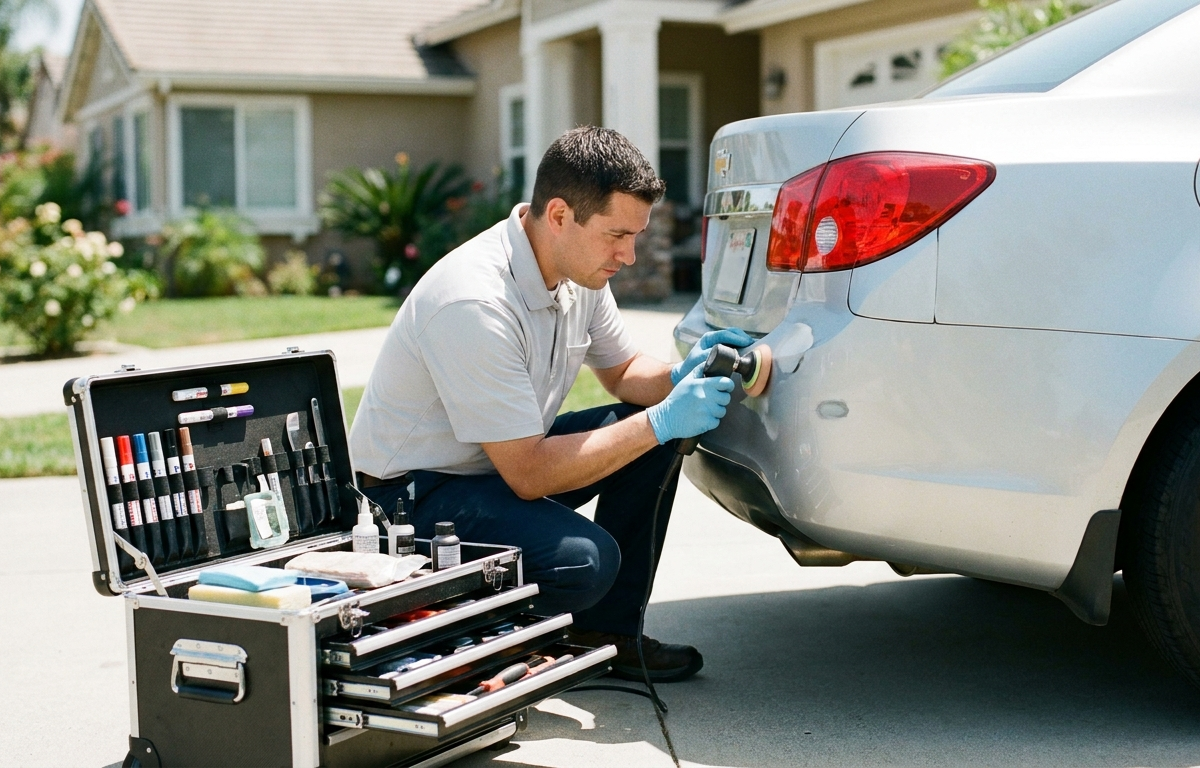
A body shop quotes by the panel. A mobile SMART operator doesn't have that luxury — you're standing in someone's driveway with a cordless buffer and a color-match kit, and the customer wants a number before you've even opened your case. Quote it by the hour like a mechanic and you'll underbid the skill every time. Quote it wrong the other way and you'll lose the job to the guy who already has a menu.
Why hourly pricing shortchanges this trade
Mobile auto body — SMART repair (Small to Medium Area Repair Technology) — isn't sold by labor hours the way a brake job is. A "deep scratch repair" that fills, primes, color-matches, and blends into the surrounding clear coat takes real skill to make invisible, and that skill doesn't scale linearly with the clock. Two techs can spend the same 90 minutes on a bumper scuff; one blends it so it disappears, the other leaves a halo you can see from the sidewalk. Customers can't tell the difference until it's done, so pricing by the hour prices the wrong thing.
The trade actually runs on a flat per-repair menu: a fixed price for each type of damage, with a separate hourly rate reserved for custom time that doesn't fit the menu. According to SideWRK's rate report, mobile auto body and paint tickets run on an $95/hr custom-time rate with materials pulling roughly 15% of a typical ticket — the rest is skilled labor, which is exactly why flat-rate menu pricing protects your time better than an hourly quote does.
What a real ticket looks like
Here's an actual SMART repair menu, priced the way the job really tickets out:
| Repair | What's involved | Typical ticket |
|---|---|---|
| Rock chip touch-up | Brush & pen session, no spray gun | $150 |
| Bumper scuff repair | Sand, prime & color-blend | $375 |
| Clear-coat scratch polish | Wet-sand & buff, no fill needed | $125 |
| Deep scratch repair | Fill, prime, color match & blend | $450 |
| Bumper crack repair | Plastic weld & refinish | $475 |
| Headlight restoration (pair) | Sand, polish & UV seal | $90 |
| Alloy wheel refinish | Curb rash, per wheel | $150/wheel |
Take the deep scratch repair line item by itself. At $450, with the trade's roughly 85% labor share on a job like this, you're looking at about $382 in skilled labor and $68 in materials — primer, basecoat, clear, sandpaper, tape. Quote that same job at $95/hr and you'd need to bill 4 hours straight to hit the same number, which either scares off the customer with a big hourly estimate or has you working fast and sloppy to justify a lower one. The flat ticket sidesteps both problems: the customer sees one number for one outcome, and you get paid for the result, not the clock.
Wheel refinishing is the cleanest example of why per-unit pricing beats a blanket hourly rate. Two curbed wheels on the same visit isn't "double the time" — it's two units of the same repair, so it prices at $150 each, $300 for the pair. Try to hourly-rate that and you're either shortchanging yourself on the second wheel (same setup, same buffing wheel already spinning) or overcharging on the first.
The line you can't blend past: pen work vs. a booth
Here's the part most "how to price body work" content skips, and it's the one that actually changes what you can quote in a driveway. Under EPA's federal auto body rule (40 CFR Part 63, Subpart HHHHHH — most techs just call it "6H"), spray application of automotive refinish coatings has to happen inside a properly filtered enclosure, with the paint gun operated by someone trained under the rule. That's a booth requirement, full stop — and mobile doesn't get you around it.
The exemption that makes mobile SMART repair legal in the first place: nonrefillable aerosol containers — the pen and the rattle can — are exempt from the booth requirement. That's why rock chip touch-up (brush & pen) and a lot of clear-coat polish work is legitimately drive-up work, while a deep scratch repair or a bumper crack that needs actual spray-gun color blending is not something you can legally shoot in someone's driveway. It has to go to a booth-equipped partner shop, or you need a portable enclosure that actually meets the filtration standard — a pop-up tent with a fan doesn't count.
This isn't a "check your state" footnote here — 6H is federal, so it applies everywhere, though some states layer stricter air-quality rules on top (worth a quick check with your state's environmental agency before you set up shop). The practical upshot for pricing: build your menu around what a pen and a buffer can actually finish, and have a standing referral relationship with a booth shop for anything that needs real spray work. Quoting a job you legally can't perform at the customer's curb is worse than losing the job — it's a liability you don't want.
That's also why the disclosure line matters on any SMART ticket that blends into aged paint: note that an exact match would require full-panel refinishing at a booth-equipped shop. It protects you and it's honest — the customer isn't getting a body shop repaint, they're getting a fast, affordable spot fix, and the paperwork should say so.
Turning the menu into faster estimates
Once you've got real numbers for each repair type, the estimate stops being a negotiation and starts being a lookup. Photograph the damage, match it to a line on your menu, add the wheel count or the pen-vs-blend distinction, and the number writes itself — which is the whole point of a flat, per-repair menu instead of guessing an hourly figure on the spot. SideWRK's auto body repair cost calculator runs this exact menu so you can check your numbers against real tickets before you write the estimate, and the auto body trade page shows how the app fills in this pricing automatically once you pick the job type.
If you're weighing whether a repair belongs on your menu at all or needs to go to a booth partner, it's worth reading how paintless dent repair pricing handles a similar per-unit, no-spray-gun problem — coin-size tiers instead of an hourly guess, for exactly the same reason.
FAQ
How much does mobile auto body repair cost in 2026?
Most SMART repair tickets run $90–$475 depending on the job: a headlight restoration pair or clear-coat polish sits under $150, while a deep scratch repair with fill, prime, and color-blend runs $450 and a bumper crack repair with plastic welding runs closer to $475. Materials typically make up 10–15% of the ticket, with skilled labor covering the rest.
Can I do spray painting in a customer's driveway?
Only if you're using nonrefillable aerosol containers — a touch-up pen or spray can is exempt from EPA's spray-booth requirement under the 6H rule. Actual spray-gun refinishing has to happen in a properly filtered, ventilated enclosure by someone trained under the rule, which generally rules out a driveway setup unless you own compliant portable equipment.
Why do body shops charge by the repair instead of the hour?
Because the skill in color-matching and blending doesn't scale with time the way a diagnostic or a tune-up does — two techs can spend the same 90 minutes on a scratch with very different results. A flat menu prices the outcome the customer is actually paying for, and it protects you from either overbidding a fast job or underbidding a slow, tricky one.
What's the difference between paintless dent repair and SMART auto body repair?
PDR fixes dents without touching the paint at all, using metal-manipulation tools from behind or beside the panel — no color matching involved. SMART repair covers damage where the paint itself is broken: scratches, scuffs, chips, and cracks that need filling, priming, or color-blending to disappear.
Is a mobile alloy wheel refinish priced per wheel or per job?
Per wheel. Curb rash on one wheel and curb rash on two wheels aren't the same job — pricing per wheel (commonly around $150 each) keeps the math honest whether the customer curbed one rim or all four.
Ready to stop guessing at tickets and start quoting off real numbers? Start free and see the auto body pricing menu built into your first estimate. Five jobs a year free, no card, then $19/mo or $190/yr.